
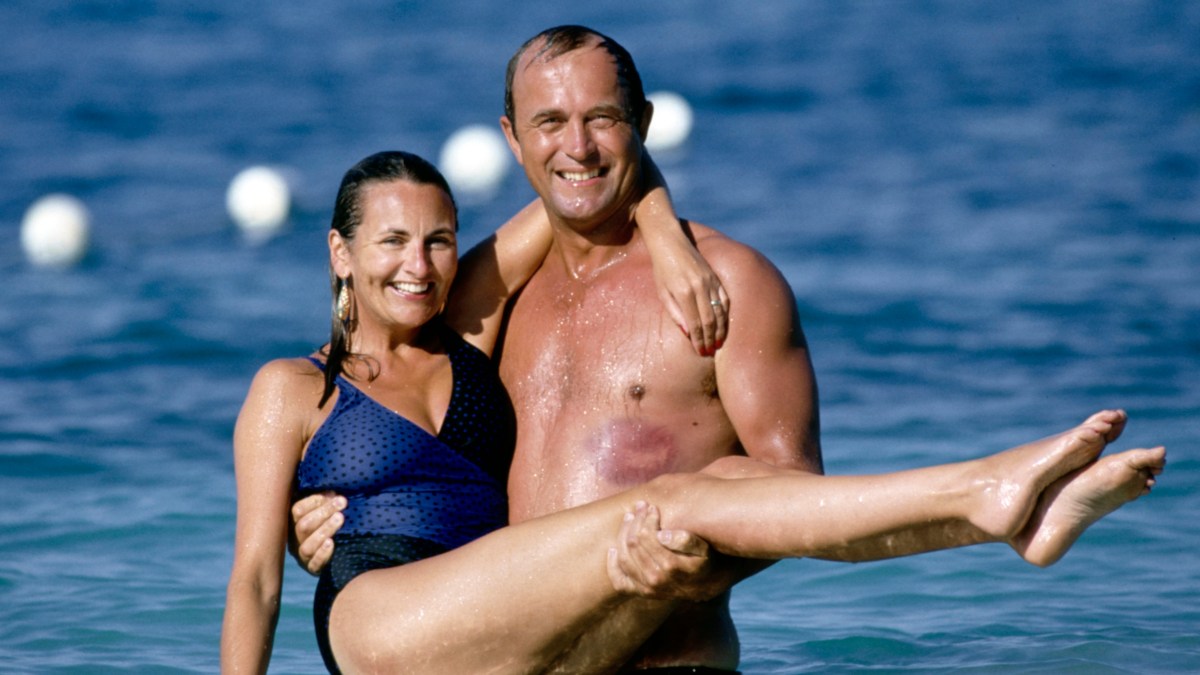
‘I love Australians,” says Frances Edmonds, somewhat off-message with an Ashes tour looming and partisanship hardening. “They’re like Californians. They’re a can-do society and very welcoming. You can take the mickey out of them, and they’ll take it back out of you. Why are they so good at sport? As Dame Edna said, ‘Oh, it could be the sun, sand, sea, sex — and the total absence of any intellectual distraction.’ ”
It is almost 40 years since Edmonds, armed with her irreverent wit, covered from the press box England’s victory in Australia under Mike Gatting while her husband, Phil, was on the field, averaging more than 50 overs a match and taking 15 wickets. As she was also appearing regularly on radio and TV, she was probably the more celebrated half of the relationship. Did Phil mind her being more famous? “It wasn’t fame, it was notoriety,” she points out.
We meet in a stylish, eye-wateringly expensive café near her Notting Hill home and, although I remind her she once described Australians as “just the same as us except they operate in fewer polysyllables” she says she envies me the prospect of another trip down under.

Frances, photographed at her London home, says she would love to follow another tour down under
LUCY YOUNG FOR THE SUNDAY TIMES
“That tour was the best three months of my life. I don’t think I had more than one hour’s sleep a night. They’re great characters and surprising people. Dennis Lillee would stay with us whenever he was in London. Alexandra [her daughter] was small and I’d go to the supermarket, and he’d come along and carry the Pampers home for me. Jeff Thomson grows orchids for a passion.
“I guess when you’ve got rid of your machismo through your fast bowling, you can be there with your Pampers and your orchids. You’re just a nice person.”
Edmonds wrote accounts of two tours, Another Bloody Tour, about England’s 5-0 drubbing in the West Indies in 1986, and Cricket XXXX Cricket, on the triumphal procession of Gatting’s team around Australia the following winter. They were hugely successful and took her career along a new path, away from work as an interpreter in Brussels and Strasbourg, and into life as journalist, author and conference speaker.
Phil retired not long after to pursue interests in agriculture and mining in Africa. Even while playing he was developing a business career and once, when he was struck over the heart by a ball from Patrick Patterson, Frances said she knew he would be OK due to “excess adipose tissue and a wodge of cheque books”. He is now retired and lives in Switzerland.
Her books were groundbreaking because she did not write about the cricket but everything around it, viewing the game “through the meniscus of a large gin and tonic” with a relentless focus on the inadequacies of the male species. Only one woman had reported on an England tour before — Margaret Hughes in the 1950s, who complained of being treated as a “freak” by her colleagues — so Edmonds’s take on things was a shock to the cricketing system.
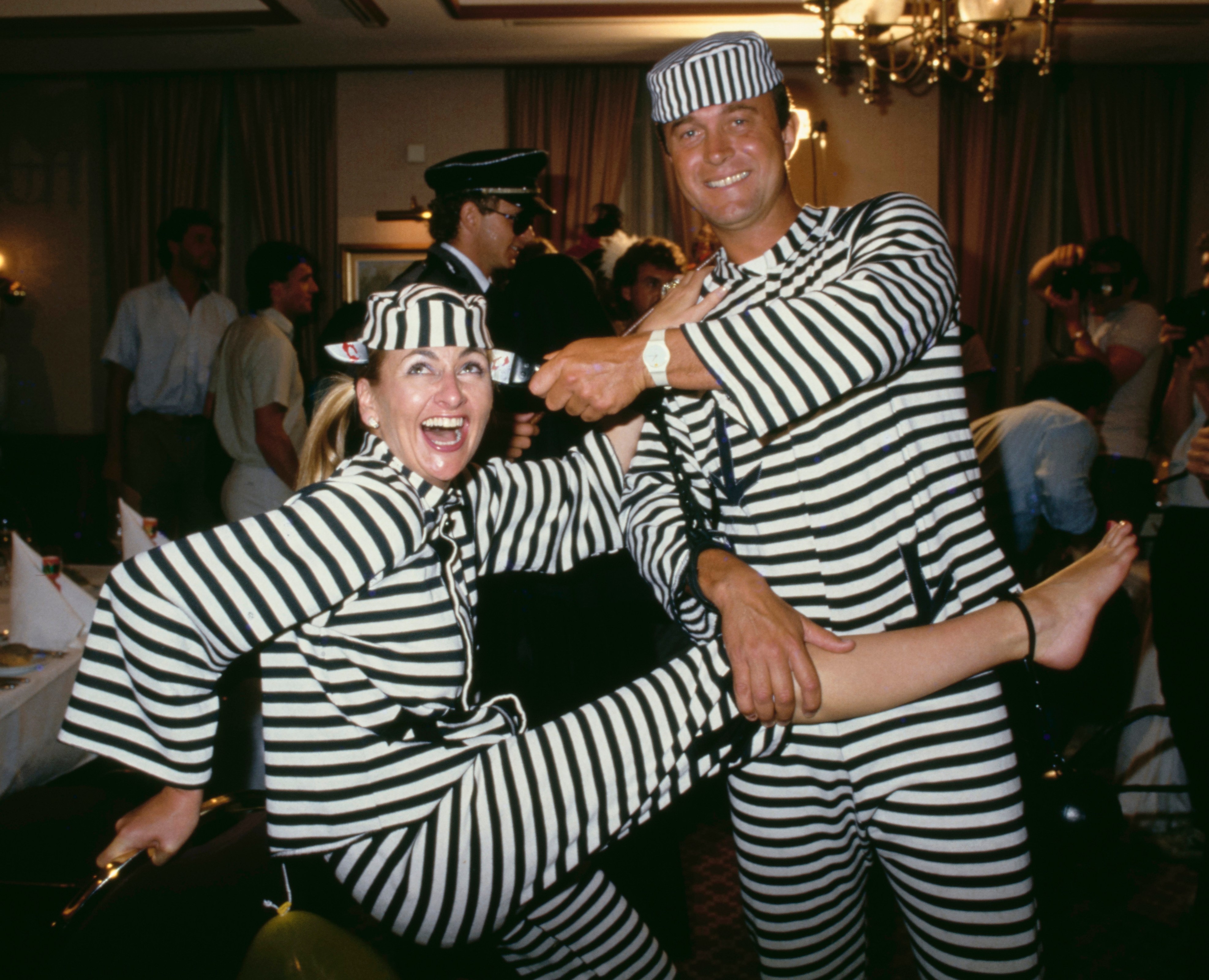
Frances and Phil dressed as convicts at England’s fancy-dress party on Christmas Day 1986, hours before the start of the fourth Ashes Test in Melbourne, which the touring side won by an innings
ADRIAN MURRELL/GETTY IMAGES
She noted how the conversation of cricketers “only seems to sparkle when there is nooky in the offing”, adding: “It is pointless to pretend that three and four-month tours are not going to involve a fair amount of hanky-panky.” When the amount of training the England players did came under scrutiny, she observed: “[Some players] do get a lot more practice in than the others. It is not, unfortunately, always in the nets.”
The West Indies tour was possibly the most ignominious in England’s history. On uneven pitches, against a fearsome pace attack, the team disintegrated so badly that a full-time head coach, Micky Stewart (originally titled team manager), was installed for the Australia tour. There has been one ever since.
“It was crucifying,” Edmonds recalls. “It was just such an ugly tour — the intimidation, four Exocet merchants, people with broken noses and ribs. I don’t care what anybody says, all these great mates, as soon as it starts getting nasty, they start bitching about one another. Talk about women being bitchy, men can be bitchy too. When things go badly, no one takes responsibility.”
In Another Bloody Tour she cited her husband coming out of team meetings protesting about “defeatist f***ing tactics”. Not that the wives and girlfriends of the players escaped scot-free, as she likened some women around professional cricket circles to Madame Defarge, the Dickens character who knitted beside the guillotine during the French revolution.
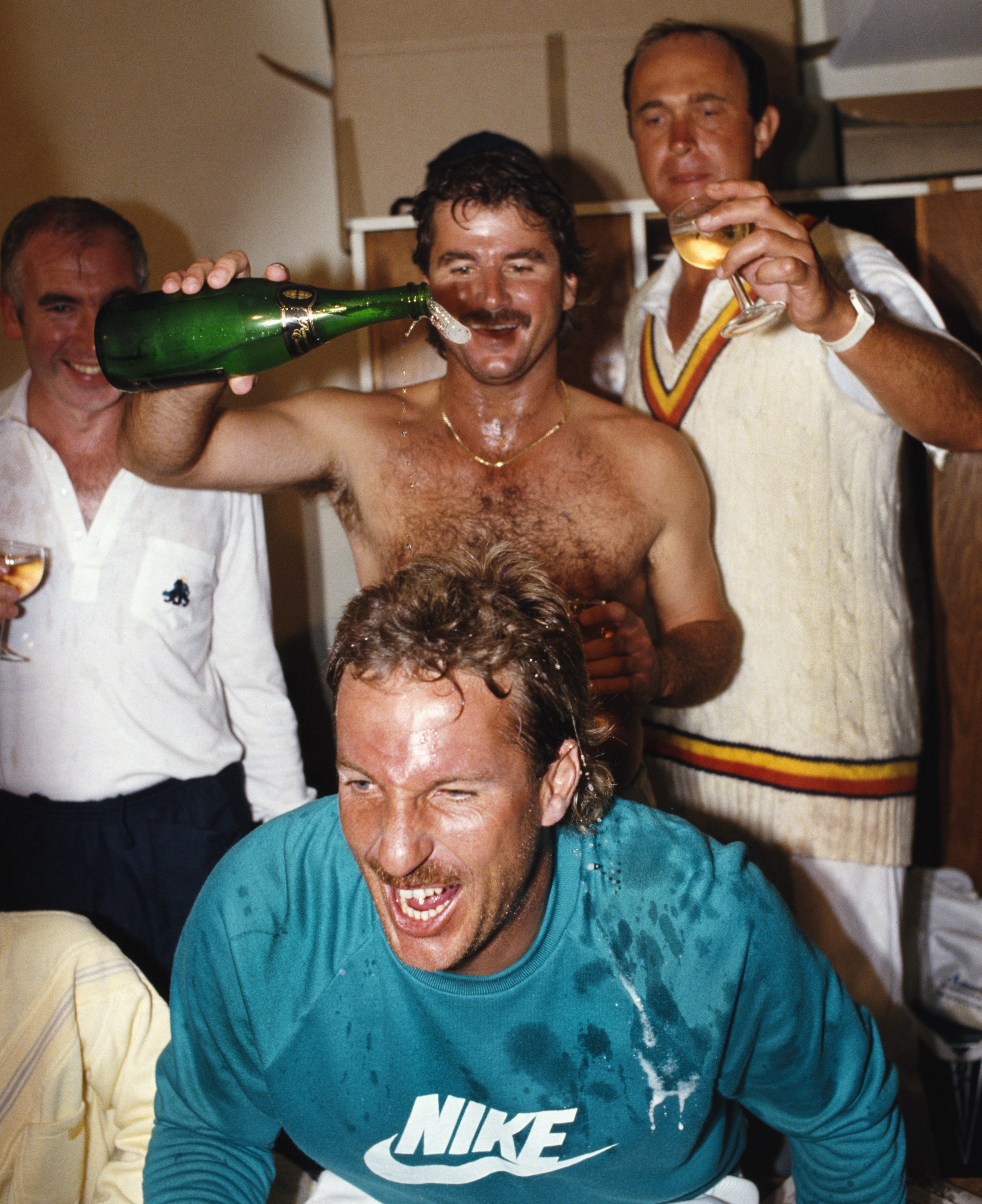
Botham is doused with champagne by Allan Lamb and Edmonds after England’s win in Melbourne that put them 2-0 up in the 1986-87 series and clinched the Ashes
GETTY IMAGES
Needless to say, the men in the press box were not writing this sort of stuff. “At that time there was definitely an omertà between — and it was completely understandable — the cricket correspondents and the players,” she reflected. “What goes on in Vegas, stays in Vegas. You travel together, you’re in the same hotel.”
She reserved her most withering condemnation for administrators, describing MCC and the Test and County Cricket Board (the precursor to the ECB) as the “last bastions of male-chauvinist piggery”. At that time England’s women cricketers had only ever played one international match at Lord’s, while MCC voted to admit women only in 1998.
Amazingly, wives and girlfriends were then barred from joining the players for the first six weeks of a tour, an antediluvian mindset Edmonds delightedly skewered (from her accommodation down the road from the team hotel). She noted that when partners did finally arrive they “tended to create a more cohesive and convivial collective”.
“They were the worst excesses of clubsville, where people with no talent who get a blazer become completely obnoxious,” she reflected. “I’m all in favour of charismatic visionaries doing what they want but Mr Buffoon laying down the law in his blazer, I can’t take it. You’ve got to be a bit of an iconoclast when you see stupidities going on.”

Frances in the garden of her home in Notting Hill, with daughter Alexandra
LUCY YOUNG FOR THE SUNDAY TIMES
Does she now regret her more acerbic judgments? “I didn’t think it acerbic at the time but, as someone said, I would happily go to jail for the sake of a good one-liner. It was true. You said unkind things you didn’t mean. If you said it in the bar, it was a good gag, but in the sanctity of print it becomes something else. Those things I’m sorry about.
“Nowadays everything is captured on camera-phones, but we didn’t have them. We’d write things, they’d be printed in England, and they would only arrive in the West Indies a few days later. I wrote a piece about what a corrupt place Antigua was. Two days later, the anonymous letters started arriving under my hotel door. ‘You’d better leave this island. You’re not welcome’.
“I don’t think people were really upset. People would go, ‘Oh, that’s Frances’. It was just my take on what was being said. Les scandales were already in the papers. It took off because other stuff was happening . . . the sex, drugs and rock’n’roll. And mine was one of the few books about the tour.” My envy of her is that even my wife has read Another Bloody Tour, while she has never read any of the 13 books I’ve written.
Frances met Phil at Cambridge in the early 1970s. She was studying modern languages and he combined playing cricket with land economy — “a course virtually unheard of by anyone except rugger Blues, cricket Blues, rowing Blues”. She once jokingly described her wedding as the day of the “original mental aberration”. They have since parted ways.
“We’re happily separated, we’re not divorced, we would never be divorced,” she says. “We see one another but disagree on everything. He was Brexit, I was Remain. He’s devoted a lot of time and money to a school near Lusaka [in Zambia]. That’s a real passion of his. When you see kids in Africa, hungry to learn, proud of their uniform, desperate to improve, that is cheering.”
She had breast cancer diagnosed last year but has thankfully recovered. “All of a sudden your life can change on a sixpence. Mercifully, I’m out the other side. Phil has been extremely supportive.”
It was also at Cambridge that she first got to know Imran Khan, a future cricket captain and prime minister of Pakistan, now in jail on corruption charges.
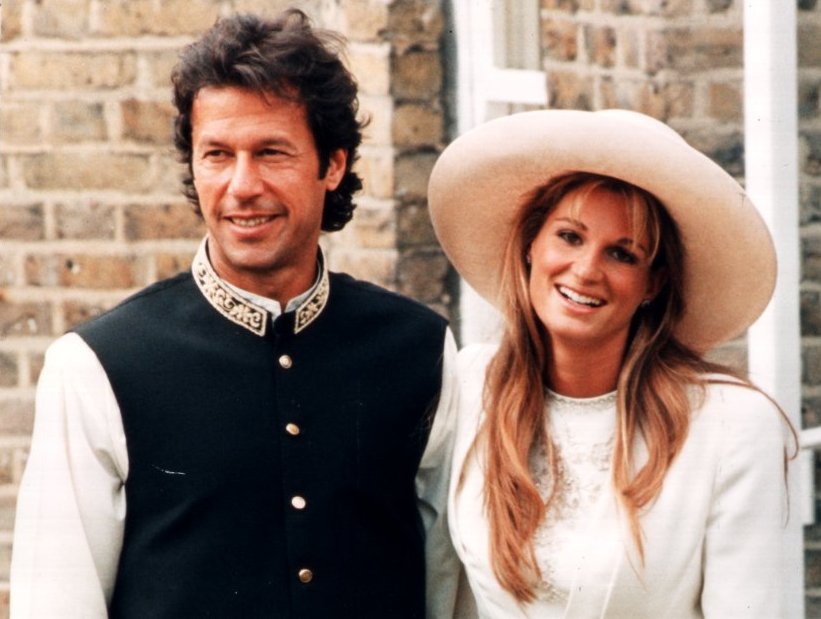
Frances attended the wedding of her good friend Imran Khan and Jemima Goldsmith in 1995. The Pakistan cricket legend is now in jail on corruption charges
PA
“I’ve known Immy since we were 18. He was at Oxford but he was Majid Khan’s younger cousin and Majid was cricket captain of Cambridge. We were at his wedding to Jemima [Goldsmith]. You have to give him credit, he wanted to use cricket to do something bigger and he did. He always wanted to go into politics, too, but did say, ‘I’m going to end up murdered or assassinated’.
“I do worry for him. He’s not in a good place and I feel very sad about that. They say if he apologises and leaves the country they’ll let him out, but that’s not Immy’s way. He’s a Pathan. I do not believe for a minute that he is corrupt.”
Ian Botham was the biggest star in the English cricketing firmament in the mid-1980s. Edmonds’s view at the time was that he was “in no way inhibited by a capacity to over-intellectualise”, but concedes a reappraisal is due.
“The House of Lords is a bit of a debased currency with Baroness Mone and the like in there, the third-rate politicians and the place-men, but why shouldn’t Both be in there? This is somebody who has added to the gaiety of the nation, done an enormous amount for charity and given people hope. He is doing fantastic work as a spokesman for the countryside. He is a force of nature. Good on him.”
Botham never had a problem developing new careers, but Edmonds feels that people in many fields struggle to reinvent themselves, something she explored in her book Repotting Your Life. Cricketers are particularly vulnerable.
“It’s an issue I grapple with more and more. Before you drop off the edge, you’ve got to plan what you do next — and in cricket more than any other sport. You belong to a club, a family. You have your breakfast, lunch, dinner together, you go for drinks. You go on tour, that’s another club.
“Then all of a sudden, at 35, you stop and the organising principle around which you based your life has gone. People are living longer, which means more repotting, more transitions, and we don’t have the structures or culture to cope.”
The arrival of satellite TV coverage in 1990 removed much of the mystique attached to England tours — who writes tour books now? — and has also led to cricket losing its role near the centre of British life. This is something Edmonds would like to see change.
“Cricket has lost market-share,” she says. “We need to get back to things that unify rather than separate, and cricket was one of those things. Cricket has to become relevant to a wider demographic. It teaches people so much, and in a fragmented society it can be very helpful in bringing people back together. We need a lingua franca, common ground, and cricket was that.”