
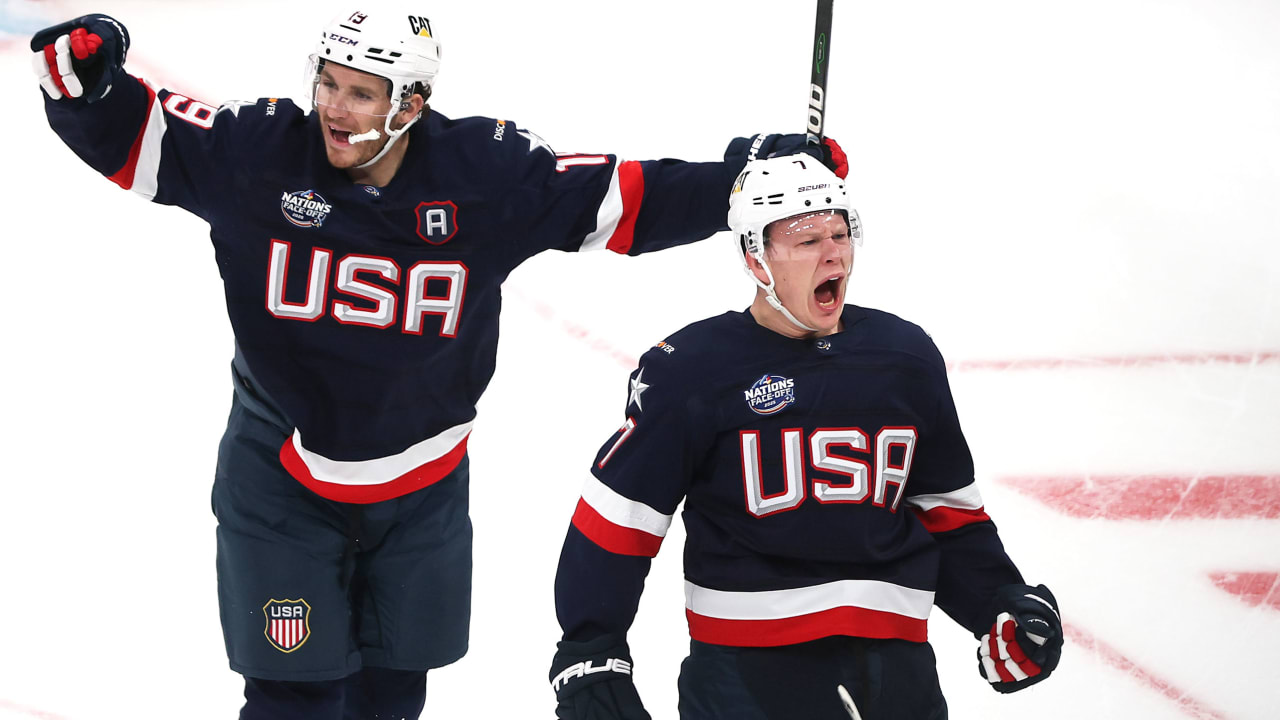
First off, what was it like to find out that your sons, Matthew of the Florida Panthers and Brady of the Ottawa Senators, were two of the first six players selected in June to the U.S. 2026 team?
“I think Matthew gave us the heads up when we were down at his place in Florida. He knew he’d been picked but he didn’t tell us about Brady. He wanted it to be a surprise for us.”
Your initial emotions?
“Less stressful, to be honest. You’re not worried about them having to be scrutinized over the next few months while they try to make the team. For us, it makes it easier to make arrangements to go to Milan. For them, well, they grew up always wanting to play together and they got that chance at 4 Nations. Now, to be able to do it again for their country at an event when the whole world will be watching, it doesn’t get any better than that.”
What advice did you give them about the Olympic experience, given your four appearances?
“They’re playing together, which they love to do and, before 4 Nations, they never had the chance to do. So that’ll be a whole new thing. I think the thing you’re going to realize is you’re in a village with the other athletes. All the athletes are together, and you’ve got to kind of just enjoy the moment of going through what all these other athletes go through. These athletes have been training their whole life for this one moment, so you have to enjoy that. At the same time, you’re on a mission to win a gold medal. They can’t lose sight of the fact of that. But I want them to join the overall experience, not just them finally playing together, but just to be around the village, with guys you don’t normally play with, mingling in with other U.S. athletes and athletes across the world. It’s something to see. It really is.”
How excited are you to watch them there?
“It’s going to be great. The boys were there in Italy when I was there at the 2006 Turin Games and were sort of old enough to realize what’s going on. We took pictures of them there. And now they get to go live their dream of playing in the NHL but also playing in the Olympics. I mean, who knows what will happen down the line? So take advantage. Take advantage of it, and enjoy every moment of this, because who knows when the opportunity will come up again.”
On the ice, how much extra motivation, if at all, do you think the Americans will have after the heartbreak of losing to Canada 3-2 in overtime at the 4 Nations?
“Judging by the 4 Nations, they give a you-know-what. I think all the players that participated in that tournament did. I can tell you from personal experience when you represent your country on a big stage like that, who wouldn’t want to do that? And it means everything. Everybody across the world is watching this, the Olympics. It’s such big event. It’s the biggest. So they’ll take it seriously. I mean, I don’t think you’ll see the fireworks you saw in the 4 Nations, which, by the way, I thought that was the best, fastest, hardest tournament I’ve ever watched in hockey. That was the best. And I think you’ll get that same thing at the Olympics, minus [the fighting]. There’ll be different rules from 4 Nations, so you have to be careful and control your emotions. But again, who wouldn’t want to play for their country?”
After you were selected No. 19 in the 1990 NHL Draft by the Winnipeg Jets, you spent the 1991-92 season with the U.S. national team. Because you hadn’t played in the NHL yet, you were still eligible for the 1992 Games in Albertville. Given NHLers weren’t eligible to play in the Olympics, what was that like?
“I went in as a longshot to make the team. It was a mixture of amateurs and pros who were playing in Europe and the AHL. I wanted to make it, but I didn’t think I had a chance being so young at 19. They would cut guys along the way and then bring in new guys. And it was very stressful. When you finally got word you made it and you realize you’re going to the Olympics, I mean, that’s every kid’s dream, obviously, especially being an amateur. To be able to represent your country like Mike Eruzione did, the 1980 Olympic team did, you know, to get to that experience was incredible, especially for a 19-year-old kid. Albertville was beautiful, with the mountains and such. I remember the Russians being stacked. I’ll say this: We surprised a lot of teams. We made it to the semis before being beaten by the Russians.
You’ve said before that winning the 1996 World Cup gave you and your U.S. teammates a lot of confidence, a lot of swagger. Then came the 1998 Games in Nagano, Japan, when NHLers were finally allowed to participate. How disappointing was it to be eliminated in the quarterfinals after the momentum you guys had accrued two years earlier?
“It was kind of just thrown together. It was still a great experience but, being a pro instead of an amateur, you weren’t starstruck. Obviously, when you have best on best at an Olympic event, that’s what you want. It’s unfortunate we didn’t play particularly well down the stretch, but anything can happen in one game eliminations. That’s what I don’t like about it. But you still got to represent your country. And doing that with most of the guys who you won the World Cup in 1996 with, I’ll always cherish that, even though it was a tough ending. You’re used to playing a four-out-of-seven series and usually the better team wins. It was tough. Those European teams do a great job on the big ice. They defend well. Meanwhile we were a little helter-skelter.”
Fast forward to 2002 in Salt Lake City. On one hand you helped the U.S. win silver, the country’s first medal since the “Miracle on Ice” team 22 years earlier. On the other, you lost the gold medal game to Canada on home soil. Which one resonates with you: the positive or the negative?
“It was devastating, to be honest. I mean, it’s still a success. You’re getting a medal, but you have missed out on the big one, and we were playing so good going into that. We just ran out of steam. Obviously we’re a little disappointed coming short of our goal, but Canada was a great team. They played well in that game, and they deserve to win.”
Finally, you’ve discussed how monumental the Olympic Winter Games Milano Cortina 2026 could be for the sport. Interestingly, as we are doing this interview, you’re on your way to scout for the St. Louis Blues. Those are the same Blues whose goalie, Jordan Binnington, is favored to be the starting goalie for Canada. The same Blues whose GM, Doug Armstrong, holds that same position for Canada. Any conflicts on who to cheer for?
“Ha! Not in the least. I’ll always be in the corner of my boys. Family first. And I’m a proud American. Go USA!”