
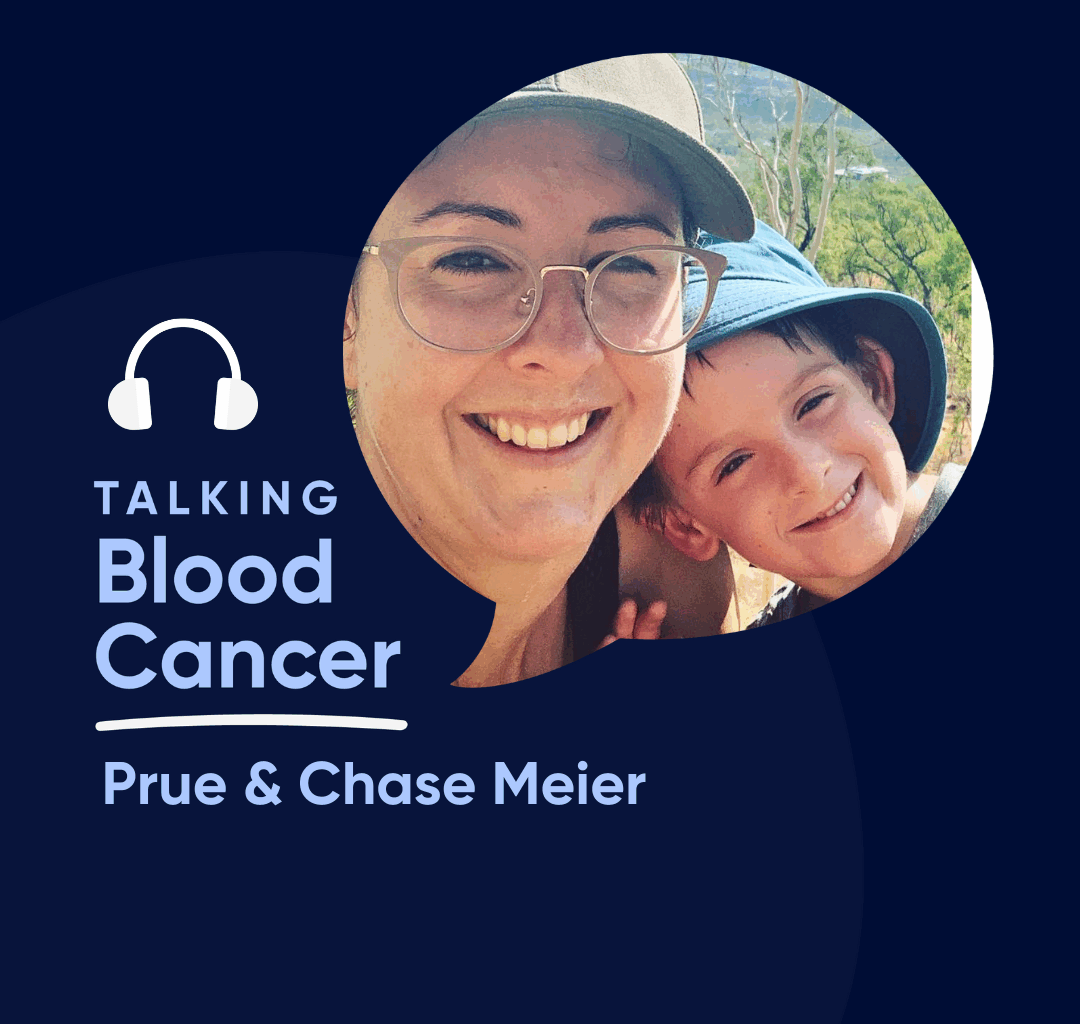
[00:02:36] Kate: Hello and welcome to Talking Blood Cancer Podcast. I am your host, Kate Arkadieff, and today I have something really special to share with you. In this episode, my wonderful colleague, Maryanne Skarparis, sits down with an incredible family, Prue Meier and her brave 10-year-old son Chase. Their story is one that will touch your heart and remind you of the remarkable resilience that lives within all of us.
[00:03:01] Kate: When Chase was just four years old, he was diagnosed with acute myeloid leukemia. Today, six years later, he’s a vibrant 10-year-old with some pretty sweet memories from treatment, including the special room where he got some cookies. You’ll love hearing Chase’s perspective on his journey and how he’s thriving at school today.
[00:03:22] Kate: Prue shares with such honesty and grace, what it was like to notice those first warning signs and navigating the world of a diagnosis and treatment, and ultimately becoming Chase’s bone marrow donor, an experience that is filled with both fear and profound love. She also opens up about the incredible support that they receive from their medical team and the Leukemia Foundation and how their community rallied around them. What makes this conversation so valuable is that Prue doesn’t just share their story. She offers real practical advice for other families who are walking this path. Learning to accept help when it’s offered, and to the importance of capturing those precious moments along the way.
[00:04:09] Kate: This story is of hope, healing, and the unbreakable bond between mother and her son. So let’s listen to the beautiful conversation with Maryanne, Prue and Chase.
[00:04:21] Maryanne: Good morning. Welcome to Talking Blood Cancer. My name’s Maryanne Skarparis, and I feel very excited because here with me this morning, I have Master Chase Meier and his mum, Prue. Hello, Chase. Tell me, Chase, how old are you, darling?
[00:04:38] Chase: Ten.
[00:04:39] Maryanne: Ten. So you’ve just gone on Christmas holidays.
[00:04:43] Chase: Yeah.
[00:04:43] Maryanne: And I believe that you are currently in at Mummy’s work this morning so that you could participate in the Talking Blood Cancer podcast.
[00:04:53] Chase: Yeah.
[00:04:54] Maryanne: Thank you. Now, I have some questions to ask you. Are you happy to answer in a big voice?
[00:05:02] Chase: Maybe.
[00:05:02] Maryanne: Maybe. Oh that’s okay. Tell me, Chase, what grade are you in?
[00:05:07] Chase: Five.
[00:05:08] Maryanne: Grade 5. And do you like school?
[00:05:12]Chase: Yeah.
[00:05:12] Prue: Can you elaborate?
[00:05:14]Chase: What does that mean?
[00:05:16] Prue: Well, what, yes. You like school? What do you like about school?
[00:05:20] Chase: Recess.
[00:05:21] Prue: Recess.
[00:05:21] Maryanne: Recess. So, you, you’re like the Hungry Caterpillar. Do you remember that book? Are you like the Hungry Caterpillar?
[00:05:28] Chase: No.
[00:05:28] Prue: No
[00:05:29] Maryanne: Now, I don’t know whether you remember, Chase, I’m from Brisbane. Do you remember coming to Brisbane years ago?
[00:05:36] Chase: Yeah.
[00:05:37] Maryanne: What was Brisbane like for you?
[00:05:39] Chase: Cookie.
[00:05:40] Maryanne: Cookie. What does cookie mean?
[00:05:43] Chase: Special room. I got cookie every day I went into special room.
[00:05:48] Maryanne: Oh, you went to a special room and you got a cookie. Can you tell me a bit more about that special room?
[00:05:54] Chase: I got to choose flavour, and then they put mask on me and I smelled the flavour and it put me to sleep.
[00:06:02] Maryanne: Oh, how lucky. Was that a nice experience or was that a scary experience?
[00:06:08] Chase: I say good.
[00:06:10] Maryanne: Oh, it was a good experience. Did you guess the right flavour all the time?
[00:06:17] Chase: No.
[00:06:18] Maryanne: No. So, was that the nursing staff who gave you the cookie? Who gave you the cookie?
[00:06:23] Chase: Mummy and Daddy.
[00:06:25] Maryanne: Oh, Mummy and Daddy gave you a cookie. And what else do you remember about being in Brisbane?
[00:06:32] Chase: Christmas.
[00:06:33] Maryanne: Christmas, and what was so special about Christmas?
[00:06:36] Chase: I got presents.
[00:06:37] Maryanne: You got lots of presents. You were spoiled. And tell me, Chase, because how old were you when you came to Brisbane?
[00:06:45] Chase: Four?
[00:06:46] Maryanne: Four. That’s a lot. And you are now?
[00:06:49] Chase: Ten.
[00:06:50] Maryanne: Ten. So that was six years ago. That’s a long time ago. And special memories of Christmas and presents. Is that all that you remember about being in Brisbane?
[00:07:01] Prue: Remember when you started when you’d get out of the hospital?
[00:07:03] Chase: Café 63?
[00:07:05] Prue: No, that’s when we’d go visit after we moved back.
[00:07:09] Chase: Oh, where I’m needing my shirt back?
[00:07:10] Maryanne: Tell me, Chase. When you finished treatment, what special thing did you do?
[00:07:16] Chase: Ring the bell.
[00:07:18] Maryanne: You ring the bell. So tell me, Chase, what is school like for you now? Do you play sport?
[00:07:25] Chase: Soccer.
[00:07:26] Maryanne: Soccer. So you’re a soccer fan.
[00:07:29] Chase: Soccer and futsal.
[00:07:32] Maryanne: Soccer and futsal. And are you a fast runner? No. And do you like school? Yeah. What do you like about school?
[00:07:41] Chase: Recess.
[00:07:41] Maryanne: That’s right, recess. And do you have lots and lots of friends? You do. That’s lovely, Chase. Is there anything that you would like to share in this podcast or in this space that you think is kind of special for other little kids just like you.
[00:07:59] Chase: I don’t know.
[00:08:01] Maryanne: You don’t know?
[00:08:01] Chase: Cookies. Cookies are the best.
[00:08:05] Maryanne: Cookies are the best and have a Merry Christmas?
[00:08:07] Chase: Have a Merry Christmas and New Year.
[00:08:10] Maryanne: Lovely, Chase. Thank you for joining us this morning. You’re very special and oh my goodness, you’ve grown so tall. Maybe there might be something for you to nibble on.
[00:08:20] Chase: Yum yum yum yum.
[00:08:22] Prue: He’s a child of a few words when he gets on these things, but he doesn’t shut up at home.
[00:08:27] Maryanne: Isn’t that always the way, Prue? I think that’s just boys in general, so it’s okay. It’s nice to hear their little voices, and it’s certainly lovely to see him. His hair’s a bit darker than what it was.
[00:08:41] Prue: Yeah, it was sort of more my, his dad’s shade, my husband’s shade, before he had his treatment and then it came back closer to my shade afterwards.
[00:08:48] Maryanne: That’s right, isn’t it funny? But you can still see his little cheeky face. I remember that little face at ESA Village. Marie says to say hello.
[00:08:58] Prue: How lovely.
[00:08:59] Maryanne: And to thank you, the story that you’ve shared, which you’ve done so generously with the Leukaemia Foundation shared your family’s story. So personally, I’d like to thank you on behalf of the Foundation, Prue, because you’ve been very open and warm in sharing what’s happened with you over the years. And I’m sure it hasn’t been easy, but that story that’s reflected in the calendar.
[00:09:20] Prue: That’s the least that I can do and it does get easier each time you retell your story.
[00:09:25] Maryanne: So we might just start from the very beginning, Prue, if that’s all right, because often in these conversations, it’s very difficult to know where to start. And I’m sure you’ve given a lot of thought around what it is that you’re wanting to share, but I often think when you’re engrossed in a conversation, you’ll be thinking of things that you haven’t thought of. So let’s just start from the very beginning, if that’s okay with you.
[00:09:49] Prue: Yeah, absolutely.
[00:09:50] Maryanne: So where abouts do you live, Prue, and where were you when Chase was first diagnosed?
[00:09:55] Prue: Yeah, so we live in Townsville in North Queensland and we were living here at the time that he was diagnosed. Haven’t moved on from town here, but yeah, we like it up here.
[00:10:04] Maryanne: Lovely. And what was happening with Chase that identified that he needed to get some medical treatment? I know it’s a lot of years ago.
[00:10:11] Prue: Oh no, it’s the first question that people ask, actually. They go, what were his symptoms? But for us, he had a temperature that went on for a couple of days, quite high. It was sort of 39, 40 degrees. And Panadol and Nurofen were only helping so much. It was breaking through before that next dose could be given. So I took him to the GP who said that it was just influenza and he could have the temperatures for up to seven days. And just come back in a couple of days if he didn’t improve. Didn’t improve. We went back in a couple of days at which point he referred us through to the paediatrician.
I remember him, he said, “Oh, look, I still think it’s the flu, but I can see that you’re, anxious about it, so we’ll refer you through to the paediatrician.” So we saw the paediatrician who had the same verdict, but did run some swabs or did send us to pathology to get some swabs just to confirm what strain of the flu it might be. Because we saw the paediatrician external to the hospital, we went to Sullivan Nicolaides or something. And I remember it was a Friday and they said, “Oh, we won’t have the results ‘til Monday,” because where we live, everything gets sent down to Brisbane to get tested and then they get the results back.
And at that point I was glad we were getting some tests and we’d get some confirmation, but I think our paediatrician actually rang on the Saturday, he touched base because he just wanted to see how Chase was doing. And I think both the GP and the paediatrician could see I was really stressing about it because it had been going on for a couple of days and I’d sort of.
[00:11:48] Maryanne: And no other signs, just the temperature?
[00:11:51] Prue: Yeah, and, I think in my gut, I was like, no, something’s not right, because it was too consistent and, that you weren’t getting that relief from the Nurofen and Panadol. And I think at the time, you know, I was home, I had a four-month-old, my husband was working away, so I was highly strung. The Sunday my husband was home at this point and the Sunday, again, the fever was really high and it was just, December and so it’s quite hot up here at that time of year and we thought I’ll put him in the pool and see if that perks him up a bit and helps cool down his body.
And it was when we did that, I noticed a little red dot on his hip. So probably no larger than a pea and that was new and I hadn’t seen anything like it before it was, sort of all broken blood vessels under the skin, not a bruise, but bright red under the skin there. And I took a picture and sent it to a friend of mine.
Our kids were in daycare together and she happened to be a GP as well. Cause they’re in daycare. She knew that he’d been off sick all week and yeah, she just said, “Oh, I’d take him in to get checked anyway.” So that was a Sunday evening. It was about 6 PM and dinner was half prepared on the stove and loaded them into the car and off we went.
And I remember at the time, like putting him in, and I think this had only started that day, but he’d been complaining that it hurt when he sat down, like he was uncomfortable sitting, he preferred to lay. And now, we know that was, those larger bones in your body where your hip and things are and that was a chock full of leukaemia cells. So it was causing him discomfort to sit at that point. So yeah, so that began our whirlwind. We went to the emergency department at the private hospital here and they still thought that it was potentially some sort of viral infection. But they did do the swabs onsite. And so the onsite lab could test for influenza and get those results quickly.
And when they came back negative, they thought, “Oh, we need to investigate further here” and they ran some bloods. And I think when they got those results back, they pulled us into the room and said, “Oh, something’s not quite right. We’re going to send you over to the public emergency department and they’ll run some more tests.” And I think I said to the ED doctor at that time, as I said, “Oh, what could cause it? The blood counts to be off.” And he said, “Oh, it could still be a viral infection. We just got to figure out which one.” And I remember saying to him at the time, “Oh, or it could be leukaemia.” And he said, “That would be worst case.” But I think at that point he must have known. And was…
[00:14:31] Maryanne: So what made you say, or it could be leukaemia, what was it about that moment? I mean, I always trust mother’s instinct.
[00:14:39] Prue: Yeah. I’m not sure. I think, you know, I had enough knowledge to know that, a high white blood cell count is linked to leukaemia. So I don’t know if it was a combination of those things that my head put two and two together.
[00:14:55] Maryanne: That instinctive knowledge, a lot of people don’t know medical terminology, let alone what attributes to leukaemia and blood counts and that sort of thing. So. You’re quite astute really, in identifying that could have been a possibility for Chase. You would’ve felt very vulnerable. With the newborn, relatively, a newborn four month old. So in many ways, Prue, you were postpartum your whole lines would still have been, were you breastfeeding?
[00:15:26] Prue: Yeah so I was exclusively breastfeeding. And I remember, and before we got transferred to the public hospital, I’d given Jacob, our youngest, his nighttime feed. And thankfully he was a really good sleeper. And at that point was only having one feed during the night. But then my husband was gonna take him and put him home, like put him to bed at home.
[00:14:03] And it was as that we’re about to leave that the doctor came and said, “Oh, can we just have a chat?” And, you twig and you go, “Oh, something’s not right. They’ve found something now,” but you’re just waiting for the final verdict. Which didn’t come until later that evening. Once we got to the public hospital and now, at that point, Brisbane was already pulling the strings and guiding them in what to do and when to do it. So…
[00:16:12] Maryanne: Were you airlifted down or were you brought down by commercial flights or?
[00:16:16] Prue: So they airlifted Chase. My husband went with him because they wouldn’t let me take Jacob and because he was breastfeeding. He fed a lot more during the day than he did at night. So my Mum and myself and baby Jacob, we jumped on a commercial flight early the Monday morning and we met them in Brisbane.
[00:16:37] Maryanne: What a terrible night you would’ve had, Prue.
[00:16:40] Prue: It was a bit of a whirlwind and there’s things that I don’t remember from that night, but then when I got his discharge papers many, many months later and read them, I was like, oh, that happened there too, and I can’t remember it because he has a reaction to one of the antibiotic IV drugs called vancomycin. And the reaction that they get, they refer to it as “red man syndrome”. It’s not necessarily a allergy, but I guess more an intolerance. And if they push the drug through the IV too quick, there’s this topical reaction to the skin and you go, they go bright red like all over. And it’s like a bad rash or something.
And I remember it happening in Brisbane, I think on day two or something. And they said, oh, and they just slowed the drip down and it’s fine. But when I got the discharge papers from the Townsville Hospital, it had on the notes there that he had this reaction there that night, and I can’t even remember him having it. Like even to this day, I don’t remember it happening.
[00:17:45] Maryanne: Oh, goodness me, darling. So you came to Brisbane, and you stayed how long in Brisbane?
[00:17:52] Prue: So we arrived in Brisbane on the 17th of December in 2018, and we left on the 11th of June 2019.
[00:18:04] Maryanne: Wow, that’s a long time that you were in Brisbane, long time. So what are your, I know I asked Chase, what are your memories of that time, and how did you manage? Did you and your husband both come down to Brisbane, or did your husband remain working? How was that time?
[00:18:21] Prue: Initially, we were all there and as I said, my mum came with us. She had recently retired. So that was a real blessing, especially with Jacob. So we were all there through his, the initial stages of his treatment and then post-transplant, once he got released from the hospital my husband started to go back to work a bit and he would fly up and back outside the weekends. So he’d come down for the weekend or sometimes he’d go for two weeks and then come down. But mum stayed with us for the majority of it as well.
[00:18:54] Maryanne: So you mentioned that Chase had a transplant.
[00:18:58] Prue: Yep.
[00:18:58] Maryanne: Who was his donor?
[00:18:59] Prue: I was.
[00:19:00] Maryanne: You were. Wow. So can you tell us a little bit about that experience and what led to that decision?
[00:19:07] Prue: Yep. I think initially when we found out he’d need a transplant they tested parents just as, a matter of course, I think. But they did say to us at the time that the parents are usually only a 50 percent match. And, that being the 50 percent of the markers that the child gets direct from you.
Jacob being a baby was too young to test, like he wouldn’t have been able to produce enough for them to harvest for Chase. So they didn’t even bother testing him from a transplant match perspective. So we had initially been told that, it’ll be a third party from the registers and it’d take a few weeks to identify they’ve got a match and how good that match is. And I remember the transplant team coming into the room one day and we’d been waiting and waiting, anxious to find out if you’ve got a match, because if you don’t have a match, then it’s a far different story. And they came in and they seemed a bit like giddy, a bit excited. And even the nurses must’ve had some knowledge because they were all a bit like, yeah, excited.
And I said, “Have we got a match?” And they said, “Yeah.” And I said, “Who is it?” And they said, “You”. Sorry, what? And they said, “We couldn’t find a 10 out of 10 match on the register.” Apparently one of the markers that Chase has, one of the particular genes that they look for that he has was quite rare. And the best they could get, I think, was a nine out of 10, which still would have been good. But that particular marker he got from me and then the markers that he got from my husband or the genes that he got from my husband that they look for were really common, White European. And so I just happened to carry the same common genes. So I ended up being a 10 out of 10 match. A 50 percent was an exact match because it’s what he received from me. And the 5 percent were, yeah, shared ones that my husband and I both happened to carry. So they were really excited cause it’s quite rare that you’ll get a parent that’s such a strong match.
[00:21:18] Maryanne: Mmm, and what a gift, really, all that turmoil. And as a mum, because we are all lions with a cub, a gift for you to be able to offer that for Chase.
[00:21:30] Prue: Yeah, it was tough to process at the time for me because you’re faced with the reality that you can save your child. And the question of whether I did it or not was, a no brainer, of course you’re going to do it. But then, it’s quite daunting to think that if it didn’t work, you’re also the reason that they might not be there if, yeah, so it was really that, it has to work because I don’t know that you could live with the alternative.
[00:22:00] Maryanne: It’s interesting that you had that perspective, Prue, because my understanding is it’s never really about the donor, it’s more about the host, so the patient either not accepting the cells.
[00:22:14] Prue: Yeah.
[00:22:14] Maryanne: So it’s, cause I know that that is a reality that many donors face. They take responsibility for an outcome, but it’s actually not the case, my understanding is it’s more the patient rejecting those donor cells. But I’m so pleased that, you know, and this is why we’re together today is to celebrate what has happened and where you are now. All of that time back then, as I’m sure you’re reflecting now, feels like it was yesterday.
[00:22:43] Prue: Yeah. It’s funny because we just had his six-year anniversary of his diagnosis last week and..
[00:22:51] Maryanne: On 17th of December, yeah.
[00:22:53] Prue: Yeah well, I think the 16th was the day we went to the hospital. So we treat that as the anniversary.
[00:22:58] Maryanne: Okay.
[00:22:59] Prue: The official on-paper diagnosis came on the 18th. The verbal diagnosis came at some point between the two. So, it’s a, it’s always an evolving beast, I think from diagnosis to, you know, your treatment. It’s forever changing from one day to the next.
[00:23:13] Maryanne: Of course. And Christmas too, in the mix.
[00:23:16] Prue: Oh, I remember when they initially said, “Oh, we’re going to send you for more testing. You’ll probably be in the hospital for a couple of weeks.” I was like, we can’t do that it’s Christmas next week. Like, no, we don’t have time. And at that point, I think I was still oblivious to the seriousness of it. But no, it’s, this anniversary for some reason sat really heavy with me. I was thinking about it from the moment I woke up that day. But then in contrast last year, which was five years and is quite a big milestone in your journey I didn’t realise what day it was until about 2pm in the afternoon. So it’s…
[00:23:51] Maryanne: Oh wow..
[00:23:51] Prue: You know, some days it sits heavier than others and there’s no rhyme or reason as to when it’s sort of, the trauma response and the emotions rise up.
[00:24:02] Maryanne: It’s very true really, you know, some days are harder than others and you don’t know rhyme or reason, you’re quite right. What are the triggers that make one year different to the next or one situation or how we feel about things different from one year to the next? Where were you at five years? Are you someone who celebrates that event each year or do you do something special to acknowledge it or it is just a day, is there any ritual?
[00:24:30] Prue: Well, we always do something on the anniversary of his transplant or around that, and they refer to that as the rebirth. Cause really they gaining a new set of DNA essentially. So..
[00:24:46] Maryanne: What date was his transplant?
[00:24:47] Prue: The 6th of March 2019. Yeah.
[00:24:50] Maryanne: 6th of March. Mm-hmm.
[00:24:51] Prue: I keep telling him not to commit any serious crimes and leave blood at the scene because they’ll pin it on me. We always do something for that one. And it’s normally, you know, it’ll be dinner and we’ll do a fun activity as a family, go bowling or to arcades or something. Nothing so huge or don’t, it’s part of his story and his journey, but it doesn’t need to be the only part to his story. So I think you see, sometimes people will fixate on that really traumatic big event and that becomes the only thing about them and, you know, we want Chase to grow up and be confident in other ways. And yeah, not for that to be the main part of his story, even though it is a really huge and significant event in his life. So..
[00:25:39] Maryanne: Do you think the beauty of being so young, all three, four when he was initially diagnosed, the beauty of life and memory has protected him from maybe the harder memories that he would’ve endured during that time back then?
[00:25:56] Prue: Yeah, definitely. He only remembers positive things about that journey. Like, you heard every time he came out of what they’d call, the special room, because he was four, so we had to really dumb things down in language.
[00:26:06] Maryanne: Absolutely. Plus also the imagery, you know, creating a place of fascination, a place of..
[00:26:14] Prue: Yeah, and you know, it was a special room in a sense because they had superheroes strung up all around the theatre and tried to make it not so scary for the kids that are going in. But yeah, every time he had a bone marrow aspirate or, spinal tap or anything like that and had to go in the room we’d get him this same cookie that had Smarties in it from the cafe under the hospital. And that’d be the first thing he’d have when he’d wake up because they have to fast. So they’re always ravenous by the time they actually come out of the theatre and wake up. Yeah, it’s those things that he remembers and they’re positive memories. So, It’s nice that he doesn’t carry the burden that I think some of the older kids do from their journeys.
[00:26:58] Maryanne: Absolutely. When you returned home, because I’m still in touch with a couple of others who are now, one’s 35 and the other one’s 21, females, and it’s interesting they were four, two, and they were diagnosed. And I remember others sharing with me when they went into a school environment returning home because the treatment for a child extends over a longer period of time. So sometimes when they step into normalcy, but they’re still on maintenance, they’re still on treatment, there can be a lot of anxiety related to, depending on the child, but also the parent. Was that time an anxious time for you?
[00:27:43] Prue: Absolutely for us, I think, and our journey was a little bit different in cause he had AML. Your treatment’s a lot more intense, but shorter. And especially with going to transplant our actual treatment period was shorter again, but that post-transplant period, you’re in isolation for quite a while. He had his transplant in March and it wasn’t until we were allowed to come home that he really left the hospital or the room at Leukaemia Foundation. And, then it wasn’t until the December following that he was okayed to return to anything social outside of the immediate family.
So, it was nice to reach those milestones. And I think because Chase managed his treatment so well, he didn’t have any complications in transplant. It was quite smooth sailing as far as it goes, which was lovely. He didn’t catch any colds or bugs or viruses while we were in that isolation period immediately following the transplant. It seems like we were just doing a lot of sitting at home and waiting till he could go out in the world, but it was definitely daunting because you don’t know how they will be when they pick up that bug or, how they will handle it and how sick it might make them. And let’s be honest, kids are germ pits, they carry it with them.
It was very nervous, sending him back out there. And I remember when he started grade one, which was the beginning of 2020 the transplant team sent through a whole list of stuff for the school you know, do’s and don’ts, what they should be looking out for and how they should react if this happens or that happens.
And I remember he had a temp of like 37, so very mild on his very first day of grade one and they rung me and I had to pick him up and I was like, “Oh God, what is this? What are we in for?” And that was straight to the hospital. And cause yeah, as soon as it goes above 37, even though, that’s not too worrying in a normal kid, it’s to the hospital and they run a whole heap of tests. And I think we spent a night there that night. But then when he got cleared and went back on day three or something, I get a phone call from his prep teacher. And she goes, “Oh I, I turned my back for a minute and he took his shoes off and he’s in the sand. Oh, what do I do? Is it going to be okay?” And I’m like, he’ll be fine. It’s all right. But you know, it was on the, very scary list that the transplant team sent through, you read it. And it is daunting if you haven’t lived the experience. And yeah, it was just so worrying because he took his shoes off like every other kid to go in the sandpit. He was, a little preppy, he didn’t know any different, just wanted to be like the other kids.
[00:30:35] Maryanne: And, you know, that is the beauty of that age group. They wanna live in the present whilst they’re well, they’re up and at it. I know myself and you would’ve witnessed it yourself. ’cause I do remember Chase, they’ll have the Hickman line in and, they’ll look like the patient, but if they’re well. They’re up climbing, they’re running, they’re getting into life and it’s often the parents who spend their time on eggshells wondering, I want to give him some flexibility and opportunity to embrace life yet I want to wrap him in cotton wool and just ensure that he’s safe. How are you moving on now? How are you now? Do you feel like you’ve had any, like post-traumatic stress in relation to having to monitor a newborn a child with leukaemia and life in general?
[00:31:24] Prue: Yeah, there’s definitely a trauma attached to the experience. And I think, like those days that sit a little heavier than others. Sometimes it triggers when you’re not expecting it. There’s never one thing that oh, you know, this is gonna not be good. I don’t cope well hearing about other kids diagnosed, like when they first get diagnosed, if that hits me, out of the blue, then I’m just like, have to leave the room. And I think there was an instance here, different, because I work in an education space there was circumstances that became aware of but wasn’t expecting it. I wasn’t expecting to get that information in that environment, and I remember saying to someone afterwards, I’m like, you’ve got to give me a trigger warning before we have those conversations in future so.
[00:32:07] Maryanne: Well that’s that, true empathy isn’t it, Prue?
[00:32:11] Prue: You remember, you were there, so. And I think you feel less for the actual patient and more for the family that’s receiving it, I think, for me anyway. Cause I’ve been in those shoes and I know what’s to come and what that journey’s like and how much of it really is a rollercoaster because it does change day to day. You’re getting new information or you know, the team’s getting more information that changes the trajectory of where you were going. I think that first week we were told, “Oh, you know, it’s leukaemia, it’s likely ALL, you’ll have to do, three months of treatment here and then you’ll go home and it’ll be, you know, that maintenance period for a couple of years.”
And then the next day it was like, “Oh no, it’s actually AML. So you’ll be an inpatient for about six months and you do a four rounds of chemo and then you can go home” and then, a couple of days later, it’s “Oh, actually it’s high risk. You’re just doing two rounds and straight to transplant.” And it’s, all of that, as you’re trying to digest the diagnosis and what it means, and it’s just forever changing. It’s like whiplash. Sometimes you don’t know what’s coming and you just come to terms with one thing and it changes on you. So, I think that though creates a bit of a resilience in everyday life. So less anxious when the proverbial shit hits the fan, I suppose. Like it’s tend to get as stressed over those situations because you’re so used to just getting on with it and dealing with it. So.
[00:33:33] Maryanne: Built your resilience haven’t you?
[00:33:35] Prue: Yeah.
[00:33:36] Maryanne: That acceptance that things are what they are and what is within your power.
[00:33:40] Prue: Correct
[00:33:41] Maryanne: What can you control? And to have to pivot in that moment and look at. Okay. Who helped you through that time? Because I’m sure it wouldn’t have been an easy time.
[00:33:49] Prue: You get support from everywhere. I think, during that active treatment phase. We’re very lucky, our personal lives, we’ve got a great support network of family and friends that really rallied behind us both in person, my parents were there to help with Jacob, but then also back home, they’d be mowing our yard, and… We didn’t have to worry about any of those things, but then I think like the hospital and the support that you get there from all of the different avenues, not just the direct medical team in relation to like explaining the treatments and all of the jargon and how it fits together. But the social workers and welfare workers and the charities. And then, the Leukaemia Foundation, just being able to have a place that felt like home. Like I, no disrespect to other charities that help in this space there, but I couldn’t have lived in a hotel-style room for six months. It would have driven me up the wall. So to have a unit that was self-contained where you can cook a meal and, get a little sense of normalcy and those small moments where you are back in that space, ‘cause for us, it was four months really of alternating nights, my husband and I at the hospital with Chase.
So, when we finally all got to be together and to be able to be together in a space that allowed us to do the normal everyday things we would have done you know, had we been at home was, yeah, you can’t put a price on that.
[00:35:23] Maryanne: No.
[00:35:23] Prue: And I think the families as well in the villages, you’re all on somewhat of a similar journey and it was, it’s lovely. I don’t know if you remember Maryanne, but it’d be 4 pm in the afternoon and everybody had toddle out of their little units and down to the playground and that’s where we’d all have a catch up and there might be a wine here or a coffee there and..
[00:35:44] Maryanne: It’s connection, isn’t it?
[00:35:45] Prue: Yeah.
[00:35:45] Maryanne: Connection is key.
[00:35:47] Prue: Yeah, and just to have that understanding. And I think again, other places that offer a space for you to stay, everyone’s on a slightly different path or diagnosis will be different, or they might be there for trauma because somebody’s had a, you know, a motorbike accident. Whereas at the Leukaemia Foundation Villages, all have a really deep understanding and respect for the journey and the importance of things like cleanliness and..
[00:36:16] Maryanne: Yes. That respect, that silent respect where you know that you’ve got to look out for each other the “why” around why you have to.
[00:36:23] Prue: Yeah, correct.
[00:36:25] Maryanne: So, looking, five years now post-transplant.
[00:36:29] Prue: Yeah, nearly six.
[00:36:29] Maryanne: Nearly six years post-transplant, Prue. With the theme of our invitation, we’re looking at, where are they now? And so Chase is going into year five. How is he managing at school? Do you see any aftermath? Do you see any things that you need to continue on providing that support and lens for him, or?
[00:36:54] Prue: Initially when he started in schooling, because he spent so much time in isolation and with adults only. It took him a while to remember how to play with kids again. So that felt sort of, prep year he would often hang with the teachers at lunchtime and stuff because he’d had adult company for nearly two years. And, that was a journey, but we were really lucky that it was a cool group of kids that kind of, they all went through the same classes from prep to year three together. So he was able to build some strong foundations there. And then I think, whilst he doesn’t remember a lot of journey, I think he’s built his own resilience in a way. So he’s very carefree of the small stuff as well, I think, and the things that other kids will get really upset over, he just goes, eh, and moves on. It’s hard to know what parts of his personality have been developed or derived as a result of that part of his journey and what parts were always going to be him. Cause he was so young.
[00:37:56] Maryanne: Yeah.
[00:37:56] Prue: But he’s doing really well. He, yeah…
[00:37:58] Maryanne: Yeah, he looks really well bopping around in the background. How about you? How’s, you know, moving on, and how are you and how’s your relationship? How’s your hubby?
[00:38:10] Prue: Yeah. I think, I don’t know if it’s us, again, it’s hard to know what part of you and who you are in this moment has come from events or what was always, you know, it’s that nature versus nurture argument.
[00:38:23] Maryanne: Yes.
[00:38:23] Prue: But I think for us, we, very much enjoy living in the moment. For me personally and professionally, I made some changes once we got home. And set some real strong boundaries, which I find hilarious as I’m sitting at my work, having this conversation with you when I was going to try and be at home to do it. But I did really set some strong boundaries, professionally and, where I wanted to go career-wise as well. So I’ve moved into a space of working in not for profits to, where you feel like you’re contributing to something bigger, bigger than the bottom line anyway. And that’s nice and I’m very conscious of time at home and being present. I think again, both myself and my husband, we, that perspective it is what it is and it’s outside our control and just moving forward with whatever is thrown at you in that moment.
[00:39:19] Maryanne: Were you both on the same page moving forward, aren’t you?
[00:39:22] Prue: Yeah and I think you’re just more accepting of those challenges that get thrown your way and, yeah, finding a path forward that you’re comfortable with.
[00:39:33] Maryanne: Do you have any, because you know, often I don’t know whether you’ve had the opportunity to listen to other conversations shared in this space often we ask, and I’ll certainly ask you because for those that are new to starting on the pathway of treatment and newly diagnosed with the child. They’ll be reaching out and wanting to listen to someone who’s further down the track. Are there any key things that you think that would be, really just pearls of wisdom or just offerings of comfort for those starting?
[00:40:03] Prue: Yeah, definitely. We were told it was the emergency doctor that was on the plane that flew Chase down with my husband. When we met them in emergency at the hospital in Brisbane, I remember this doctor saying to us, to my husband and I, he said, “Take all the pictures.” He said, “Even if that’s all you have left, take all the pictures”. And I remember that so profoundly and it’s so true. Like some of them are really hard. It took me years to be able to look back on some of them, years. But I’m so glad that I listened to that. So that’s probably one thing I’d say like, just, it is going to be the toughest and the most challenging time especially as a parent to watch, your child go through that and not really having any sense of control over it at all. But yeah, take the pictures, you’ll be grateful for them, no matter what the outcome. I think the other thing is don’t let pride get in the way. I know in the early days, people are wanting to give and they’re wanting to do whatever they can to help and to ease the burden. And I know myself and my husband are both, the sort of people that it’s pride and you don’t want to always accept that.
So I do always say to people when I talk to them that are at the beginning of their journey, I say, “Just say yes.” Because people want to help in whatever way they can. And, sometimes that looks like mowing your lawn, or sometimes that looks like contributing to a GoFundMe page. Sometimes it looks like a cooked meal, put it, whatever it is. So just say yes, forget about the pride. Don’t think about, “Oh, they’re gonna expect something later” because they don’t. So yeah, I think take the pictures and just say yes.
[00:41:49] Maryanne: Oh, they’re lovely messages, and so humbling really, Prue. And I know that you are someone who gives back, and I think when in life, if you look at the full circle, you are now in a position where your little boy is immersed in school, he’s ticked off coming up to his six years post, he’s bopping around behind you, he’s immersed in soccer and the joys of being a little boy. And you can celebrate that and you’re giving back, you’re sharing your story for others to see: a success, which gives comfort, doesn’t it?
[00:42:25] Prue: Yeah, and we went on a family camp recently with some other families, and I think sometimes you go, “Oh, we’re so far along in the journey, should we still be saying yes to these things when they’re offered?” And I was talking to a family that’s probably only two years on in their journey. So nowhere near as far as us. And I mentioned that, that sometimes you wonder if, oh, you, are you taking too much? Are you accepting too many things? And they said, “Oh no, it’s so great to see you guys here and to see where you’re at,” cause they’re still just fresh off treatment a couple of years on from diagnosis. They say, you know, this is what it’s about. It’s, we can, it’s something to hope for, I suppose.
[00:43:08] Maryanne: Hmm. I mean, that generosity of the tickets that you bought.
[00:43:11] Prue: Oh, the Pink ones.
[00:43:14] Maryanne: Yeah, the Pink tickets that you bought, and I will mention this story because this is that full circle of giving. Prue you bought for your own enjoyment, some tickets to Pink and for whatever reason and circumstances you are unable to make that concert, but guess who went, the 22-year-old who was diagnosed at four who’s moving on with life has just graduated from a degree and, you know, that full circle of paying it forward and how grateful was she, she squealed through the phone with excitement. Plus also she was the one who said, give them my number because that message of hope.
[00:43:53] Prue: Yeah
[00:43:54] Maryanne: It’s a seed that, you know. Oh, everything will be okay, and what we’re doing, and living in the present, but enjoying things as well, as we go along.
[00:44:03] Prue: Yeah. I’d actually forgotten about those until you mentioned it, to be honest.
[00:44:07] Maryanne: Yeah.. well I remember all stories Prue. Because, I do, I feel privileged to have met so many people, like Chase and yourself and I’m still regularly in contact with them, her and her mum. I do feel privileged. Thank you. Look, thank you for sharing with us this morning where you are now five years down the track. I don’t know whether Chase wants to say anything little bit more if he’s um, ’cause we, he’s, done and dusted.
[00:44:34] Prue: Yeah I’m not sure we’ll get much more out of him, Maryanne.
[00:44:37] Maryanne: That’s okay. That’s okay. I really do value the time that you’ve given here this morning, Prue, and thank you very much.
[00:44:43] Prue: That’s all right. Thank you for having me.