
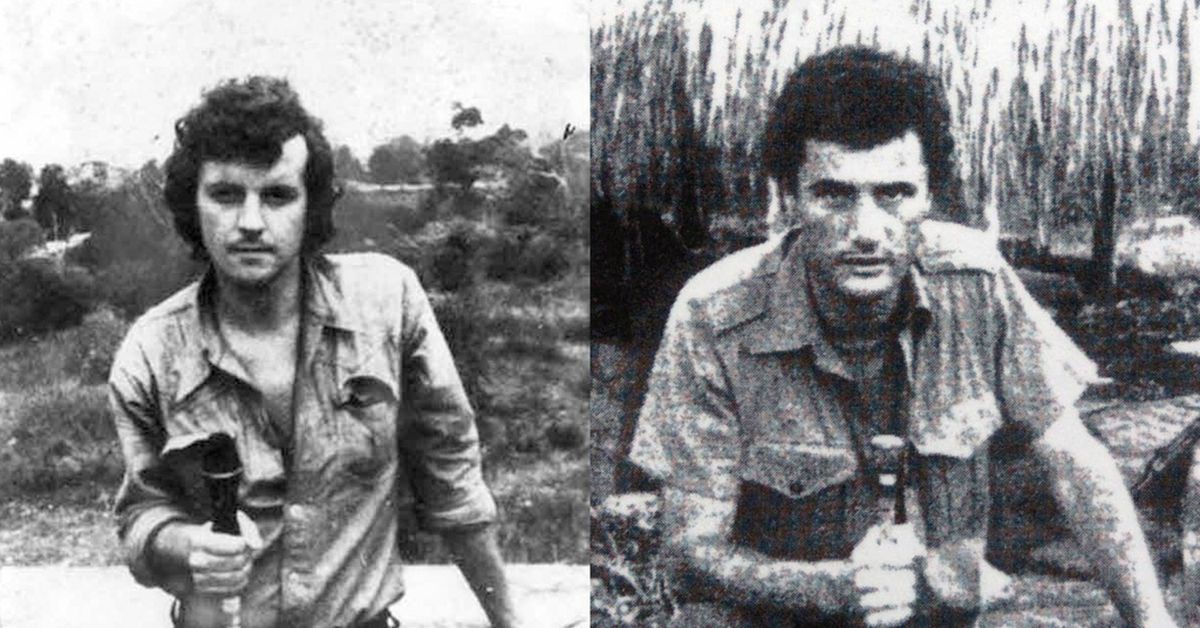
Five journalists who worked for Australian media networks were killed on October 16, 1975, while reporting from Balibo in East Timor.
Known as the Balibo Five, reporter Greg Shackleton, camera operator Gary Cunningham and sound recordist Tony Stewart of the Seven Network, along with reporter Malcolm Rennie and camera operator Brian Peters from the Nine Network, were killed as they witnesses an Indonesian incursion in the town of Balibo.
A sixth, Roger East, a reporter working for Australian Associated Press and Reuters, was executed in Dili on December 8, 1975.
 Brian Peters, Tony Stewart and Gary Cunningham were among five killed while trying to report on Indonesian troops invading Balibo, East Timor in 1975. (AAP) (AAP)
 Malcolm Rennie and Greg Shackleton were among five killed while trying to report on Indonesian troops invading Balibo, East Timor in 1975. (AAP) (AAP)
No one has been brought to justice for their murder.
They were in East Timor to cover the tumultuous move to self-rule when former Portugal released its colonies, sparking clashes between pro-independence fighters and militias who backed Indonesia.
The situation escalated when the Indonesian military launched its invasion of East Timor.
The five journalists decided to stay in the town of Balibo even though the East Timorese had fled, believing that as journalists they would not be military targets.
They painted a crude Australian flag on the wall of the house they were staying in, believing it would warn Indonesian troops.
 Journalist Greg Shackleton, one of the Balibo Five, paints a crude Australian flag on the building where they were staying. (Sydney Morning Herald)
But after the heavy bombardment of Balibo early on October 16, the journalists were reported missing.
It took nearly a month before confirmation of their deaths, when a box of human remains was given to Australian diplomats in Jakarta.
They were later buried in a single coffin in the Indonesian capital, despite calls for the bones to be returned to Australia for forensic examination.
The official Indonesian version is that the men were killed by a crossfire during the battle for the town.
But many others, including the Balibo Five’s family and friends, claim they were executed by Indonesian security forces.
 Former Australian prime minister insisted the Balibo Five were not executed by Indonesian troops. (Domain)
The killings of the Balibo Five cast an ugly shadow over relations between Australia and Indonesia.
The then Australian prime minister Gough Whitlam maintained the journalists had always claimed the men were killed in the crossfire between Indonesian troops and East Timorese independence fighters.
But his critics accused him and his government of covering up the affair to maintain good relations with the Indonesian dictator Suharto.
A NSW coroner in 2007 blamed the deaths on Indonesian special forces soldiers, but said there was no evidence to suggest Whitlam or subsequent Australian governments knew they had been murdered and had covered it up.
A five-year Australian Federal Police war crimes investigation into the deaths of the Balibo Five was closed in 2014, due to insufficient evidence and problems establishing jurisdiction.