
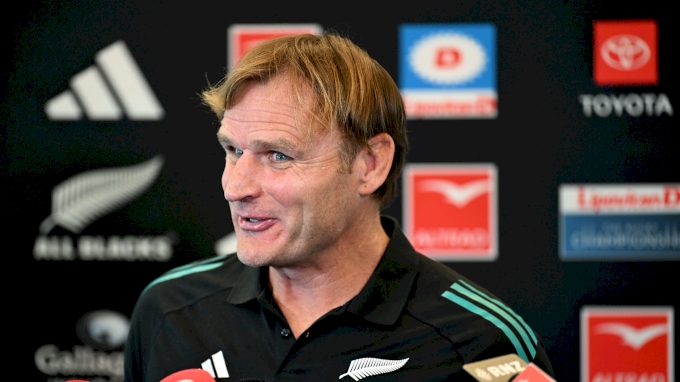
When Scott Robertson signed his four-year deal to lead New Zealand Rugby, the goal was simple. Win the next World Cup in Australia and rebuild the All Blacks brand in the process. Sixteen months in, the journey has proved far more complicated than the trademark grin or breakdancing flair would suggest.
The All Blacks under Robertson remain a side trapped between eras. There is the fresh energy of debutants like Leroy Carter, Fabian Holland, and Peter Lakai. Then there is the muscle memory of a core that once ruled the world but is now fighting to stay relevant in a faster, more tactically varied game. The result is a team that has yet to find its rhythm, alternating between brilliance and bewilderment throughout 2025.
New Zealand’s recent Rugby Championship campaign painted that picture vividly.
A record 43–10 loss to South Africa in Wellington and a historic first defeat to Argentina in Buenos Aires marked new lows in All Black history.
The numbers underline why. They conceded an average of 27 points per game, their worst defensive return in a decade. Across the six rounds, New Zealand missed more than 20 tackles per match and gave away roughly 13 penalties, a discipline issue that turned pressure into punishment.
It was not all doom. Their set piece, for generations the foundation of All Black rugby, remains elite. They operated at ninety-five per cent success in the line-out and over eighty per cent at scrum time.
The issue is not structure but execution when fatigue and tempo rise. In key moments against the Springboks and Pumas, the breakdown slowed and the defensive line fractured. Robertson’s side often dominated possession and territory but failed to turn that control into points. In Buenos Aires, they owned nearly sixty per cent of the ball but produced only one clean line break.
The attack itself has been a puzzle. Early in the Championship, New Zealand averaged more than five tries per match. By the final rounds, which dropped to barely three.
Ball retention is high, offload numbers are strong, yet the conversion rate inside the opposition’s twenty-two remains poor. It takes roughly eleven attacking entries to produce a single try.
The All Blacks still generate metres and width, but too often the ball carrier runs into traffic rather than space.
Individual performances offer both hope and concern. Will Jordan continues to be the most dangerous broken-field runner in the sport. Ardie Savea leads all New Zealand forwards in carries and tackles made. Cam Roigard’s return at scrumhalf coincided with the only stretch of back-to-back victories, suggesting his tempo and decision-making bring clarity to an otherwise stuttering attack. Quinn Tupaea’s emergence at outside centre, capped by two tries against Australia, has finally given the midfield some thrust. Yet the same names are carrying a disproportionate load while several veterans appear to be treading water.
Robertson’s selection strategy has been bold but also inconsistent.
Nineteen new players have debuted since he took over, evidence of a long-term rebuild aimed at the 2027 World Cup. But the conservative squad named for this Grand Slam tour tells another story.
Just one uncapped player, prop Tevita Mafileo, made the cut. Others on the fringe, like Dylan Pledger and Christian Lio-Willie, remain parked in the All Blacks XV. The result is a group that looks neither fully transitional nor entirely settled.
Robertson insists the approach is about depth and cohesion. He wants four players capable of performing in every position by the next World Cup cycle.
The All Blacks XV travelling alongside the test squad is designed to mirror that system, giving fringe players exposure to northern conditions.
On paper, it makes sense. In practice, results suggest cohesion has not yet followed.
Robertson knows better than anyone how crucial it is to blood players who can handle the pressure that will inevitably come with being an All Black. He played in an age when the All Blacks rarely blinked under pressure.
This group has shown flashes of that resilience, most notably in the final round of the Rugby Championship, where they beat Australia 28–14 in Perth. That match featured strong line speed, improved defensive spacing, and reduced handling errors.
Still, one solid performance cannot erase the underlying pattern. Across the season, New Zealand averaged fifty-three per cent possession but were outscored on aggregate.
Their once fearsome counterattack now feels hesitant, their aerial game reactive rather than dominant. Too many carries end in contact rather than continuity. When the pressure mounts, the tactical kicking game loses its edge, and the once automatic clinical finishers look human.
The challenge for Robertson is clear. He inherited a side stripped of more than six hundred test caps after the retirements of Sam Whitelock, Brodie Retallick, Aaron Smith, Richie Mo’unga, and Dane Coles. The leadership void is real.
Scott Barrett’s captaincy has brought steadiness but not yet the commanding authority of past eras. The team’s body language under pressure, particularly in Wellington and Buenos Aires, told its own story.
This November tour offers a chance to reset that narrative. Starting with Ireland at Soldier Field, then Scotland, England, and Wales, the All Blacks have a shot at their first Grand Slam since 2010.
Anything less will add noise to the questions already circling Robertson’s tenure. Are the All Blacks still the benchmark? Can their new systems deliver under northern scrutiny? Or has the rebuild simply stalled halfway?
The raw material is there. The new forwards are physically imposing, the backline has pace, and the tactical variety is broader than in recent years. What is missing is consistency. Robertson has spent fifteen months identifying the right players. Now he must identify the right combinations. He promised a revolution built on clarity, cohesion, and flair.
The All Blacks remain a team capable of blowing anyone away on their day. The problem is that their day no longer arrives often enough.
If the Grand Slam tour reignites that spark, Robertson’s vision will finally have a foundation. If not, the noise around New Zealand Rugby’s most charismatic coach will grow louder.
How To Watch Rugby Matches In The United States On FloRugby
Professional club rugby in Europe all streams on FloRugby and the FloSports app in the United States. FloRugby and FloSports also are the U.S. home to:
FloRugby also is home to match archives and match replays.
Join The Rugby Conversation On FloRugby Social