
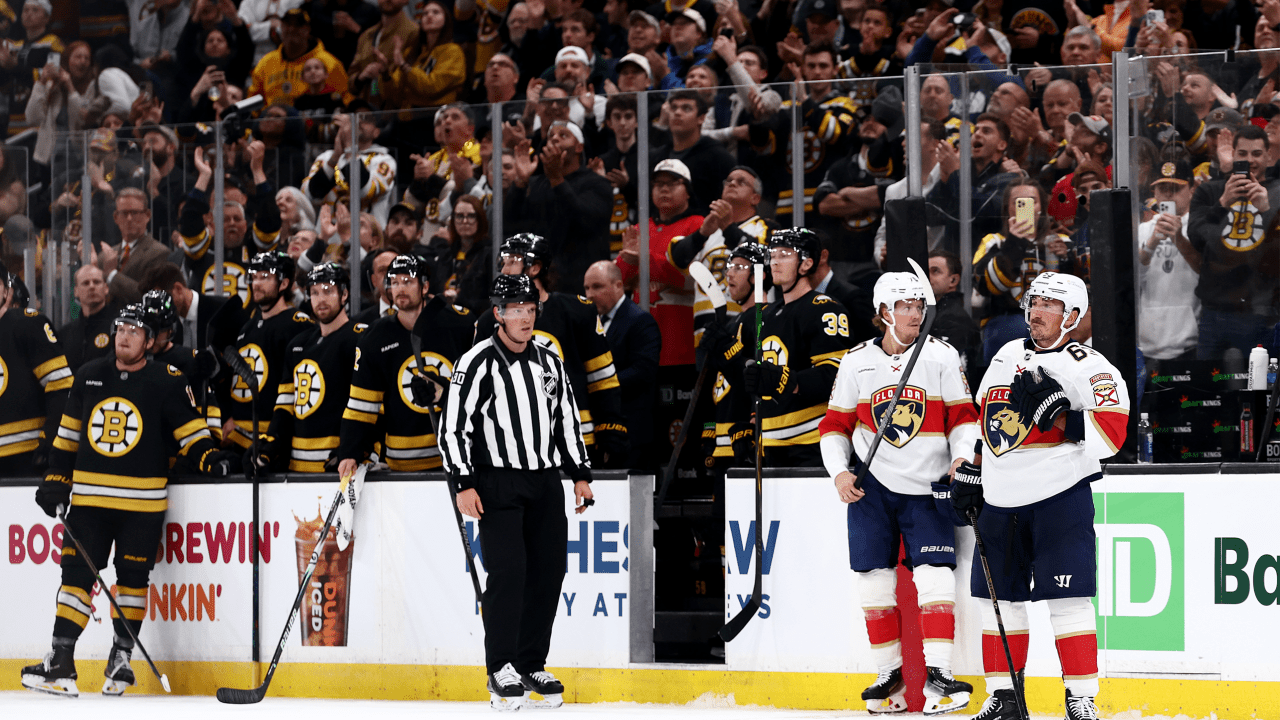
You could see it all wash over him, a lifetime spent in this building, with these fans, a lifetime of standing by him, of accepting him, of cheering him, of wearing his No. 63, of watching his glory and his missteps, of loving him. Because they did. They loved him.
They still do. He does too.
“I was trying not to cry,” he said. “That was what I was trying to do. And then, as soon as I saw my kids on the screen, it hit like a ton of bricks. Just the memories and the emotions of everything, just the years and the years and the incredible times. It just kind of came pouring into your memory.”
Marchand returned to TD Garden on Tuesday, a moment he hadn’t dared think about in the days and weeks leading up, a moment he hadn’t wanted to envision. It started to hit him on Sunday night, as he went out to dinner with the people who had helped build his career, who had shared road trips and locker rooms, the starts of families and the Stanley Cup, in Patrice Bergeron and Zdeno Chara, Tuukka Rask and Adam McQuaid.
This was his home. It still is, in so many ways, despite the trade that sent him to the Florida Panthers on March 7, despite the Stanley Cup won last spring wearing red instead of black-and-gold, despite the six seasons for which he may still play in Florida.
It was the home in which he built a life, a legacy, one he added to on Tuesday night, with two assists in a 4-3 win for the Florida Panthers against the Bruins, bringing him to 988 career points, 976 (422 goals, 554 assists) of which he scored for the Bruins in his 1,090 games over 16 seasons. It was the place where he became Brad Marchand, for all the good and all the ill, the place where he had stumbled and gotten up, where he had formed bonds and scored goals, where he had become a hockey player he never, ever could have imagined at the start.
That was who they celebrated on Tuesday, a player who did not have the perfection of Bergeron or the intimidation of Chara, a player whose very humanness, whose mistakes and survival were indelibly part of his story, part of what endeared him to them.
And as much as Marchand tried to forget what was coming, tried to put it out of his mind and focus on the game at hand, the TV timeout hit at 9:21 of the first period and, with it, his face appeared on the video board, the crowd rising as one.