
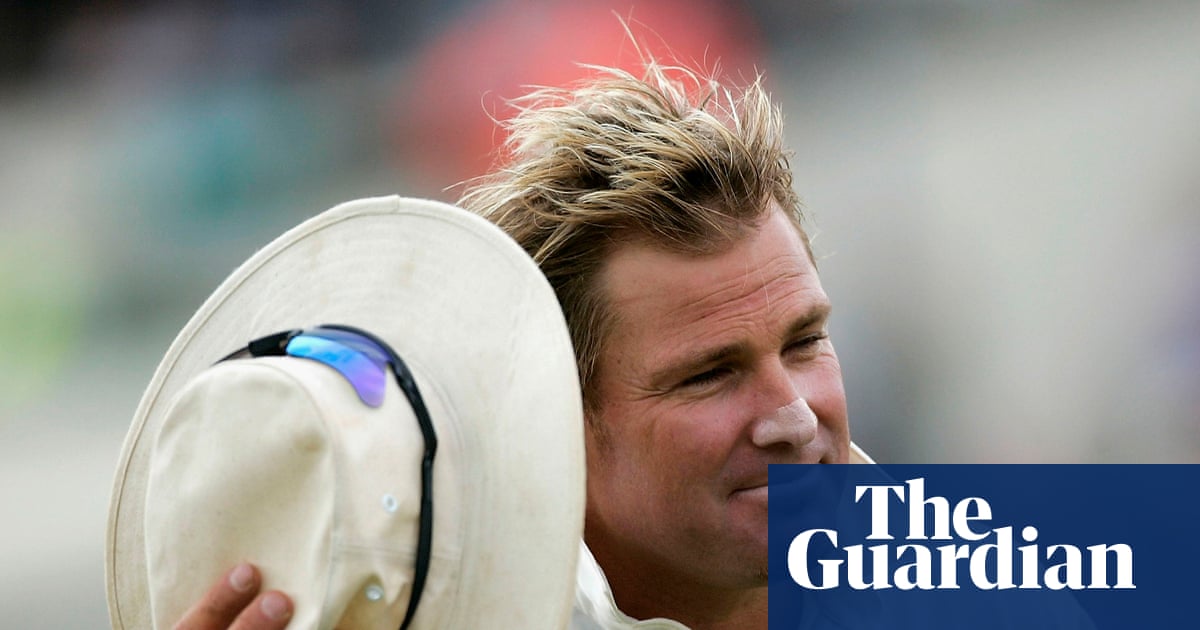
At the most famous cricket ground in the world, inside the sport’s most revered pavilion, there is a lifesize painting of a man who terrorised English cricket for 15 years. Across the manicured green turf at Lord’s, inside cricket’s most iconic media centre, the main commentary box is named after this generational tormentor. About 84 miles away, at the Rose Bowl near Southampton, an entire stand bears his name.
English cricket has every reason to hate Shane Warne. In 36 Ashes Tests he bagged 195 wickets at an average of 23.25. From his opening ball of the century at Old Trafford in 1993 to his final bow in Sydney in 2007, he seemed to operate on a different plane. This peroxided devil ruined summers and deepened cold, bitter winters, yet he became an English national treasure, the perfect reminder that cricket, above all else, is something that should be enjoyed.
Warne was everything that the English stereotype wasn’t: a technicoloured rogue in a land of beige, a beer-chugging, chain-smoking larrikin plucked straight out of central casting. As Nietzsche once wrote: “To love is to be in a state of perpetual want.” Perhaps that’s the secret to England’s endearment, the joy of yearning for what could never be theirs.
In other cases affection comes from recognition, when a rival seems to share a nation’s sporting DNA. Nowhere is that clearer than with Virat Kohli in Australia. Few visiting players have been booed so loudly, or applauded so enthusiastically. At first his snarls and send-offs grated, as if he was trying to cosplay as something that he wasn’t, as if he had forgotten that Test captains should stick to the archetypes they’ve been assigned.
By the end Australians realised they were looking at something uncomfortably familiar. He became, in their eyes, the worthy antagonist. “Kohli redefined expectations, challenged conventions, and symbolised the self-assured, unapologetic India of the 21st century,” the former Australia captain Greg Chappell wrote last year. He wasn’t copying the Australians; he was mirroring them, feeding their energy back at them with the volume turned up. They came to admire him not because he tried to be different, but because he played as they believed cricket should be played.
Kohli’s numbers in Australia speak for themselves. Against the Aussies in one-day internationals he has piled up 2,451 runs in 51 matches at an average north of 53. In Tests he’s tallied 2,232 runs at 43.76 in 30 outings. His nine hundreds are the most he registered against any opposition and his twin-ton display in Adelaide in 2014 stands as one of the greatest individual performances in the country. Like a true blue Aussie he leaned into the fight and gave as good as he got. Now, having bowed out of Tests and Twenty20 internationals, his curtain call in the ongoing ODI series has carried a sombre tone. His duck in the first of three matches drew muted celebrations, the Perth crowd knowing that this would be the last time they’d see him in the flesh.
Virat Kohli at Perth last weekend: out for a duck but acclaimed by the Australian crowd. Photograph: Saeed Khan/AFP/Getty Images
And then there are players who are loved simply for their style and grace, the ones who melt borders altogether. AB de Villiers never played for India, but you wouldn’t know it. In Bengaluru, where he spent a decade with the Royal Challengers in the Indian Premier League, crowds treated him less as an overseas professional than as a favourite son. The South African stroke-maker, nicknamed “Mr 360” for the way he reimagined the geometry of batting, became a symbol of how invention and humility can coexist.
Where Warne thrilled with his unconquerable wizardry, and Kohli compelled respect through combat, De Villiers connected through joy. “India is my second home, I’m half-Indian now and proud of that,” he has said. “I sort of fell in love with the culture, the country, the people, and their absolute love for cricket. I’ll always be grateful for all the love this beautiful country so unconditionally gives me.”
All of this still feels rare in cricket. Even amid the rise of franchise leagues and the blurring of borders, the game remains stubbornly tribal. International cricket endures as the sport’s pinnacle while carrying echoes of a previous age when distinctions between “us” and “them” were more stark. Despite cricket’s devotion to an idealised code of conduct its rivalries seem to be built from harder, more ancient stones. However, they are prone to leaks.
This is part of cricket’s charm. The long hours, the undulations across a day’s play, the tours that stretch into months; perhaps this is what allows villains to turn into folkloric figures with Shakespearean arcs. The longer you let the narrative breathe the harder it is to hold on to hate for some players who, whether we like it or not, have earned our respect. In the end, all the noise settles into admiration for their skill and their spirit, for the audacity to play this strange, beautiful game in a way no one else quite can.
It’s why De Villiers has a home away from home. It’s why fans in Sydney will rise to their feet when Kohli leaves the scene one last time at the SCG on Saturday. It’s why Warne’s portrait now hangs at Lord’s and why the pain he inflicted on English cricket is celebrated in both hemispheres. That’s the paradox at the heart of cricket. You spend a lifetime picking sides only to realise it’s the game itself you ever loved.
Smith races to get Konstas Ashes-ready
Steve Smith’s mentorship helped turn Marnus Labuschagne into one of the world’s top run-getters between 2019 and 2021. Now, Australia’s leading batter is hoping he can help steady the top order again, this time by offering a guiding hand to young Sam Konstas.
Australia’s batting stocks aren’t exactly brimming, and the national selectors are running out of names to scribble at the top of the Test list. Konstas, 21, is the latest great hope. Tall, fluent but prone to moments of madness. His domestic form, all erratic flashes and early dismissals, has done little to calm nerves before the Ashes begins in Perth on 21 November.
On Monday, he was bowled for 20 trying to ramp Victoria’s Cameron McClure – the sort of shot that makes coaches reach for herbal tea. Smith, ever the statesman, has stepped in with the offer of a phone line and an open door. “Whenever he wants to chat batting, I love talking batting,” Smith said this week. “I’m happy to help wherever I can.”
It’s classic Smith: part Zen master, part cricket tragic. He remembers his own early struggles, and knows every Test opener has to find their rhythm the hard way. Still, his faith in Konstas remains: “He’s got so much time against pace. That’s something you can’t teach.”
Time, though, is exactly what Australia don’t have. The Ashes clock is ticking, and an unsettled top order could yet undo a side otherwise built for dominance. If Smith can’t fix the problem with quiet chats and throw-downs, Australia may soon discover that even the best mentor can’t patch over an empty scorecard.
skip past newsletter promotion
Subscribe to our cricket newsletter for our writers’ thoughts on the biggest stories and a review of the week’s action
Privacy Notice: Newsletters may contain information about charities, online ads, and content funded by outside parties. If you do not have an account, we will create a guest account for you on theguardian.com to send you this newsletter. You can complete full registration at any time. For more information about how we use your data see our Privacy Policy. We use Google reCaptcha to protect our website and the Google Privacy Policy and Terms of Service apply.
after newsletter promotion
Quote of the week
I’m a bit of a sicko. I love sitting down and watching Test matches, so I’m going to be in Australia later this year and the Ashes is going to be on” – Rory McIlroy perfectly sums up the ridiculousness of watching an away Ashes series in the early hours.
Memory laneThe late Phillip Hughes of New South Wales celebrates victory over Trinidad and Tobago in the Champions League Twenty20 final in 2009. Photograph: Getty Images Australia
Under warm Hyderabad lights in October 2009, New South Wales sealed the inaugural Champions League Twenty20 title and with it a tidy US $2.5m cheque, thanks to Brett Lee’s 48 with the bat and two new-ball wickets as the Australians beat Trinidad and Tobago by 41 runs. The Champions League folded quietly in 2014, a victim of scheduling chaos and IPL fatigue.
Still want more?
Simon Burnton on Adil Rashid’s undimmed passion, at 38, for playing for England.
Australia’s Scott Boland on trying to shut out the noise as the Ashes hype mounts.
England’s women have made it to the World Cup semi-finals, putting some wobbly performances behind them in beating India in a thriller, reports Raf Nicholson.
In?
To subscribe to The Spin, just visit this page and follow the instructions.