
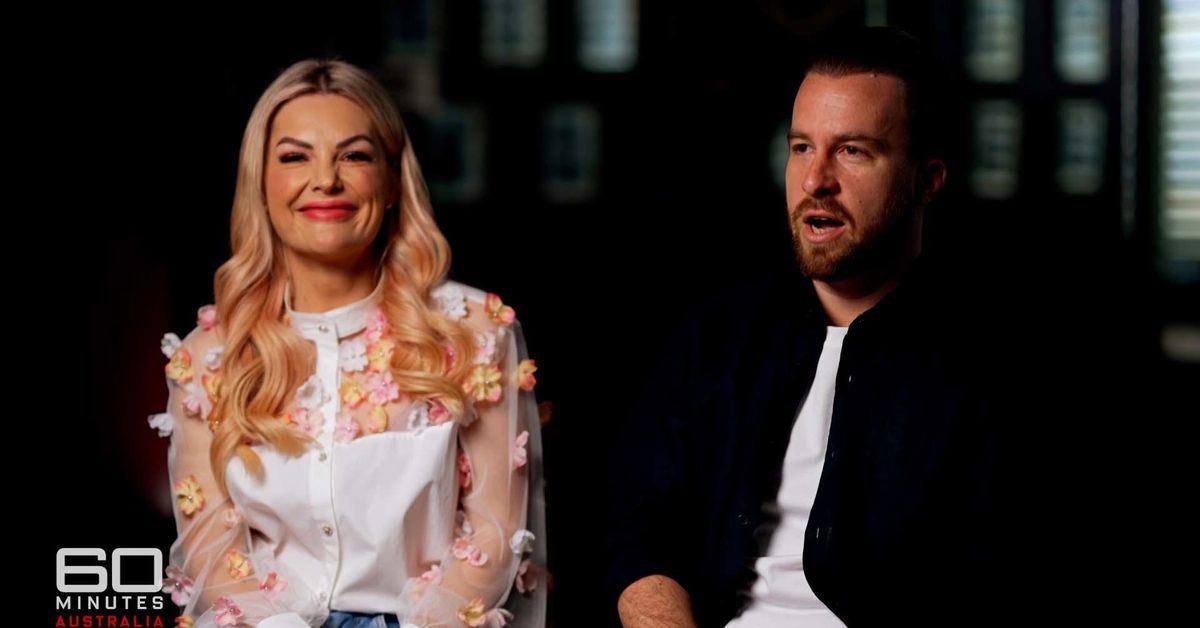
Jack and Amanda Delosa can’t stand schools – and they’ve already decided their toddler daughter will never set foot in one.
They’re also relishing the chance to tell the world why. In fact, they’ve come out swinging.
“It’s not just a waste of time, it’s worse than that,” Jack says.
 At just two years old, Ariella Delosa has travelled more than many adults. (Nine)
“It’s preparing students for a world that no longer exists, and so we’re setting them back before they even start.
“That should frustrate all of us.”
The Delosas are successful entrepreneurs.
So, they’ve got the money and the lifestyle to raise their two-and-a-half year old, Ariella, through a particular style of home-schooling: world schooling.
Ariella’s already been to eight countries.
“This concept of world-schooling is something that, you know, we see as being very valuable for her because of how much we move around,” Amanda says.
“More time to actually do more of their sort of creative sort of activities, things that they’re naturally going to lean towards for their development as opposed to just sticking in a box with the curriculum side of things.”
Ariella’s dad, Jack, couldn’t be more scathing. He believes actual schools would do his daughter more harm than good.
“The traditional education system was set up and designed in the 1800s, and it was designed to produce factory workers,” he says.
“But if you fast-forward 200 years, schools simulate an environment that is almost the opposite to the real world: we want you to sit down and not talk to the person next to you and wait to be told what to do.
“Well, in the real world, if you sit down, you don’t talk to the person next to you and you wait to be told what to do, you’re unemployable at best.”
 Amanda Delosa works as an influencer, while Jack Delosa is an entrepreneur. (Nine)
Jack and Amanda are aware they’ve built a privileged life.
For instance, they’ll have the wealth to hire tutors for their daughter, when required.
Nonetheless, they’re part of a growing trend towards homeschooling.
About 48,000 Australian families – albeit the vast minority – are now shunning traditional schooling. And most include regular, working-class parents.
“Home-schooling has experienced by far the biggest growth of any education choice in Australia,” says Dr Rebecca English, an education lecturer at the Queensland University of Technology.
“I separate families who choose home-schooling into two groups. I think there are the deliberates, which is this family. They are never going to choose a school, so it’s a waste of breath trying to get them to go.
“The really interesting part and where all the growth we’ve experienced in Australia has been in this group that I call accidentals.
“Most so-called ‘accidentals’ are parents whose children have struggled with school so much – particularly due to bullying or neurodivergence – that they feel they have no choice but to pull them out.
 Dr Rebecca English says more than 48,000 Australian families are choosing home-schooling. (Nine)
Dr English says sometimes a short period in home-schooling is “just what that child needs”.
“Get over the anxiety, move on,” she said.
“Most of them just try it for a couple of years and then they’ll often go back to school.”
But don’t expect little Ariella to ever join her peers in a classroom.
“My problem isn’t with the teachers or the principals,” Jack says.
“My problem is with the system that they operate within. It punishes the skills that make somebody successful.
 Young Ariella Delosa will never set foot in a school classroom. (Nine)
“We’re still in the hangover from a period of the ’80s and ’90s where, if you went to school and you went to university … it almost guaranteed you a successful career that would set you up for a really healthy and happy life.
“That’s just simply no longer the case, and the world is waking up to that. It’s just waking up to it slowly.”
Watch the full episode of 60 Minutes on 9Now.