
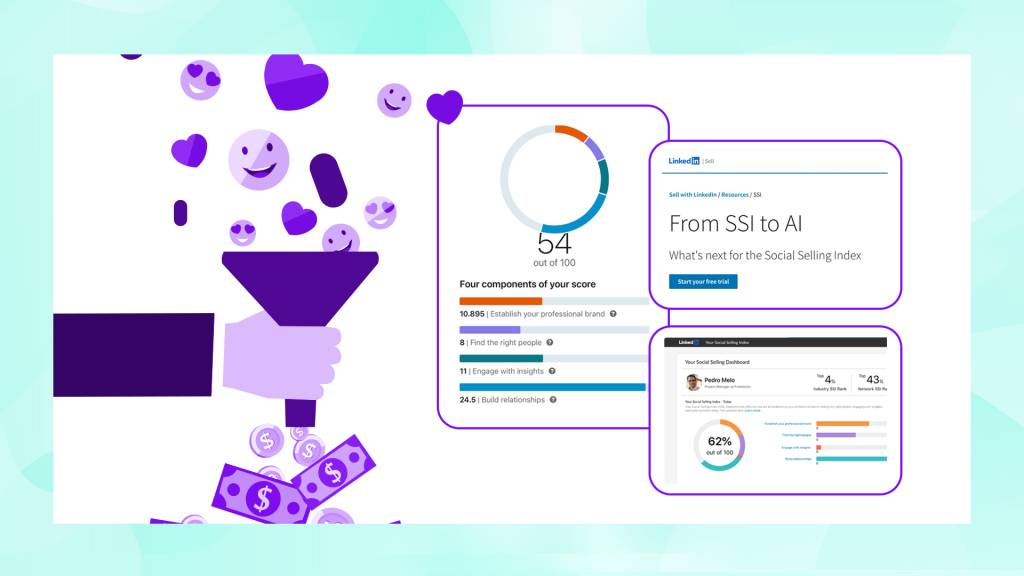
Unless you’ve been living under a rock, chances are you’ve come across at least one post from a LinkedIn connection featuring a screenshot of their SSI score, and a promise to unpack what it means. (Hint: They probably don’t)
So why is everyone suddenly obsessed with their LinkedIn SSI score, and more importantly — what is this score in the first place? TL;DR: it’s basically just a trend, and it’s not even new. But that’s the beauty of the internet, and everyone who loves to jump on the bandwagon.
Related Article Block Placeholder
Article ID: 279053

However, if your interest is now piqued, here’s exactly what this trending topic on LinkedIn is and what you can do with it — or not, because as it turns out, AI has already replaced it.
What is the LinkedIn SSI score?
According to the professional platform, the Social Selling Index (SSI) score was developed as a “benchmark to measure how effectively a salesperson uses social media for social selling, helping them improve performance”.
The metric, which ranges from 0 to 100, indicates how well a social seller has established their professional brand. It also measures how they “find the right prospects, engage with key insights, and build relationships on LinkedIn”.
Smarter business news. Straight to your inbox.
For startup founders, small businesses and leaders. Build sharper instincts and better strategy by learning from Australia’s smartest business minds. Sign up for free.
By continuing, you agree to our Terms & Conditions and Privacy Policy.
Nope. It’s actually been available to users since 2014.
How do I check my LinkedIn SSI score?
You need to be logged into your LinkedIn account and head to the Sales Navigator, or simply click on this link.
Why is the LinkedIn SSI suddenly trending?
No one knows why. Could it be one LinkedIn post from a thought leader that suddenly snowballed into a trend? Possibly.
Or could it be LinkedIn pushing users’ interest because it has actually sunsetted the SSI Score to launch its new AI agent for sales? (Hey, I’m not a conspiracy theorist, but when you put it like that …)
Related Article Block Placeholder
Article ID: 309246

According to a LinkedIn post from earlier this year, the SSI score “has been the go-to metric for sales professionals on LinkedIn — a badge of honor signaling credibility and connection”.
“But as buyer behaviors shift and sales cycles become increasingly complex, the SSI score no longer accurately reflects the modern sales environment.”
Instead, LinkedIn promises its new AI innovations in LinkedIn’s Sales Navigator will help sellers learn about the new tools and technologies, and close deals and build client relationships.
According to LinkedIn, it is changing the approach so people focus less on building a high SSI score and more on building customer relationships… (So you mean all that effort to build that score so I could boast about it in a post accompanying the screenshot of my SSI score is …)
Great, now what does it mean?
LinkedIn suggests this means focusing more on a human-centric approach, and not send mass InMails or spam other users. Instead, the platform says you should use its AI agents to send personalised messages at the right time.
Related Article Block Placeholder
Article ID: 295254

So how does LinkedIn’s new AI for Sales work?
The Sales Assistant uses data from LinkedIn’s platform to help sellers find high-quality leads. The AI agent will find “new, high-potential leads based on your target buyer criteria, going beyond titles to uncover prospects most sellers miss”.
The agent, which is still in beta, will also explain to users why the lead is a good match and “learn from feedback” for future recommendations. It will also suggest the best way to connect with them: an InMail, a connection request, or even a warm introduction through a mutual connection.
Anything else I should know about it?
Probably that you don’t need to worry about most “trends” that put you in a competition with other users over vanity numbers. (That’s rich coming from a part-time blogger/influencer like me, but hey, that’s life)
But if you indeed are interested in using AI for sales for LinkedIn, this resource might be a good place to start.