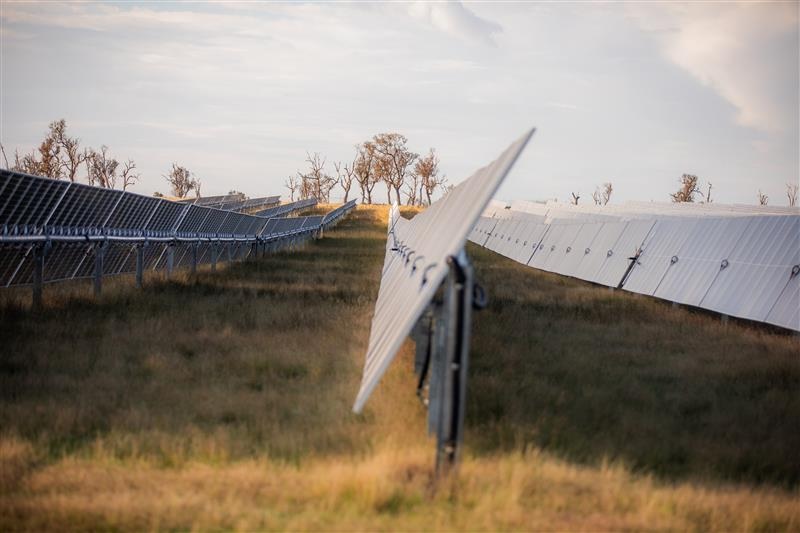
The nearly one million PV panels that make up the 400 megawatt Stubbo solar farm in central western New South Wales have been signed up for end-of-life recycling, despite the project not yet reaching full commercial operations.
Acen Australia says the decision to “embed circularity” into the project from the start of its life is about setting a new standard for the large-scale solar industry while also helping to build demand signals and a supply chain for solar recycling.
The move also makes Stubbo Solar is the first large-scale project to meet independent standards designed to make circular management commercially viable.
The project has earned an “exceeds” rating from Circular PV Alliance (CPVA), which recognises that it has gone beyond baseline requirements and taken a whole-of-lifecycle approach to managing materials for reuse, rather than waste.
“Decarbonising Australia’s energy system is a crucial step, but if we only replace the fuel, we risk repeating the logic of the old extractive model,” Mr Pollington said.
“Circularity challenges us to design for longevity, resilience and renewal, and Stubbo shows what’s possible when those principles are built in from the start.
“We hope what we’ve achieved encourages others across the industry to take the same step.”
Philippines-based Acen has more than 1,000 megawatts (MW) of renewable capacity in operation and under construction in Australia, and a further 13 gigawatts (GW) in development across the National Electricity Market (NEM).
Its projects include the country’s biggest solar farm, New England, which will total 720 MW once its second stage is complete, as well as a big battery, as well as the contested Robbins Island wind project in Tasmania.
In May, Acen was awarded 30 per cent of the capacity of the Central-West Orana Renewable Energy Zone, securing transmission access for its Birriwa Solar, Birriwa BESS and Valley of the Winds projects – all expected to reach financial close within the next 12 months.
Stubbo Solar began generating power this year and will reach full commercial operations by the end of November, having secured a 20-year Long Term Service Agreement in 2021 in the NSW government’s first renewable energy and storage auction.
CPVA co-founder and CEO Megan Jones says the technology to recycle and reuse solar panels already exists, but is waiting on the right market infrastructure, regulations and incentives to make it commercially scalable.
“By embedding circularity into a project of this size, Acen Australia is helping build the demand signals and supply chains that make large-scale recovery viable.”
If you would like to join more than 26,600 others and get the latest clean energy news delivered straight to your inbox, for free, please click here to subscribe to our free daily newsletter.