

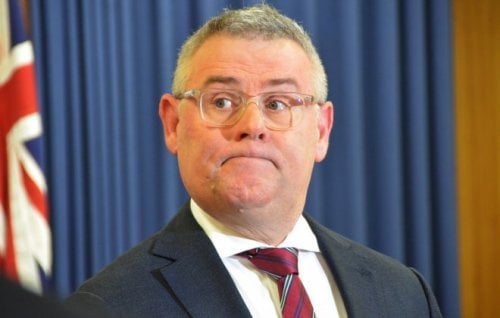
Murray Watt is still optimistic about the chances of passing his reforms to the Environment Protection and Biodiversity Conservation (EPBC) Act.
“I think for all the rhetoric flying around, when I actually meet with the Coalition, the Greens and stakeholders, no one is saying they are totally opposed to this bill,” the environment minister tells The Saturday Paper.
“There are obviously things that they want to negotiate on and amendments that they would like to seek, but no one is saying, ‘Absolutely won’t, no way.’ So that’s encouraging.
“I’m talking with people every day, so I’m certainly hopeful that the sorts of issues that people are raising with me can be dealt with by our amendments, and that way we can get on with it and pass these laws.”
Watt’s shadow minister, Angie Bell, regards the current offering from Labor as a handbrake on business. Still, she hopes to reach a compromise.
“I’ve met with the minister a number of times, and we’re working through some of these big, primary concerns,” Bell tells The Saturday Paper. “I’ll continue to meet with the minister or the department or both, to see if there’s a way through. But right now, these bills … the way they currently are, we cannot support them.”
All parties agree the current laws are broken, but it is hard to find a satisfied voice on the package Watt designed to replace the nature laws that cover the assessment and approvals of green projects and large housing developments, as well as more controversial land clearing, mining and forestry.
Conservation groups and the Greens fear nature protection will be weakened, while business and industry want the reforms to be more pro-development. The only element that has been ruled out by Watt is a “climate trigger” to strike out projects based on greenhouse emissions, and he says he won’t entertain splitting the bills.
If passed, an independent environment protection agency would be established to oversee environmental protections, including enforcement, with stronger powers and penalties to deter breaches and respond to harm.
There is also a new power for ministerial rulings; a new definition for what constitutes an “unacceptable impact”, which could be used to stop proposals on environmental grounds; an overhaul of the environmental offset system; better collection of national environmental data; and a new application of the rarely used “national interest” exemption, which the minister can use to fast-track major projects, even if they don’t meet the national environmental standards.
This exemption is designed for matters of defence, national security or a national disaster, but the minister “has in mind” critical minerals mining, renewable energy projects and housing developments.
The reforms also contain a fast-track option and propose new bilateral agreements between the Commonwealth and each state and territory to sort out the powers of assessment and decision-making.
“What we’re trying to do is stick to Graeme Samuel’s recommendations,” Watt says. “We’ve got to find ways to be able to speed up the delivery of projects while having those strong safeguards for the environment.”
The reforms have a “no regression clause” contained in new environmental standards that are being introduced through regulation rather than the big package of EPBC legislation. The clause means the standards cannot be changed or updated unless the new standard would deliver “equivalent or improved environmental outcomes”.
Watt is first releasing two draft standards, on what constitutes matters of national environmental significance and on an overhaul of the offsets regime. The offset will require a net gain rather than the current test of no net loss.
“The big win will be to pass the legislation. I think they just need to understand the reality of what’s being put forward. It is a massive, massive step forward.”
The standards are the “centrepiece” of Samuel’s reforms, according to Watt, and the first two are stand-outs.
“They were the two standards that most of the stakeholders had most interest in,” he says. “Because we’ve accelerated the timetable, we don’t have the time to draft every single standard, but those two were critical to stakeholders and so we’ve really prioritised those.”
The Coalition is concerned about the sweeping powers that will be given to the chief executive of the EPA, as well as emissions reporting requirements under the new EPBC Act. Bell says she is also keen for the definition of “unacceptable impact” to be taken out of the legislation and put into an environmental standard instead.
Since the minister has already ruled out a climate trigger, one of the Greens’ major sticking points is the protection of forests.
“What we will continue to call for is nature laws that actually protect nature,” says Greens leader Larissa Waters.
“I’m sorry Mr Samuel isn’t happy that people aren’t picking up his report and turning it into gospel, but the Greens will always fight for nature and for an end to forest logging and for climate to be factored in and not to have the red carpet rolled out for coal and gas corporations.”
For his part, Watt believes he still has a hope of negotiating with either the Coalition or the Greens.
“I’m pretty confident that we can pass the bill this year,” he tells The Saturday Paper. “I have no doubt whatsoever that we will pass a bill.
“These are reforms that have been dragging on for five years. The community is tired of the debate. The business community is tired of the debate. The environment continues to suffer while we go round and round in circles. It is urgent that we get this done.”
Renowned as a “fixer” for the prime minister, Watt insists he is sticking very closely to the recommendations from Graeme Samuel, who was commissioned by then environment minister Sussan Ley to review the laws in 2019.
“I feel for Sussan Ley, because I think she’s just jammed between what she probably believes, judging from the discussions I had with her when we did the review, and what sections of the party room are obligating her to deal with, and so that’s as best as I can read it at the moment,” Samuel tells The Saturday Paper.
“I’ve done that as much as I can … which is to say that I’m frustrated, I’m angry, and to try and point out that she embraced the report back when it was delivered to her, and she embraced it as we went through it.”
Samuel, a former chair of the Australian Competition and Consumer Commission, is just as disappointed by the Greens, who he regards as “deliberately misunderstanding” his 2021 report.
The Greens, while still very much in negotiations, see a package skewed to big business and the “fast-tracking of fossil fuels”.
Environment groups regard the proposed reforms as the “biggest test the Albanese government has faced” but believe they contain too many loopholes. They are also concerned about a deal with the Coalition that made the laws more favourable to business.
“We would be concerned about any pathway that included the Coalition,” Paul Sinclair, the acting chief executive of the Australian Conservation Foundation, said on Thursday.
“We assessed the Coalition’s climate and nature policies at the last federal election. They were rated between zero and 100. They received one. The Coalition has not proven by its actions that it supports [stopping] deforestation, that it supports including climate change in our new nature law. We want the pathway to be with politicians, with the parliament. We want to see a strong law, not a half-arsed law that is stuffed up for future generations.”
The Business Council of Australia, which represents the big miners, wants approvals sped up and wants more clarity over the powers of an EPA to issue stop-work orders. “What is clear is that the existing system is holding up our capacity to deliver housing,” the council’s chief executive, Bran Black, says. “It’s holding up our capacity to deliver renewables. It’s holding up our capacity to support new infrastructure.”
According to the Clean Energy Council, the current laws have created delays in the transmission rollout for the renewable energy transition. “We are at a pivotal stage in terms of scaling up clean energy generation, distribution and storage in Australia,” Jackie Trad, the council’s chief executive, tells The Saturday Paper. “We need the changes to the EPBC Act to really take that growth to the level that it needs to get to in order to meet our commitments under legislation to reduce emissions and to increase renewable energy into the national electricity market.”
With two sitting weeks left this year, Watt wants the bill passed in the House next week and he expects a short Senate inquiry into the bill before a possible deal at the end of November. Labor’s super majority in the Lower House means little in the Senate, where the government is in minority.
The man who created the blueprint for reform is urging compromise for the benefit of future generations. Samuel says environmental law reform should be above politics.
“The big win will be to pass the legislation,” he says. “I think they just need to understand the reality of what’s being put forward. It is a massive, massive step forward.
“If you care about the environment, if you think that nature is going to be an important part of our ecosystem, and I use ‘ecosystem’ in that broad sense of the word, then you’ve got no choice: you actually have to deal with it and deal with it in a sensible manner.
“And dealing with it means adopting a different regime and a different process for preserving the environment, for stopping degradation and … hopefully to recover where we’ve got species that are facing extinction.”
This article was first published in the print edition of The Saturday Paper on
November 1, 2025 as “Watt next”.
For almost a decade, The Saturday Paper has published Australia’s leading writers and thinkers.
We have pursued stories that are ignored elsewhere, covering them with sensitivity and depth.
We have done this on refugee policy, on government integrity, on robo-debt, on aged care,
on climate change, on the pandemic.
All our journalism is fiercely independent. It relies on the support of readers.
By subscribing to The Saturday Paper, you are ensuring that we can continue to produce essential,
issue-defining coverage, to dig out stories that take time, to doggedly hold to account
politicians and the political class.
There are very few titles that have the freedom and the space to produce journalism like this.
In a country with a concentration of media ownership unlike anything else in the world,
it is vitally important. Your subscription helps make it possible.
Send this article to a friend for free.
Share this subscriber exclusive article with a friend or family member using share credits.

Used 1 of … credits
use share credits to share this article with friend or family.
You’ve shared all of your credits for this month. They will refresh on December 1. If you would like to share more, you can buy a gift subscription for a friend.
SHARE WITH A FRIEND
? CREDITS REMAIN
SHARE WITH A SUBSCRIBER
UNLIMITED
Loading…
News
Labor’s environmental reform racket
Mike Seccombe
Labor is hoping to push through its environmental reforms next week, seeking to pass them without revealing the national environmental standards on which they would depend.