
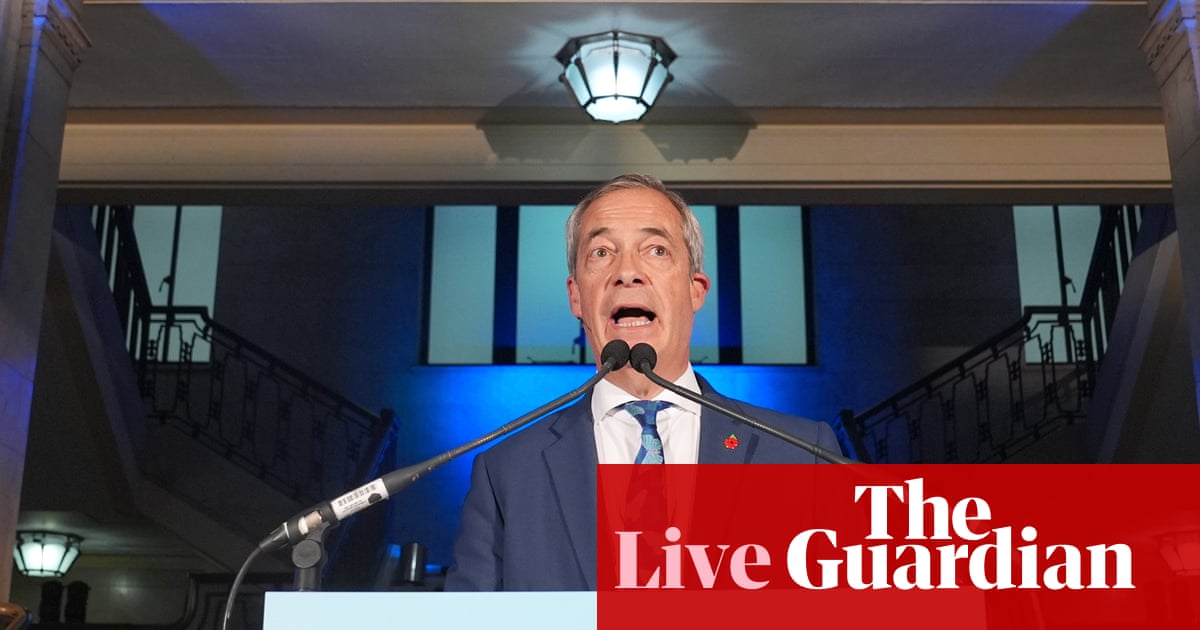
Farage accused of betraying pensioners, but praised for ‘fiscal discipline’, after hinting he might ditch pensions triple lock
If Nigel Farage was hoping to use his speech this morning to establish some economic credibility (see 9.34am), he did not really achieve that. While he confirmed that the 2024 Reform UK manifesto has been consigned to the dustbin, and that the party is now committed to controlling borrowing before it starts slashing taxes (see 11.53am), there was next to no detail at all about what this policy might involve, or how the party would cut overall spending. Instead, most of it was just a familiar rant about regulation, and how everything was better in the 1980s.
But there is at least one area where Farage might attract the backing of mainstream economic opinion; he refused to commit to keeping the pensions triple lock. (See 11.58am.)
Commenting on this, Daisy Cooper, the Lib Dem Treasury spokesperson, said:
Farage is looking to raid the pockets of some of the most vulnerable pensioners to pay for his anti-net zero agenda and the mysterious, unelected ‘advisers’ he envisages running the government.
He is no champion of pensioners – he’d betray them if he ever reached Downing Street.
The Lib Dems were proud to introduce the pension triple lock to tackle pensioner poverty and we will fight to protect the pensioners of today and tomorrow from the vultures in Reform UK.
Kemi Badenoch, the Conservative leader, has also backed the triple lock, implying her party would commit to keeping it in a future manifesto. Labour has not made a commitment on the triple lock for the next election, but it has not indicated any enthusiasm to get rid of it.
Yet many economists and policy experts believe the triple lock, which guarantees that the state pension will rise every year in line with earning, inflation or by 2.5%, whichever is higher, is not a sensible long-term policy. It is due to cost £15bn a year by 2030, three times more than expected when it was introduced by the coalition government.
This is what Robert Colvile, director of the Centre for Policy Studies, told Politico after it reported that Reform might get rid of the triple lock.
For years it’s been clear to everyone who’s looked at the public finances that the triple lock is unsustainable – and increasingly unfair given that so much of the extra money goes to the already wealthy.
If Farage really does commit to replacing the triple lock with a more sustainable alternative, it will not only be an extremely welcome – and courageous – move, but would allow Reform to depict themselves as the real party of fiscal discipline.
Updated at 08.11 EST
Key events
Show key events only
Please turn on JavaScript to use this feature
Tories claim Farage’s ‘incoherent’ economy speech leaves multiple unanswered questions
The Conservatives have described Nigel Farage’s speech today as rambling and incoherent. This is from Mel Stride, the shadow chancellor.
After a speech that was supposed to be Reform’s attempt to restore their economic credibility, Nigel Farage has left the public with far more questions than answers.
Farage did not set out which of the £140bn of commitments he made last year he still stands by, and which he has now dropped. And in a speech which was supposed to be demonstrating fiscal restraint, he instead announced ‘the biggest council housebuilding programme ever’, which could run into the tens of billions of pounds.
Stride was referring to Farage saying in his speech: “We will commit to the biggest building programme of genuinely affordable housing in this country that has ever been seen.”
Stride added:
After this rambling, incoherent speech, it is clear Reform’s economy policy is in chaos. Farage might claim he’s not a ‘one man band’, but he can’t even tell us who his chancellor would be. This is not serious, it is just more announcements without a plan.
To back up Stride’s point about unanswered questions, the Tories released a list of 10 questions unanswered by Reform UK. For the record, here they are:
1) Which of their previous £140bn of spending commitments are Reform saying are fully funded commitments, and which are merely “aspirations”?
2) In the speech, Farage promised the biggest council housebuilding programme ever – how much would this cost and how would it be funded?
3) Reform’s ‘Contract’ promised what they said were £141bn a year of spending increases and unfunded tax cuts. The IFS pointed out their proposals would cost “tens of billions of pounds per year” more than they had calculated. What are Reform’s current spending and tax pledges, and how are they being paid for?
4) Farage claimed that he had been “misunderstood” on the two-child benefit cap. So why did he previously say “we believe lifting the two-child cap is the right thing to do”? What’s changed?
5) Farage claimed he has proposed the biggest welfare cuts of any party, including £9bn from Pip for people with low level anxiety – what evidence does he have for these claims?
6) Farage today criticised stamp duty on shares – is he promising to remove this?
7) Farage praised crypto again today and last month promised to cut capital gains tax on crypto assets from 24% to 10%? How much would this cost, and what would stop it from being used for tax avoidance?
8) Farage said public sector pension savings are supposed to pay for these promises. How much are Reform proposing they will save and how? Can we see their workings?
9) Why can’t Farage say who his shadow chancellor will be – or is he just a one-man band?
10) Reform’s last manifesto was billed as a “contract” with the British people. Isn’t today’s speech a (partial) admission that, if he’d been elected as prime minister, he would have broken the promises he made in that contract? What does this say about our ability to trust anything Reform ever say?
The foreign affairs committee is currently taking evidence from Sir Chris Wormald, the cabinet secretary, and Sir Olly Robbins, permanent secretary at the Foreign Office, about the appointment of Peter Mandelson as ambassador to the US. There is a live feed here.
ShareFarage accused of betraying pensioners, but praised for ‘fiscal discipline’, after hinting he might ditch pensions triple lock
If Nigel Farage was hoping to use his speech this morning to establish some economic credibility (see 9.34am), he did not really achieve that. While he confirmed that the 2024 Reform UK manifesto has been consigned to the dustbin, and that the party is now committed to controlling borrowing before it starts slashing taxes (see 11.53am), there was next to no detail at all about what this policy might involve, or how the party would cut overall spending. Instead, most of it was just a familiar rant about regulation, and how everything was better in the 1980s.
But there is at least one area where Farage might attract the backing of mainstream economic opinion; he refused to commit to keeping the pensions triple lock. (See 11.58am.)
Commenting on this, Daisy Cooper, the Lib Dem Treasury spokesperson, said:
Farage is looking to raid the pockets of some of the most vulnerable pensioners to pay for his anti-net zero agenda and the mysterious, unelected ‘advisers’ he envisages running the government.
He is no champion of pensioners – he’d betray them if he ever reached Downing Street.
The Lib Dems were proud to introduce the pension triple lock to tackle pensioner poverty and we will fight to protect the pensioners of today and tomorrow from the vultures in Reform UK.
Kemi Badenoch, the Conservative leader, has also backed the triple lock, implying her party would commit to keeping it in a future manifesto. Labour has not made a commitment on the triple lock for the next election, but it has not indicated any enthusiasm to get rid of it.
Yet many economists and policy experts believe the triple lock, which guarantees that the state pension will rise every year in line with earning, inflation or by 2.5%, whichever is higher, is not a sensible long-term policy. It is due to cost £15bn a year by 2030, three times more than expected when it was introduced by the coalition government.
This is what Robert Colvile, director of the Centre for Policy Studies, told Politico after it reported that Reform might get rid of the triple lock.
For years it’s been clear to everyone who’s looked at the public finances that the triple lock is unsustainable – and increasingly unfair given that so much of the extra money goes to the already wealthy.
If Farage really does commit to replacing the triple lock with a more sustainable alternative, it will not only be an extremely welcome – and courageous – move, but would allow Reform to depict themselves as the real party of fiscal discipline.
Updated at 08.11 EST
Farage says fees paid to firms managing public sector pensions ‘exorbitant’, as he implies workers would not lose out
At the start of his Q&A Farage was also asked if his comments about defined benefit pensions (see 10.12am and 11.51am) meant that people like teachers, police officers and NHS staff would get their pensions cut under a Reform government.
Farage rejected the premise of the question.
But he said, in the councils it runs, Reform had discovered that the authorities were paying “exorbitant fees to the pensions industry”. He claimed the pension funds could be better administered. And he said Richard Tice would say more on this in a speech later this week.
In response to the first question during his Q&A, which was about whether people would trust Reform UK now that it has ditched its manifesto tax promises, Farage claimed the party was being responsible. He said:
I would say this to you, we are being mature, we are being sensible and we are not over promising.
But for us not to take account of the dire state of our public finances, that, I think, would be irresponsible.
Do we want to have a smaller state? Yes. Are we going to cut the benefits bill? Yes. Will the civil service be smaller? Yes. Will we get a grip on public sector pensions? Yes.
But we can’t have massive tax cuts until the markets can say we’ve at least got these things in hand.
ShareFarage claims Reform UK not ‘one-man band’, but says it’s ‘not ready’ to announce who its chancellor would be
Q: [From the Guardian’s Pippa Crerar] Who would be your chancellor – Richard Tice, Zia Yusuf, or someone else? Do you still support PR? And, if you are breaking promises, doesn’t that make you look like other parties?
Farage pushes back at the idea that he has gone back on has promises. He says the policies in the 2024 manifesto were just “aspirations”. He says today he is being realistic “about the state of the economy”.
As for who the chancellor might be, or who the home secretary might be, Farage says: “This is a work in progress.” He said Reform has been attracting high-profile recruits. He goes on:
There’ll be more announcements in the next couple of weeks of people with expertise. No speculation about defections here …
And what I’ve tried to do really hard this year is to get away from this idea, this criticism, that somehow it’s a one-man band. It’s not a one-man band. It’s a broadening team.
He cites David Bull, the party chair, Richard Tice, the deputy leader, MPs Lee Anderson and Danny Kruger, and the policy chief Zia Yusuf sitting in the audience as members of this team. And there will be more and more as time goes on, he says.
As we develop and build that team, we’ll start to give people labels. Right now, we’re not ready.
But he says all the press conferences the party is holding shows it is developing thinking “in a wide range of areas”. He says Tice will give a speech on Wednesday.
He does not anwer the PR part of Pippa’s question.
That was the end of the Q&A.
Q: Do you still support nationalising utilities, and the steel industry?
Starmer says nationalisation should only be used in an emergency. But in the case of British Steel, that was justified, he says.
He also says he thinks Thames Water could be nationalised without any cost to the taxpayer.
Farage says there is an argument that the minimum wage is too high for younger workers. He suggests it should be lowered for that age group.
ShareFarage refuses to commit to keeping pensions triple lock
Q: [From Christopher Hope from GB News] Are you still committed to raising tax thresholds? And what will you do about the pension triple lock?
Farage says he wants to raise thresholds.
He says he thinks the election will come in 2027. And he does not know that state of the economy then, he says.
And he does not commit to keeping the pensions triple lock.
If I’m right, and that election comes in 2027, then the economy will be in an even worse state than any of us in this room could even predict. So how can anybody project on pensions or thresholds or any of those things between now and then?
Farage is now taking questions.
Q; [From Sam Coates from Sky] You are the master of reinvention. So why should people trust this fiscal responsibility Nigel?
Farage says he has believed in the same things for the last 30 years. But he says he has a deeper understanding now of “the role of the state in strategic industries”.
Farage ends by confrming that Reform would not introduce big tax cuts immediately.
We understand substantial tax cuts, given the dire state of debt and our finances, are not realistic at this current moment in time.
But a Reform government would introduce “relatively modest” immediate tax cuts he says, including reversing the inheritance tax on farms and raising tax thresholds.
ShareFarage says Reform would ‘substantially cut benefits bill’
Farage claims Reform UK are “on the side of working people”.
We are the party of alarm clock Britain, and we want people who are out there working to be genuinely better off working than they are on a whole range of benefits.
Farage moves on to benefits, and he says this is one reason he wanted to give the speech today.
Referring to the Conservatives (see 9.34am), he says there have been “misunderstandings” about Reform’s policy.
He says he would get rid of the two-child benefit cap – but only to help low-paid couples who are both working.
He also says Reform would cut spending on disability benefits, as set out by Lee Anderson last week.
He says:
We will substantially cut the benefits bill. We will reduce the size of the public sector. We will look as we’ve already started, at public sector pensions, which are a massive liability. [See 10.12am.]
Farage restates his opposition to net zero policies, describing them as “lunatic”.
And he claims Reform has given notice to renewable energy companies signing contracts with the government that “if we’re in government, we will scrap those contracts”.
ShareFarage says he wants as many rich people as possible living in UK
Farage says wealthy people have been leaving the UK because of Labour’s policy.
Britain is suffering a wealth drain, just as it suffered a brain drain in the 1970s, he says.
He says George Osborne started this when he started imposing extra charges on non-doms.
He goes on:
So let me make it clear. I want as many high-earning people as possible living in this country, paying as much tax as they legally have to.
Because if the rich leave and the rich don’t pay tax, then the poorer in society we’ll all have to pay more tax. It’s as simple as that.
What we’re doing is crazy and we need those people back.
Farage returns to his claim about City regulation going too far. That has held back the cryptocurrency sector, he says. He claims the UK has “literally turned our backs on” this sector. It has been “a disaster”, he claims.
Farage claims one of the problems facing Britain is the fact that government ministers do not have relevant experience.
We’re run by group of human rights lawyers, not entrepreneurs.
Virtually nobody on the frontbench has ever taken a risk, ever borrowed money, ever set up a business, ever had to meet that monthly or weekly, depending what you do, payroll.
As an example, he says rail ministers have no experience running railways.
They can oversee HS2 because they’ve never worked in railways. They’ve no knowledge of railways. They haven’t got a clue what they’re doing. And yet we managed to have 18 rail ministers in the space of 40 years. And this applies in department after department.
Farage says Reform would be “the most pro-business, pro entrepreneur government that has been seen in this country in modern times”.
He says the country needs a new attitude towards making money, with more respect for success and hard work.
He says he is speaking in a banking hall in the City of London. He used to work in the City, he says (he was a metals trader) and he claims that when he was working there the approach was different.
There was less regulation, he says. There is “massively overzealous regulation”, he claims, blaming the influence of the EU.
And he claims in those days the City was a genuine meritocracy. All that mattered was whether you were good enough, he says.
ShareFarage claims Brexit opportunity has been ‘squandered’, and regulations now worse than before 2016
Farage claims the opportunity of Brexit has been squandered.
Brexit has been squandered. The opportunity to sensibly deregulate the opportunity to become competitive globally – all of that has been squandered.
And the worst thing is that regulations and the way regulators behave with British business is now worse than it was at the time of the Brexit referendum vote.
And I apply that with knowledge from everything through the financial services industry to the fishing industry.
ShareFarage claims government borrowing rising so quickly that Labour will be forced into ‘genuine austerity budget’ before next election
Farage says the national debt increased by two-and-a-half times while the Tories were in office.
Our debt GDP ratio is up by nearly 60%. We are doing worse on debt than any of our competitors, and that includes eurozone countries who are in deep, deep trouble.
Our debt repayments are over £100bn a year. They’re over the level of our defence budget and the markets are getting nervy.
We’ve seen this with ten and 30 year gilt yields.
In fact, my own view is that in two budgets time the markets will actually force the chancellor into what will be a genuine austerity budget, at which point the left in the Labour party won’t buy it.
Farage says the economy has only appeared to be growing because of immigration.
I think we can argue very strongly that, on an individual basis, mass migration has made the average Britain poorer.