
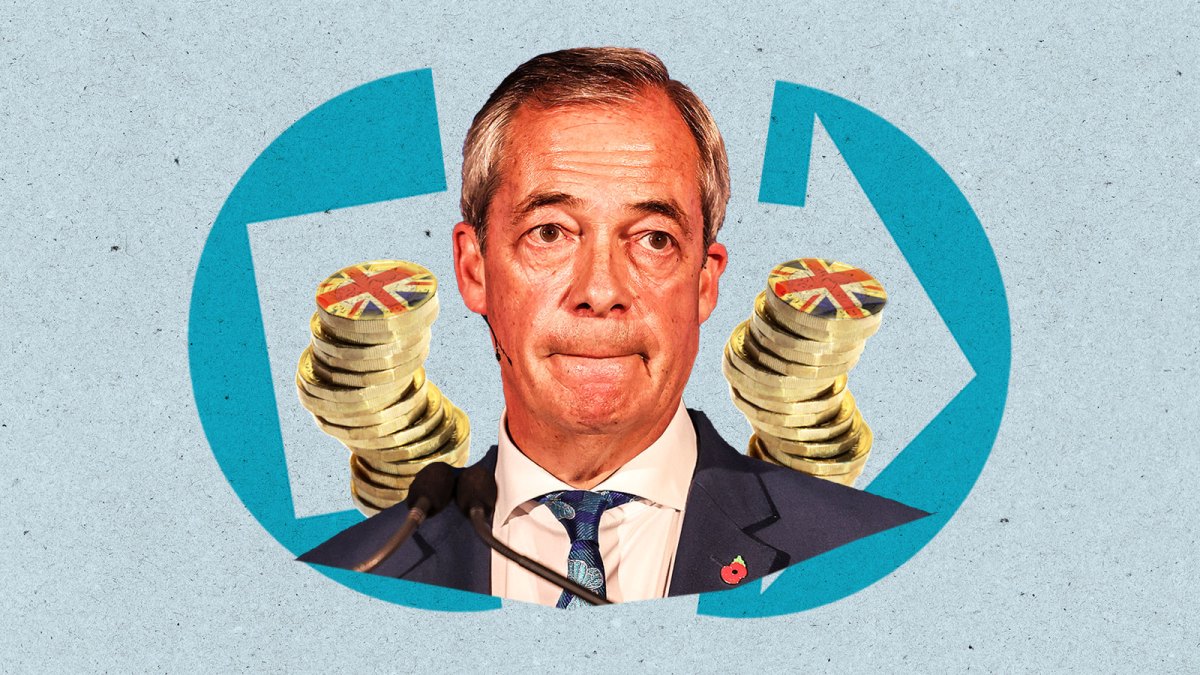
We were promised something notable from Nigel Farage on Monday morning and in two respects he delivered. Firstly, he spoke for more than half an hour about the economy. This, his aides told me a couple of weeks ago, is something he has never done before. Secondly, he did so with a carefully prepared script to hand — something he seldom ever does.
The mere existence of Monday’s speech by the Reform UK leader tells us something significant about how the party now sees itself. Over the past year, it has risen to the top of the opinion polls because a critical mass of voters agree with its terminal diagnosis of British immigration policy in particular and the failure of the old political establishment in general.
Farage knows, however, that consolidating that advantage — indeed, extending it — demands a broader prescription for the country than stopping the boats. His electoral success invites a new level of scrutiny and Reform insist they are rising to it. Observe his small inner circle up close and what strikes you is the self-conscious seriousness with which they are adjusting to their new status as a government-in-waiting. That, Farage said, was the point of his speech: “We are being mature, we are being sensible, and we are not overpromising.”
Watch Nigel Farage’s speech
Leading members of Reform UK, including Richard Tice, centre, and Lee Anderson, second from left
THE TIMES PHOTOGRAPHER RICHARD POHLE
As The Times revealed last month, he is grasping for the mantle his critics insist will never fit him — that of fiscal responsibility. The economic policy on which he fought last year’s election is now a dead letter. Accusations of cant and hypocrisy are Reform’s stock in trade, but Farage is making a virtue of breaking his own promise of £90 billion in unfunded tax cuts.
Why? The economic context has changed, he said, and not for the better, as have the politics. Farage has always known, instinctively, that there are limits to how far a politician of the mainstream might push the envelope of acceptable speech on immigration. He recognises, too, that the same laws of gravity apply to economics. Save for the reversal of new inheritance levies on farmers, Reform will not cut taxes before it reduces spending. As fiscal policy goes, it is orthodox stuff — a word that does not often features in analysis of Faragism.
This was a familiar kind of orthodoxy, too: “We want a smaller state.” Reducing civil service headcount and the welfare bill are two staple points of conventional right-wing thinking and both turn out to be foundational to Reform’s economics. Farage’s opponents on the left were delighted to hear these old Thatcherite notes. Tories, who suppose Kemi Badenoch’s renewed focus on the economy have their rival on the run, were pleased, too.
Are they right? Take lines like that in isolation and it’s possible to construct any political argument you like. Reform know they have a point to prove on Farage’s economic credibility and are trying hard to neutralise criticism before it is too late. Rachel Reeves is blaming Brexit for Britain’s economic stagnation and so its high priest now blames successive governments for failing to seize its opportunities for deregulation.
Reform is currently leading in the opinion polls
THE TIMES PHOTOGRAPHER RICHARD POHLE
This apparently defensive manoeuvre is really an exercise in sharpening Farage’s political definition. Pay close attention and the contours of Reform country look decidedly clearer. The most important word was work. The tradesman, sole trader, small shopkeeper, the everyday risk-takers of economic life — these are Farage’s people, much as they were the people whose anger helped one of his heroes, the French populist Pierre Poujade, shake the foundations of the Fifth Republic in the 1950s.
As it happens, they once helped the Conservative Party win elections, too. Their downward mobility is always a dangerous thing for mainstream parties and a boon for insurgents. Farage is speaking to the disgruntled petite-bourgeoise, and for them, especially on welfare. His policy on the two-child benefit cap, to be lifted only for married British couples in work, is the product of conversations between Reform’s policy team and Viktor Orban’s administration in Budapest.
He has picked his side and it is not the public sector, whose workers can likely expect cuts to their pension provision. That, of course, is not the same thing as the state. For that Farage proposes both shrinkage and strategy. He is taking his cues from a book he was gifted by Armen Sarkissian, the former president of Armenia: The Small States Club. It argues that the countries that have best navigated an uncertain world are those that have been nimble enough to adapt to technological change, invest in innovation and run a tight fiscal ship. So Reform proposes to spend less and smarter on critical industries, most notably nuclear power.
If you are a small businessman concerned about commercial energy costs, you probably like the sound of that. If you are a fifty-something Reform voter living on incapacity benefits in Skegness, or a Clacton retiree enjoying the security of the triple lock, maybe not. As Farage pitches to a new coalition of disaffected workers, his existing base might yet end up as credibility’s collateral damage.