
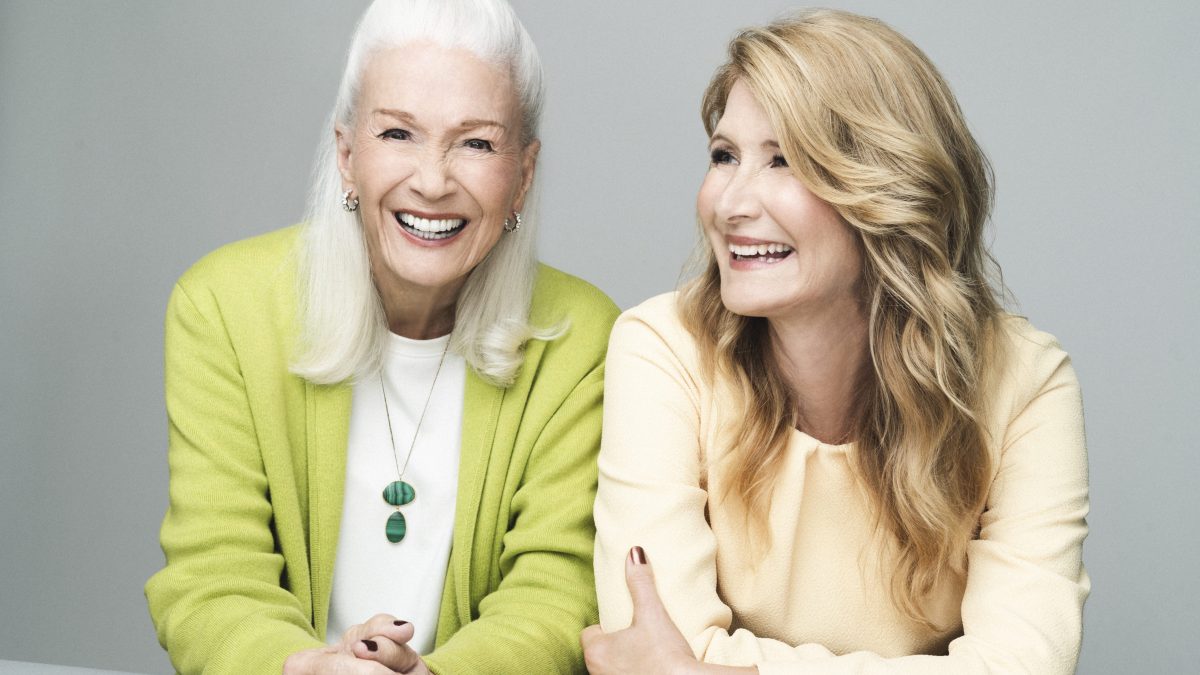
Four and a bit years ago, in 2018, when she was 83, the Bafta and Golden Globe-winning actress Diane Ladd was told by a doctor that severe scarring on her lungs meant she had six months to live, and possibly less: possibly just three. “And he told her first, behind my back,” Ladd tells me. “Her” is the Bafta, Golden Globe and Oscar-winning actress Laura Dern, Ladd’s 56-year-old daughter, who sits next to her on a sofa in Dern’s home in Los Angeles. “He asked me to walk with him,” Dern goes on. “He walked down the hall, but in her eyeline. He whispers to me [that Ladd is dying], and she sees me crying.”
“How dare he tell my daughter before me?” Ladd hisses. She is magnificent, a Mississippi-born Southern belle and a Hollywood veteran (six and a half decades and counting), equal parts charm and fire.
They were devastated, totally unprepared. Ladd hadn’t been what you might think of as “traditionally” ill, hadn’t been through bouts of cancer or any of the things that, though awful, give everyone time to adjust. Instead, she’d (she’s convinced) developed problems after inhaling pesticides sprayed over the industrial farms that adjoin her LA neighbourhood; sustained such terrible damage to her lungs she could barely breathe. “Idiopathic pulmonary fibrosis” they called it, following weeks of scans and misdiagnoses.
They’d been spraying for three years — toxins that had already, Ladd says, killed her dog, Ginger, whom Ladd had adopted from the set of Enlightened, the 2011 TV show in which she starred alongside Dern, one of the many times Ladd’s played fictional mother to her real-life daughter. (Dern’s character, Amy Jellicoe, hated Ginger. “Every time I had a scene with the dog I was saying things like, ‘Shut up, Ginger!’ and, ‘F*** you, Ginger!’ I screamed at her for two years and [Ladd] adopted her with this built-in knowledge she was going to hate me… Did that really seem like a good pet for you?” “She did get over that eventually,” reasons Ladd.)

With Laura’s father, Bruce Dern
COURTESY OF DIANE LADD,
At the last minute, the doctor gave Dern a scrap of hope and a course of action. If Dern could only get her mother to walk a bit and expand her lung capacity, it might help raise her oxygen levels, after which, who knows? It’d take 15 minutes of walking a day and no less, however, so Dern must devise a plan to get her mother, who by that point found it exhausting and painful to walk even a handful of steps, to comply.
Dern appealed to Ladd’s natural inclination to tell stories, and started interrogating her about her life to distract her from the physical effort of walking. Because Dern realised this might be a last chance to ask her mother all the questions that were left, she upped the ante, asking things she’d avoided or ignored or just hadn’t really thought about before. Ladd, for her part equally aware this might be a last opportunity, answered honestly. “Most parents, they lie to their kids because they want to be loved and adored, right?” she tells me now. “And then the kids lie to their parents because they want to be loved and adored. But because we thought I was dying, we opened our big mouths and told everything.”
When Dern’s walks miraculously paid off and Ladd did not die (“I did not! I did two movies, a TV series and I wrote a book”), they decided to transcribe the conversations, which Dern had taped onto her phone so she might share them with her children (Ellery, now 21, and Jaya, 18), and publish them. “When someone said to us, ‘I think you should share this,’ the only reason we said yes,” Dern says, “because we’re private people, was: it might do for anyone else what it did for us, which is, let us ask the questions now.”

Ladd and Dern with Wild at Heart director David Lynch, third left, and co-stars Nicolas Cage, Isabella Rossellini and Willem Dafoe
REX FEATURES
“Before it’s too late,” Ladd finishes.
Their book is called Honey, Baby, Mine, after an old folk song recorded by Woody Guthrie in the Forties as Crawdad Song, a favourite lullaby of baby Laura Dern, and it is wonderful. A little schmaltzy at times – how could it not be? Dern and Ladd thought they were losing each other – but also raw, gossipy, funny, delicate, endlessly compassionate, at moments devastating, at others spectacularly wise. It covers their childhoods, Ladd’s education at a finishing school (“You had to pick up a pencil with your lips and roll it with your tongue. Maybe that’s how I became a great kisser”), their (prolific, acclaimed) careers, their miserable divorces, Dern’s broken engagement, which wasn’t actually a broken engagement…
“DIANE: You’ve had some rough break-ups. The one when you were engaged to…
LAURA: Mom, I’m going to stop you right there, because I don’t want to hear his name and because I can’t believe you’re going to repeat this rumour. That’s someone that I never would have gotten engaged or married to and somehow you’re believing the tabloids. And every time I read an article about myself, people say I was engaged to that person. The same way people always say I had some supersexy affair with John Cusack, whom I’ve never even kissed.”
(I think the unnamed faux fiancé in question is Billy Bob Thornton, whom the press misreported as having broken an engagement to Dern to marry Angelina Jolie in 2000.)

Ladd and Dern in 1991’s Rambling Rose
REX FEATURES
It covers Dern’s father, the actor Bruce Dern, whom Ladd met on stage in front of an audience, divorced for various reasons – multiple infidelities among them — and whom, long after the break-up, she’d draft in to help explain sex to their 12-year-old daughter. Which he did, confidently and totally ineptly, leaving Dern and her best friend, Bellina, “superconfused about why a man would need to wear a raincoat during sex. And to make it all worse, in a Playboy interview he proudly told the story of how he helped his daughter and her friend stay safe by making sure they knew all they needed to know.”
It includes the only conversation Dern has had with her mother about her older sister, Diane Elizabeth, who died at 18 months in an accident before Dern was born, which leads Dern to say, “I guess I was the replacement child. I felt a responsibility to you and Dad and Grandma, to try to make sure you didn’t have to feel that pain again,” and Ladd to say, of Bruce Dern, “It always seemed to me that he didn’t relax with you until you were a day older than little Diane when she died.”
And, of course, Honey, Baby, Mine — with a foreword by Reese Witherspoon, Dern’s best friend — is punctuated with hilarious, casual, glittering reminiscences about the time Pedro Almodóvar kissed Ladd’s feet at the Golden Globes; the time she went to a New Year’s Eve party at Norman Mailer’s house with her best friend, Shelley Winters, Dern’s godmother (on finding the place deserted and “dusty”, Winters and Ladd proceeded to clean up what turned out to be an awful lot of cocaine); and the premiere of 1990’s Wild at Heart, in which Dern stars with her boyfriend at the time, Nicolas Cage, and Ladd, and which Ladd remembers primarily because, “You and Nicolas Cage were wearing matching outfits.”

With Dern’s children, Ellery and Jaya, 2017
GETTY IMAGES
It is a charming and revelatory book, more authentic really than anything else you’re likely to read, because… I suppose it was a pure accident, I say.
“An accident, like somebody hit me with a car, ha ha,” says Ladd. “By the way, you’re the first person that’s interviewing us that’s read the book. You’re numero uno! No 1!”
God, I love her, I realise. If I’d been Laura Dern, I’d have done whatever it took to keep Diane Ladd alive too.
DIANE LADD WAS BORN IN 1935 in Laurel, Mississippi, and raised in Meridian. She’s the only daughter of Mary Garey, a housewife, and Preston Ladner, a vet who sold poultry feed. Her family was not in, or interested in, showbusiness. “I was going to be a lawyer,” Ladd tells me. “I had a part-time scholarship to Louisiana State University, but that was only because I had a cousin who was the secretary of state at the time. But God had other plans for me. I wanted to be an actress. Since I was six years old, I knew I was supposed to be an actress. I mean, what kind of actress are you going to be if you’re down in Mississippi and your father’s selling medicine to chickens and livestock? What are the chances of becoming an actress? But the only thing was, I did have one cousin that was in the business — Tennessee Williams.”
Williams was a distant cousin of Ladd’s, one she didn’t actually meet until he was already famous, when she (aged just 17) implored him to come and see her perform in his play Orpheus Descending in a tiny theatre in New York, in the knowledge it would help raise the show’s profile and get it transferred to off-Broadway — which it did.

In the Eighties
GETTY IMAGES
“Of course, he had a hard time getting there. Believe me — from Mississippi. And in a way so did I, except my angels kind of picked me up and ushered me forward.” Angels, maybe — Ladd was raised Catholic and still believes; talent, graft, the sort of hustle that had her call on Tennessee Williams, certainly; also the director David Lynch, who cast her opposite Dern in Wild at Heart. (According to Honey, Baby, Mine, Lynch recently gave Dern’s son, Ellery, a DVD of the film, telling him, “Wait to watch this one until you’re 30.” Ellery replied, “Why? Is my mom crazy in it?” Lynch said, “It’s not you seeing your mom I’m worried about. It’s you seeing your grandmother that might be worth the wait.”)
Ladd has more than 120 film and TV credits to her name, and far more if you factor in her theatrical career. She was even offered a job on the TV show Chesapeake Shores moments before one of the earliest walks she and Dern took together. (“How am I going to work with a cannula in my nose?” she asks Dern in the book. Her daughter tells her they can write it into Ladd’s part.)
For Dern, raised in LA by Ladd and Bruce Dern (an actor with a career as wide-ranging and enduring as Ladd and Dern themselves), with Shelley Winters knocking about, “My experience is the polar opposite. It’s all I knew. What I wonder is, if I had not grown up in it, would I have found acting the way Mum did? I don’t know.”
“Ah, if it’s meant to be…” says Ladd, who can afford to be philosophical, given the trajectory of her daughter’s career. Aged six, Dern was an extra in 1973’s White Lightning (in which her mother starred); by 18, she was cast as a lead in David Lynch’s Blue Velvet. Her career hasn’t faltered for a moment in the intervening decades, Netflix’s Marriage Story and HBO’s Big Little Lies being just two of her recent, critically and commercially acclaimed wild successes.
According to Honey, Baby, Mine, Ladd hadn’t wanted her daughter to follow in her footsteps.
“LAURA: What are you talking about? Yes, you did. You were delighted when I booked jobs as a kid.
DIANE: No, Laura.
LAURA: What were you most worried about?
DIANE: My God in heaven, Laura! The rejection! The unsteadiness of it!”
Later in the book, Dern talks about the “dangerous people” populating their industry, how they’d both been around them.
I ask if they’d care to name some.

With Bruce Dern
REX FEATURES
“When you’re young, you walk through evil without knowing it and, if you’re lucky, your angels and your karma protect you from it,” says Ladd. “Even in New Orleans, when I was 16 and I was going to school there and I was doing little theatre plays — which I got spotted in, which is how I ended up being jerked out of New Orleans — long story. But then I danced in Las Vegas in a chorus. I was a Copa Girl!” Copa Girls were the showgirls who performed at the Copa Room in the Sands Hotel on the Las Vegas strip. “And when you’re a Copa Girl, you don’t mix and mingle with anybody. You’re protected. They just look at you. But in between the shows, they like you to come up and eat and be adored. And if anybody walks towards your table, they come out of the woodwork, like…” She growls. “ ‘Don’t talk to these women,’ and you’re protected there. But you’ve got a lot of really weird people around.”
“I think in every industry,” says Dern, “there’s the abuse of power of how you make it up the food chain. I think there are dangerous people we have all been in the company of.”
“And it’s not just men,” says Ladd. “One of the worst people I knew was a lady… When she got her position [of power] she was worse than any man I ever met.”
Even before I read their book, back when I was merely a consumer of their work, neither Ladd nor Dern struck me as especially interested in fame. Something about their conduct off screen, as well as their prickly, unpretty, tricky-woman role choices made me assume they were both slightly above anything as naff as pursuing or embracing fame.
“Didn’t think about it,” Ladd says. “If you need fame, it’s only to sell the movie or to get you the part. You have to go for it, but don’t let it take over.”
“Or be the goal,” says Dern.
“Both her father and I never thought of ourselves as movie stars,” says Ladd.
Was —– is — money important?
“Just worry about how much money you make if the guy sitting next to you in all the same scenes, working the same number of days, is making 15 times what you are,” says Dern.
“I was never paid as much as men,” says Ladd. “Marlon Brando asked me, ‘What do you do with all the money you make, Diane?’ I looked at him. ‘Do you know how much I made for Alice Doesn’t Live Here Anymore? [the 1974 film in which Ladd starred with Ellen Burstyn and Kris Kristofferson]. I made $5,000 for that whole movie. That’s right. That’s all I made. And I won a British Academy award for that, and they didn’t even give me a bonus. And I was raising a kid on that money. So don’t talk to me — you go to Washington for a meeting and they think you light cigars with hundred dollar bills! Now I make more than $5,000, but 50 years later, I would hope so.”
Then, quite out of nowhere:
“You know, I want everything good for you in the world. When’s your birthday? Month, day. I don’t care about the year.”
August 21, I say.
“That’s my son’s birthday,” says Dern.
No way, I say. Because it’s interesting, after reading the passage in your book where you row about Ladd giving Ellery — then six — a haircut without Dern’s permission, cutting his long hair short, I keep thinking about the time my maternal grandmother, Kathleen, looked after me, when I must have been about the same age, and gave me an unauthorised haircut, and…
“No!” Ladd interrupts.
No?
“No, no, no, no, no, no.”
“I’m still mad at her,” says Dern. “It opened a can of worms and it’s only got bigger since the book.”
We shouldn’t talk about it?
“Politics and my son’s haircut,” says Dern.
“They’re off the table,” says Ladd.
Given the fallout on the rehashing of one 15-year-old haircut, you might wonder what other ructions await the publication of the book, who else might be enraged and by what. Honey, Baby, Mine is by nature honest, raw and exposing — there would be no point in it otherwise. Long-buried family infidelities emerge, along with the pain Dern felt on having her mother leave her while she went away to work, the pain she felt on leaving her own kids, not to mention the slow, sad walk past the house in which Ladd and Bruce Dern lived — “Greta Garbo lived here before we did” — the place where their first daughter, Diane Elizabeth, had lived and died.
Are they nervous about the book’s reception, about who else might kick off?
“Honey, if I was nervous about how [anything] would be received, I’d never have been an actress,” says Ladd.
OK, but how about the feelings of people close to them? Bruce Dern, for example, who is (I would say) portrayed affectionately, if not entirely flatteringly?
“He hasn’t read it yet,” says Ladd.
“I’m going to drop you at his house today and you should give it to him and sit there [as he reads it],” says Dern. Then, to me, “But he knows, he knows. He knows everything.”

Dern and Ladd
VICTORIA STEVENS
What about Mary? Mary Garey was Ladd’s proper yet not-at-all mother, who cared for Dern when Ladd was away filming; a woman who, on attending the bridal shower of Ladd’s third marriage (to her current husband, Robert Hunter), presented her daughter — by then in her fifties — with a black sheer negligee, the hem of which was trimmed with faux fur and feathers. “I just love that fur along the bottom,” Ladd had said to her 80-year-old mother. “Yeah, it’s to keep your neck warm,” Mary replied. She died in 2002, but what do they think Mary would have made of their book?
“I think she’d be so proud,” says Dern. “And she’d wish we’d put more pictures of her in it. ‘How come I’m not on the cover?’ ”
I ask Dern and Ladd if there was a moment when they realised their walks had worked, and Ladd was going to keep living.
“Mmm. I feel like we continue with it,” says Dern cautiously. “That’s the one thing that’s heartbreaking. The minute a doctor says, ‘You may not make it six months…’ I feel like you’ve spent these four years going, ‘Well, I made it to here,’ but you can’t let go of that voice that’s in the head completely.”
“Oh, I’ll live another 20 years. I’ve got things to do,” says Ladd breezily.
On which, it occurs to me that this book would make an incredible film.
“There is beauty in that idea,” says Dern. “Something cinematic about a mother and a daughter.”
Exactly! In which case, who would play you?
“I think you should,” says Ladd.
I’m deeply flattered, I say, but completely without acting talent.
“Mum has already cast you.”
“I’ve already cast you. The key to being an actor — and I think Shelley Winters [said this] when I starred in a play with Bob De Niro. Forty-four years ago, Bob and I starred in an off-Broadway show together, and then we came back in a reunion in David O Russell’s film Joy. The most important thing to be an actor is to be able to listen. Not just with your ear, but with the ear of your heart. And you did that today while talking to us. I send you a lot of white light around you to protect you, and may you fulfil your destiny with joy and love for the highest good for yourself, OK?”
Please stop, I say. I may cry.
“And if you ever come this way, the bed is made, the food is on the table and the door is open for you. Do you hear me?”
I do hear Diane Ladd, and I may well take her up on it.
Honey, Baby, Mine: A Mother and Daughter Talk Life, Death, Love (and Banana Pudding) by Laura Dern and Diane Ladd is published on April 25 by Coronet at £22
Diane Ladd died on November 3, 2025