
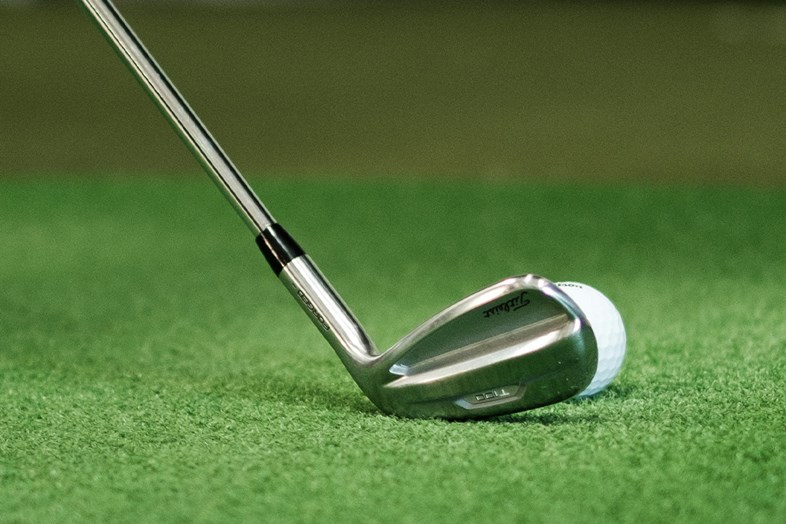
Iron distance isn’t the main reason to choose a golf ball – but if your approach shots are coming up short, your choice of ball could be part of the problem. Our 2025 Robot Golf Balls Test shows that some models can cost you up to eight yards of carry.
Few golfers pick a golf ball based purely on iron distance. Spin, flight, feel, and consistency all play a bigger role in most people’s decisions – not to mention performance with the driver and wedges. But let’s be honest: nobody likes seeing their approach shots come up way shorter than they should.
In our 2025 Robot Golf Balls Test, we saw some big gaps in 7-iron carry distance. While most premium tour balls clustered in the mid-150s for yardage, a few models stood out for all the wrong reasons – lagging a full club behind the leaders.
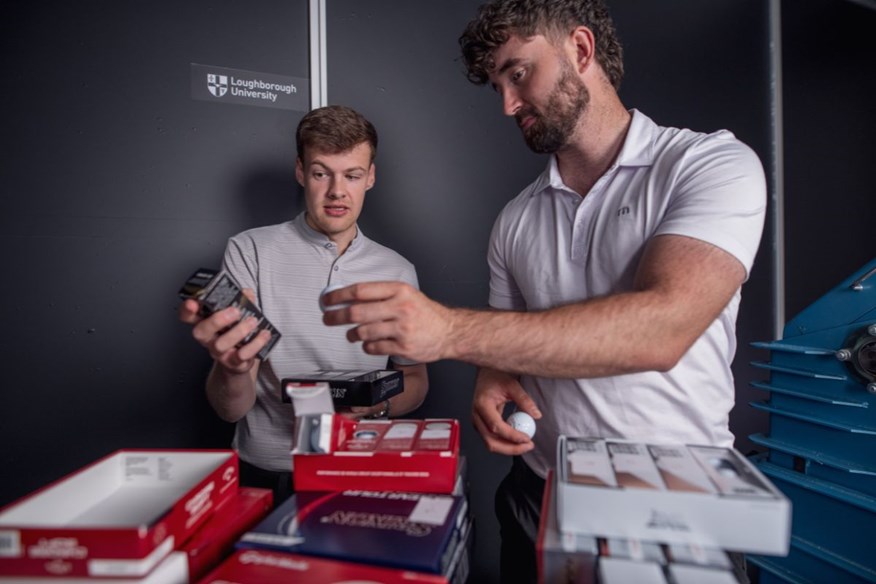 How we tested the golf balls
We put 62 golf balls through their paces with a $100,000 swing robot – the same technology manufacturers use when developing new clubs and equipment. A robot guarantees consistency that even elite players can’t match, so the only variable was the ball itself.
For the iron test, we set the robot’s swing speed to 80mph, mirroring the average for club golfers.
The longest (and the benchmark)
At the top of the chart sat the Titleist Velocity, the clear distance king with a 7-iron carry of 160.6 yards. It’s built to be fast, high-launching, and low-spinning – exactly the recipe for iron distance.
The Callaway Supersoft (159.7 yds) and TaylorMade SpeedSoft (159.3 yds) weren’t far behind, proving that low-compression, budget-friendly balls can still move.
BallBall Speed (mph)Launch (°)Spin (rpm)Descent (°)Carry (yds)Titleist Velocity108.721.93,80144.0160.6Callaway Supersoft108.422.13,88144.4159.7TaylorMade SpeedSoft108.322.03,89344.3159.3Maxfli TriFli108.521.63,98244.1159.2Seed SD-02109.521.34,39745.0158.7
With that as the benchmark, let’s look at the models that gave up serious yards.
The shortest golf balls with an iron
These are the balls that gave up the most distance on a 7-iron shot.
BallBall Speed (mph)Launch (°)Spin (rpm)Descent (°)Carry (yds)Yards Behind Titleist VelocityCallaway Chrome Tour X108.720.35,24245.3152.5–8.1Srixon Z-Star Diamond108.720.55,14945.3153.1–7.5Bridgestone Tour B XS109.020.35,17045.2153.5–7.1Srixon Z-Star108.720.84,93745.3154.1–6.5PXG Tour X108.720.94,82045.2154.7–5.9Mizuno RB 566109.120.74,94745.3154.8–5.8Srixon Z-Star XV108.720.74,93045.2154.2–6.4Titleist Tour Soft108.321.14,77445.2154.2–6.4Kirkland Signature V3.0108.620.74,86145.0154.3–6.3
That’s up to eight yards of carry lost compared to the longest-flying balls – almost a full club for many golfers.
Why they’re shorter
If you look at the ball speed, you’ll see it’s very consistent across all of the balls tested.
The key factor here is spin.
All five of the longest balls with an iron are lower-spinning models (well below 4,500rpm). That helps them squeeze out every last yard of carry – but it also means slightly shallower descent angles, so they’ll release more on landing.
The Chrome Tour X, Z-Star Diamond, and Tour B XS all spun well north of 5,000rpm with the 7-iron – excellent for control, but costly for raw distance. Higher spin equals more lift and drag, which reduces carry.
It’s a trade-off that’s actually intentional. These are tour-level balls, tuned for players who prioritize precision and spin control into the greens rather than maxing out mid-iron numbers.
If you’re a fast-swinging player who wants maximum stopping power on approach shots, these models could perform brilliantly. But if your main gripe is seeing your 7-iron come up short, you could opt for something that gives you extra yardage – just be aware that you’ll also get a little more rollout on landing.
Titleist’s best 2-piece golf ball for off-the-tee performance
Best two-piece Titleist golf ball for distance
It probably won’t come as a surprise to many that the Velocity is Titleist’s best-performing two-piece golf ball off the tee. The Velocity is a distance golf ball, but is that all this golf ball has to offer?
Across all three swing speeds, the Velocity is the fourth-best two-piece golf ball for overall performance off the tee. We fully expected the Velocity to perform well off the tee because it’s a distance golf ball, but if we’re being honest, we didn’t expect it to outperform the four-piece Pro V1x.
The velocity delivered its best performance at 114mph. At the quickest swing speed we tested, the Velocity produced 271.5 carry yards and 163.2mph ball speed.
In approach play, the Velocity is the lowest-spinning golf ball (3,081rpm) and longest (160.6yds) out of all 62 models we tested. That’s potentially expected given it’s a distance golf ball.
However, the Velocity’s short game performance is much better than we expected. This golf ball is the fifth-highest-spinning two-piece model, with 5,789rpm.
The Titleist Velocity delivers competitive distance and overall performance for all golfers. You’re guaranteed distance, but you’re also getting a golf ball that can perform around the greens.
On-course verdict
I’m quite the fan of Velocity. In the right hands, this can be a very strong performing golf ball. However, in the wrong hands, it can majorly hinder your game.
For my game, off the tee, Velocity performs very closely to the Pro V1x, but as I approach the green, distance begins to outweigh spin, which isn’t something I require.
If you’re a golfer who’s looking to reduce spin and gain distance, Velocity has to be on your radar, especially at its price.
This is a two-piece golf ball, but I honestly think it’s hard to tell. If I weren’t able to distinguish this golf ball in Titleist’s line-up by its orange numbers, I think you could trick me into thinking it’s the Pro V1x based on its long game performance. Take it to the short-game area, and it’s very easy to see this is a distance golf ball.
Pros & Cons Specs Features
Pros Very competitive distanceGreat valueGood feel and feedback Cons Low short-game spin and control Carry distance (yds) Driver 114mph – 271.5 | Driver 93mph – 208.9 | Driver 78mph – 160.6 | 7-iron – 160.6 Ball speed (mph) Driver 114mph – 163.2 | Driver 93mph – 133.5 | Driver 78mph – 112.9 | 7-iron – 108.7 Backspin (rpm) Driver 114mph – 2,677 | Driver 93mph – 2,467 | Driver 78mph – 2,261 | 7-iron – 3,801 | Pitch – 5,789 Launch angle (°) Driver 114mph – 11.1 | Driver 93mph – 13.2 | Driver 78mph – 14.2 | 7-iron – 21.9 | Pitch – 31.2 Descent angle (°) Driver 114mph – 36.9 | Driver 93mph – 31.5 | Driver 78mph – 26.8 | 7-iron – 44 | Pitch – 36.7 Peak height (yds) Driver 114mph – 31.8 | Driver 93mph – 22.2 | Driver 78mph – 15.3 | 7-iron – 29.6 | Pitch – 7.1 Compression (psi) 101 High-speed LSX coreFast NAZ+ coverSpherically-tiled octahedral dimple pattern350 dimples2-Piece constructionAvailable in white, green, and orange