
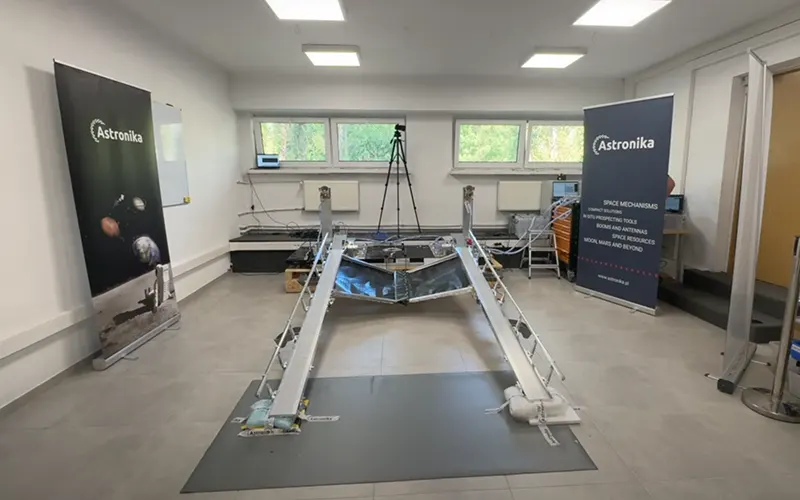
 Credit: ESA / Astronika
A pair of ramps that will allow the European Space Agency’s (ESA) Rosalind Franklin rover to roll from its landing platform onto the surface of Mars has passed a key testing milestone.
In early 2024, ESA awarded Thales Alenia Space a €522 million contract to replace key components of its ExoMars mission that were lost after the agency severed ties with its former project partner, Roscosmos. The mission will deliver the Rosalind Franklin rover to the Martian surface to hunt for signs of past life. In March 2025, ESA and Thales Alenia Space awarded Airbus a £150 million contract to develop and build the landing platform for ESA’s ExoMars mission. A key element of the landing platform is the egress system that will bridge the gap between the platform and the surface below.
The system features two sets of deployable three-metre-long ramps that will provide the rover with two paths down to the surface of Mars. Each ramp is made of lightweight aluminium with a honeycomb pattern designed to improve traction as the rover’s six wheels traverse it. The ramps are equipped with guiderails, hold-down and release mechanisms, passive spring-driven hinges for deployment, and sensors that confirm their position. When activated, the system deploys the ramps at an angle of approximately 20 degrees below the lander’s platform.
While Airbus was only awarded the contract to develop the landing platform in March, Polish space-mechanics specialist Astronika appears to have begun work on the egress system at least a year earlier. In a June 2024 update, the company stated that “Polish engineers, among others, will save the European Space Agency’s historic mission to Mars,” and outlined its role in the project, which includes developing the ramps. Its involvement was formally confirmed in April 2025, a month after Airbus was named as the landing platform’s prime contractor.
On 31 October, ESA revealed that a confidence test conducted at Astronika’s facility in Warsaw successfully demonstrated the deployment of both ramps, a process that will take approximately five minutes on the surface of the Red Planet. A confidence test is a full-scale verification exercise that confirms the hardware functions as intended under realistic operational conditions.
The egress system’s design will continue through further testing phases, including environmental and qualification campaigns, ahead of final integration with the landing platform.
Keep European Spaceflight Independent
Your donation will help European Spaceflight to continue digging into the stories others miss. Every euro keeps our reporting alive.