
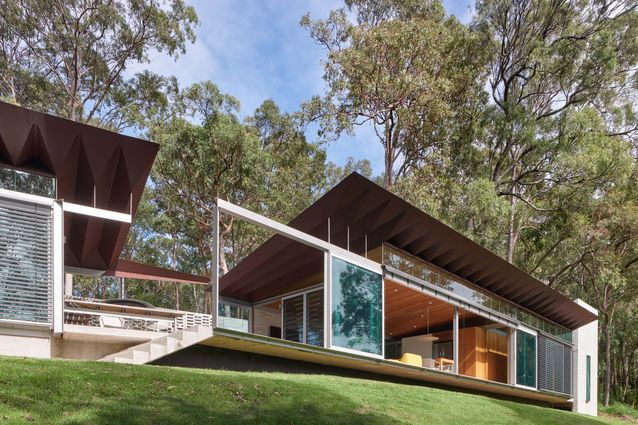
The connection between building and landscape has long been a preoccupation of architects in Australia. More than any other architect, Glenn Murcutt has brought international attention to the subtlety and richness of an architecture attuned to its place over more than five decades of sustained practice. Glenn, Australia’s only Pritzker Prize-winning architect, is celebrated for the way in which his designs are integrated with their natural and cultural landscapes, bound through siting, material and form. It is in this context that Gold Creek – a modest house of 100 square metres in the semi-rural western fringes of Brisbane – must be considered. Designed by Brian Steendyk of Steendijk and Glenn Murcutt in collaboration, the house demonstrates how the attraction of landscape remains a productive muse for contemporary designers.
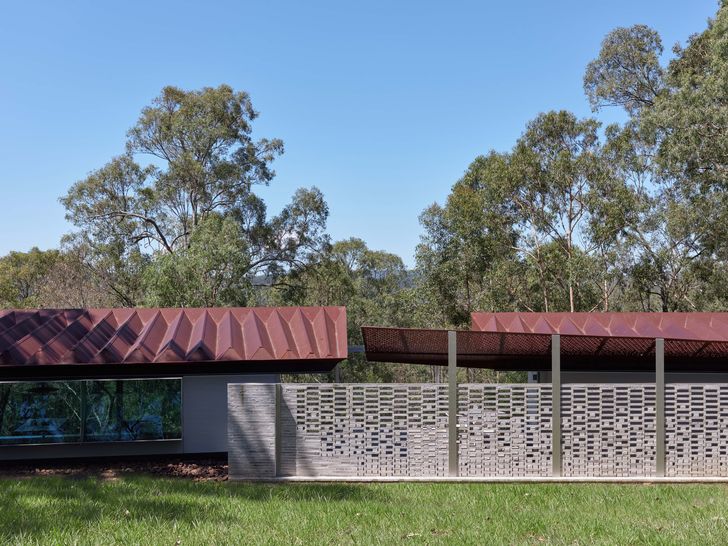
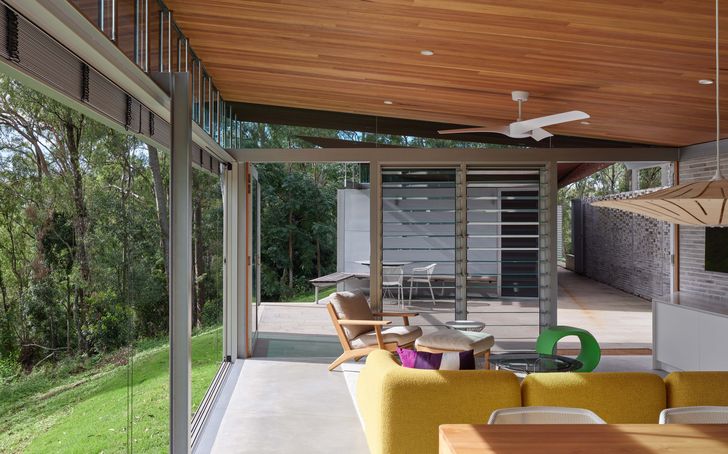
Tucked below the ridgeline, the twin-pavilion house is first glimpsed from above, through trees. Its folded zig-zag roofs of rust-red Corten stretching along the contour make a dramatic first impression. Arriving at the house, entry is from the south-east along a filigree screen of concrete bricks that immediately discloses Steendijk’s hand in the building’s fine detailing. This screen leads visitors past the first building, which contains guest bedrooms, toward a sun-filled courtyard adjoining the main pavilion. Here, a view of the treed catchment of Gold Creek is revealed in full, framed between the two buildings. On the left, the larger of the two pavilions containing the open kitchen/living/dining spills informally onto the terrace. A long view cuts through to the main bedroom and terminates at a mediation room: an intimate concrete tower lined in timber that makes a conclusive end to the sequence of rooms on the north-west.
View gallery
Throughout the project, nature asserts its presence: in the zenithal skylight above the mediation room; in the dappled shadows cast by the perforated steel awning; with the gentle breezes encouraged through every part of the building via screened openings that protect against bushfires, bugs and other unwanted visitors. The landscape is expressed in the materials of the building, too: the use of stones found on site for landscaping and drainage, and in the colours of the Corten and concrete that evoke the surrounding gums, their silvery trunks set against the flashes of new red growth in their leaves.
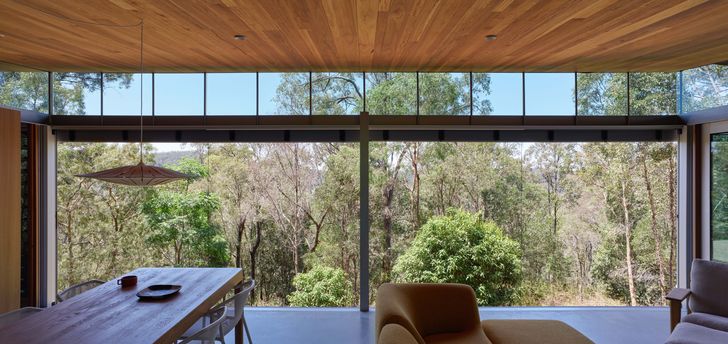
Still, the most affective coordination of architecture and landscape is best appreciated on coming to rest inside the main pavilion. With its doors slid open and disappeared from view, the building is revealed as a simple platform that seems to float within the landscape. To achieve this effect, Brian and Glenn have pushed the building forward to the steepest part of the site, gently manipulating the ground to partially bury the pavilion for thermal comfort, while cantilevering its leading edge out to erase the foreground from view. The result is a pure experience of landscape, of being suspended in the trees, standing on a platform.
View gallery
In his famous 1962 essay, “Platforms and Plateaus: Ideas of A Danish Architect,” Jørn Utzon details his fascination with ancient platform structures in the jungles of Mexico, citing them as inspiration for the podium of the Sydney Opera House – arguably the most striking combination of architecture and site in this country. The architectural power of platforms that Utzon describes resonates with some of Glenn’s best works: both the Marie Short House / Glenn Murcutt House (1974–75 / 1980) and Fredericks White House (1981–82 / 2001–04) are essentially roofed platforms that hover with lightness in the landscape, while the Done House (1988–91) embeds itself unapologetically into the site with a series of terraces overlooking Sydney Harbour. Likewise, Steendijk’s Bellbird Retreat (2018) exhibits a fanning steel roof floating over a raised platform. Such ideas may appear simple, effortless, even obvious. In fact, for both architects, they evidence carefully composed insertions into the site, with deliberate and controlled effects. Gold Creek builds on such legacies, offering a platform for collective gathering or reflective solitude that is always in connection with landscape.
View gallery