

It was Douglas Jardine who said in Bodyline Autopsy, “Cricket is a game of skill, but it is also a game of war. You must find a way to win, or you are lost.”
As the shadows shorten over the Australian spring, the 2025-26 Ashes series looms in Perth on November 21, a mere two weeks away. For England, under the audacious stewardship of Brendon McCullum and Ben Stokes, the mantra is clear: speed thrills. Their squad, boasting a cartel of express pacemen led by the enigmatic Jofra Archer and the thunderous Mark Wood, carries a deliberate echo of history.
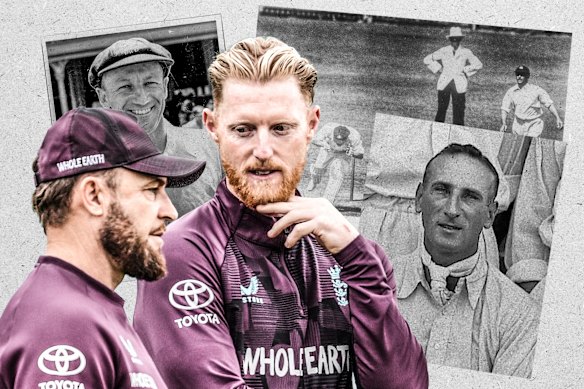
The England squad led by Brendon McCullum and Ben Stokes has echoes of Ashes series past.Credit: Michael Howard, Getty, Fairfax Archive
Yet, to understand this bold gambit, we must rewind to the summer of 1932-33, when Jardine faced a Hobson’s Choice – take the only option on offer or face certain defeat. Bodyline, that infamous tactic, was not born of malice but necessity, a desperate counter to Don Bradman’s otherworldly batting. It reminds us that cricket, for all its genteel veneer, can ignite passions that spill beyond civil norms, turning gentlemen into gladiators and crowds into cauldrons of fury.
Jardine’s predicament was the stuff of captaincy nightmares. Bradman, the boy from Bowral, had just dismantled England in their own backyard during the 1930 Ashes, amassing 974 runs at an average of 139.14 – a record that still beggars belief. His 334 at Headingley was an opus of dominance, reducing England’s attack to rubble.
Jardine, a steely, Oxford-educated amateur with a disdain for defeat, knew that accepting Bradman’s supremacy was tantamount to surrender. As England’s captain, his remit was unequivocal: find a way, within the laws, to curb this prolific scoring machine. But what options did he have? Conventional bowling had proven futile; spin was neutralised on Australia’s true pitches, and seamers like Bill Voce offered control, but not terror.
Herein lies the essence of Jardine’s Hobson’s Choice – the illusion of alternatives masking a singular path. He turned to “fast leg theory”, a tactic not invented by him, but refined to lethal precision. Precedents abounded in the 1920s: Australian pacemen Jack Gregory and Ted McDonald had employed similar short-pitched barrages with packed leg-side fields during the 1920-21 Ashes, unsettling English batsmen on lively surfaces.
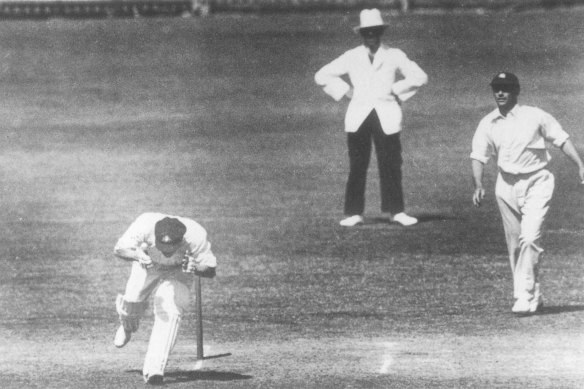
Australian cricketer Bert Oldfield is struck in the head by Harold Larwood during the Bodyline series of 1933.
Jardine, ever the tactician, drew from this example, consulting Nottinghamshire’s Arthur Carr and Percy Fender, who had trialled it domestically. His search for an attack was methodical: observing Bradman’s flinch against Harold Larwood’s bouncer at The Oval in 1930, Jardine exclaimed, “I’ve got it! He’s vulnerable!” Secret sessions in London honed the plan – short balls at the body, a ring of leg-side fielders to snare deflections. It was legal, innovative, and, crucially, the only sensible option against a batsman averaging over 100 in Tests.
Critics vilified Jardine as unsportsmanlike, but he surmised that Bradman had to be stopped at any cost. Bodyline reduced Bradman’s average to 56.57 – still formidable, but mortal. The series’ flashpoints, like the Adelaide riot after Bert Oldfield’s skull fracture, evoked raw emotions: Australian crowds baying for blood, diplomatic cables flying between boards, threats of trade boycotts amid the Great Depression. Sport, in such moments, transcends civility, tapping into tribal loyalties that can fracture empires. Jardine the scapegoat, retired from Tests thereafter, but his tactic delivered a 4-1 victory. Without it, England would have been lambs to Bradman’s slaughter.