
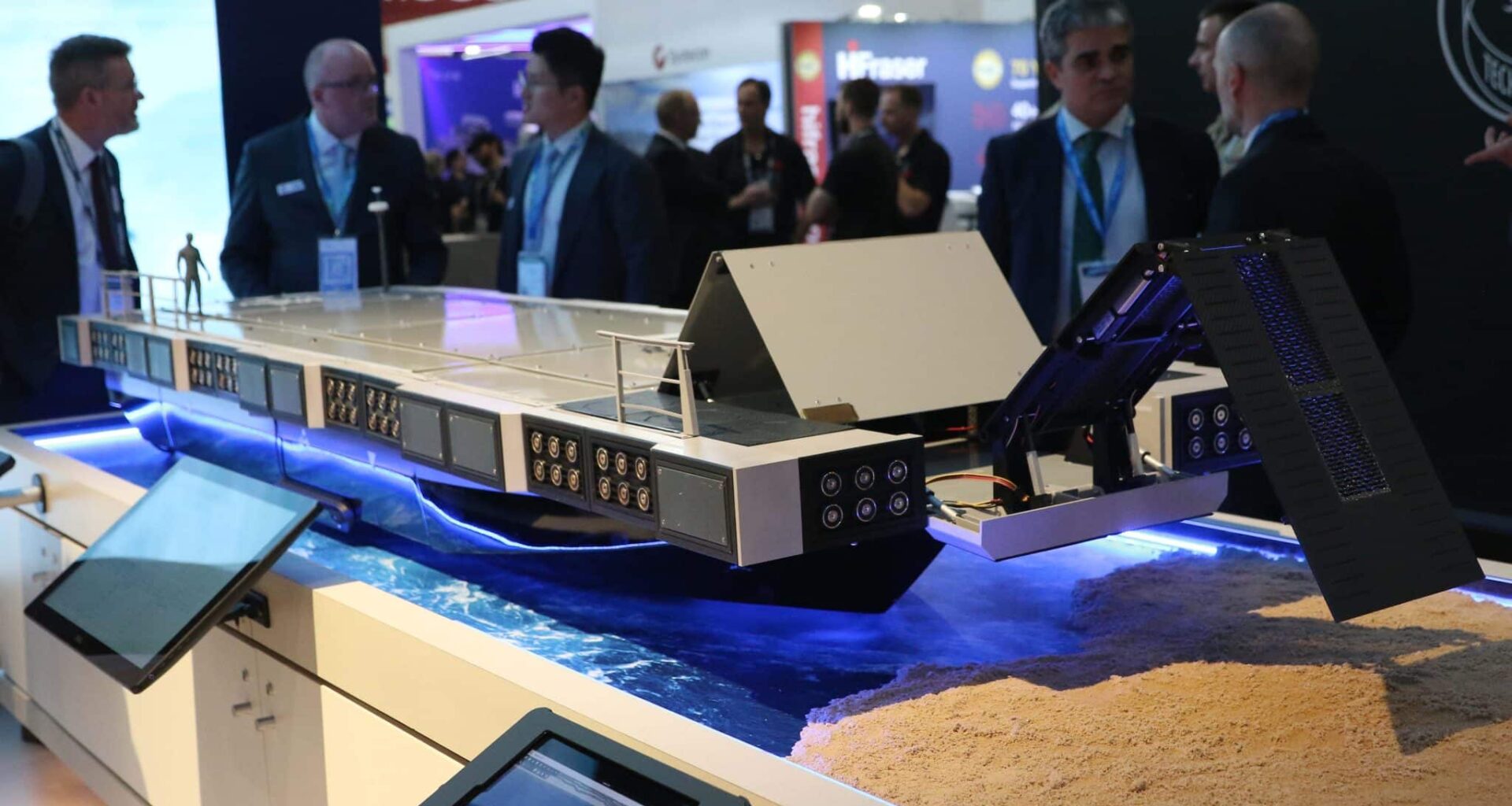
Navantia Australia exhibited an innovative new landing craft concept at the Indo-Pacific 2025 naval exhibition held in Sydney from 4-6 November. Called the Uncrewed Landing Craft – or ULC for short – a patent for the design is currently pending.
As indicated by its name, a key characteristic of this next-generation landing craft concept is that it requires no crew aboard the platform. It is also modular, so multiple ULCs can combine together in various configurations.
The ULC is versatile, able to create a jetty, floating bridge, landing platform or just simply act as a regular landing craft. Furthermore, it is able to operate in open water, riverine or littoral environments, where it can perform ship-to-shore, ship-to-ship, or shore-to-shore movements.
Somewhat resembling a Mexeflote, the ULC measures 30m long by 6m wide, so it is about the same size as Navantia’s LCM-1E landing craft already operated by the RAN. These measurements ensure they can fit in the well deck of a Canberra-class landing helicopter dock (LHD) of the Royal Australian Navy (RAN). In fact, an LHD can hold up to four ULCs.
Dr. Nirman Jayarathne, Lead Engineer – Innovation Group at Navantia Australia, explained to Naval News that each landing craft module is propelled by two 1,600kW electric water jets at the stern, as well as a 450kW retractable bow thruster, to ensure top manoeuvrability. Hydrogen fuel cells are listed as a possible future upgrade option too.
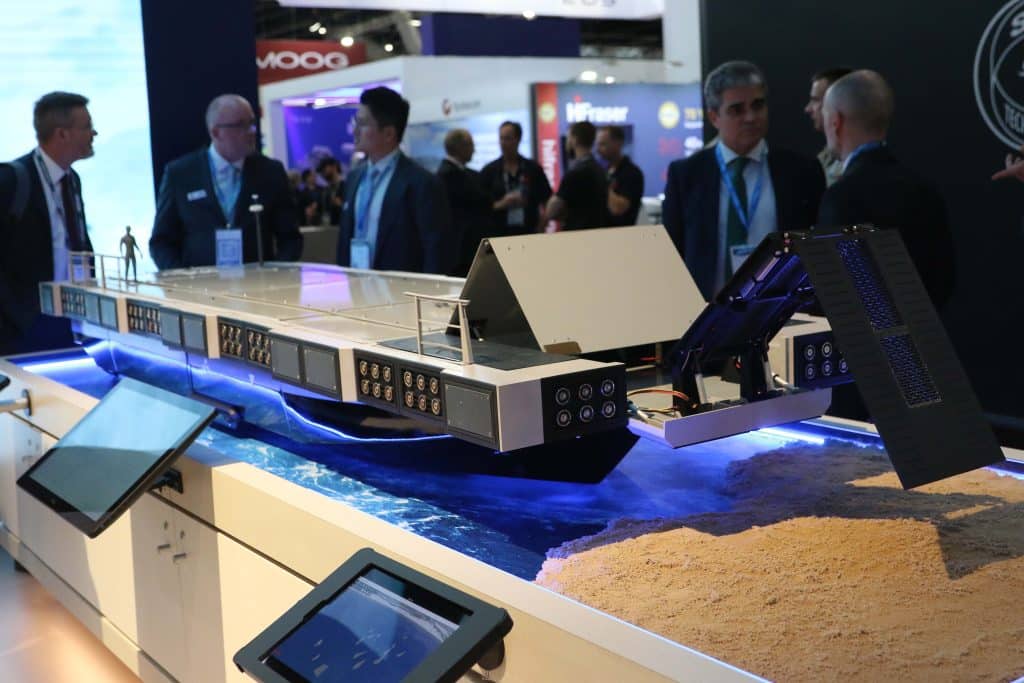
Navantia Australia has already been demonstrating the viability of the Uncrewed Landing Craft with 1/10 scale demonstrators. (Credit: Gordon Arthur)
Flat bottomed, but with a pointed bow, these steel landing craft can sail in Sea State 5, although coupling and uncoupling with other ULC modules is limited to Sea State 2 and below, Jayarathne explained.
The coupling procedure is rather novel, with Navantia Australia proposing a suction mooring system to hold modules together either lengthwise or side by side. It features a trifold bow ramp for vehicle access. With a full load of 90 tonnes, its top speed is 20kt, but this can reach a maximum of 30kt with lighter cargoes.
The system has been designed in conjunction with the University of Technology Sydney, Danish company SH Defence. A couple of 1/10 scale models exist, and these have completed more than 300 hours of testing to date.
The control system is Navantia’s Omatha, and an operator is connected to the ULC via SATCOM, essentially giving control at unlimited ranges. The ULC has a 300nm range, but this could be increased by carrying a portable fuel tank, although that would naturally mean the overall payload capacity for other cargoes is lowered.
Six organic drones are carried on the concept design, and these can perform reconnaissance missions, for instance.
Navantia lists potential uses for the ULC, including distributed logistics, amphibious ingress, automated resupply, swarm intelligence, rapid response to disasters, floating command or helicopter platform, and even precision strike if a missile module is added.
Navantia Australia signed a letter of intent with DNV to collaborate on development and advancement of the ULC concept. DNV’s expertise in autonomous vessel classification will ensure the ULC achieves high standards of safety and operational effectiveness as it is proffered to the Australian Defence Force in the future.
Also present on Navantia’s stand at Indo-Pacific 2025 was the Kodal landing craft. This 39m design with a 334-tonne displacement had competed in the Australian Army’s Landing Craft Medium competition. That Land 8710 Phase 1 project was eventually won by Birdon.
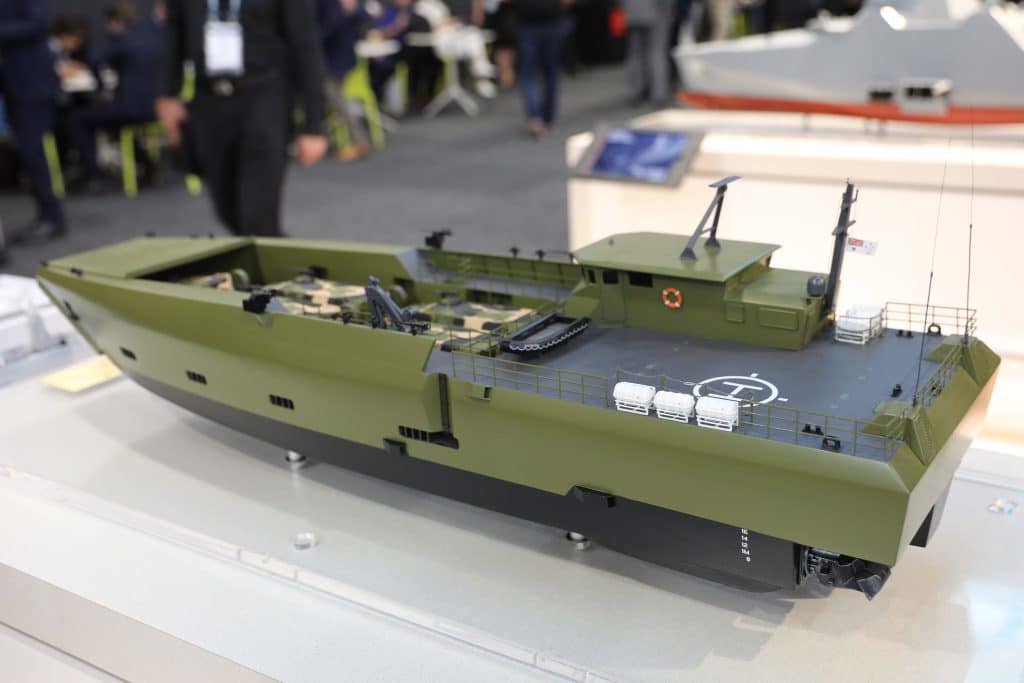
This is a model of the Kodal landing craft that competed in the Australian Army’s Project Land 8113 Phase 1. (Credit: Gordon Arthur)
However, another Kodal family member being promoted by Navantia Australia was the Kodal 500. It measures 51m long and displaces some 405 tonnes. Able to carry an 85-tonne payload on its 197m² deck, this landing craft can be turned into an optionally manned or even a fully autonomous vessel.
Like the standard Kodal, it has a stern flight deck for drones. Its maximum range fully loaded is 1,070nm, and the Kodal 500 comes with the option of an aluminium or steel hull.