
The Australian government released its first-ever National Climate Risk Assessment. You could be forgiven for paying little attention to this “first”, as there was a flurry of climate announcements and news around its release, including the ongoing saga of whether the federal Coalition will walk away from its net zero commitments.
The 284-page document is confronting to say the least, even for those of us in the climate change community who live and breathe this stuff. To have it all pulled together by the Bureau of Meteorology, the CSIRO and the Australian Bureau of Statistics feels a bit like an official imprimatur for widespread panic.
Yet in the long, long list of impacts and risks in the report, anything to do with the mental health implications of climate change is hard to find. The report calls out the unique impacts of climate change on the social health and wellbeing of Aboriginal and Torres Strait Islander peoples, as well as the mental stress on responders and communities. Beyond this, however, it does not deal with the effects on mental health and collective wellbeing of the frequent, severe and escalating impacts of climate change.
We are rapidly moving towards a scenario where instead of a single event involving recovery, we now have “domino crises”, with recurrent and even overlapping climate events making it hard to recover because of the lack of breathing space between disasters. For example, more than 60 per cent of the communities that bore the brunt of the floods in 2022 were also still recovering from the extreme fires of 2019-20.
In response to the risk assessment report, the non-profit organisation Psychology for a Safe Climate released a statement joining the dots between the findings and what they are already seeing in their work. It was not just increased mental health problems associated with climate-driven extreme weather but also general levels of climate distress, especially among younger people.
Addressing this requires more than improved mental health services and more “climate-conscious” training for mental health professionals, the organisation argues. It requires community resilience and what they describe as “collective meaning-making” – groups of people coming together to discuss and understand their feelings about the climate crisis.
Findings revealed a deeply felt experience of anxiety, distress and exhaustion across the country – not confined to those directly affected by fires, floods or drought but extending to those who witness the effects of these catastrophes on loved ones, communities and the nation as a whole.
The organisation’s chief executive, Bronwyn Gresham, a clinical psychologist with a background in the community mental health sector, treats people with climate distress in her clinical practice. Like many of her colleagues in the organisation, she is seeing different kinds of climate-driven mental health impacts across the community.
“What we’re hearing from other climate-aware practitioners is that people are coming to therapy for support around the distress or the trauma related to living, for example, in a really fire-prone area,” she says. “They’re trying to grapple with preparedness. But the most common form of distress is just the overwhelm and the dread of what we are facing. It’s very isolating trying to function within a system that isn’t responding as it should to the extent of the threat. There is this profound sense of loneliness.”
Gresham sees the distress and anguish that can occur because “social reality hasn’t matched climate reality”. This can mean not being able to talk to friends, family and colleagues about your true feelings about climate or the angst when you see those with the greatest power and responsibility to address the climate crisis engaged in various forms of delay or denial.
In addition, Gresham encounters people whose mental health is being affected by climate change but who wouldn’t necessarily recognise it as such. “There are a lot of people who are just trying to put dinner on their plate, get through the day, but they don’t necessarily realise climate change is impacting their cost of living.”
A sceptic might think Gresham’s view is a narrow one, given her job as chief executive of an organisation of mental health professionals focused on the climate crisis. I might have agreed with them before I conducted research in 2023 for the crisis support and suicide prevention service Lifeline, exploring how Australians experience and understand the mental health impacts of extreme weather driven by climate change. The survey was of 1010 Australians, as well as an extra 506 people living in higher-risk areas for extreme weather across four states.
The findings revealed a deeply felt experience of anxiety, distress and exhaustion across the country – not confined to those directly affected by fires, floods or drought but extending to those who witness the effects of these catastrophes on loved ones, communities and the nation as a whole.
This research found almost all Australians express concern about extreme weather events, with nine in 10 worried that these events are becoming more frequent and severe. These fears are not abstract: only two in 10 Australians say their community has been untouched by extreme weather in the past five years. Many respondents describe firsthand experiences of floods, bushfires and heatwaves. One woman from flood-affected Richmond in New South Wales said, “If I talk about the flooding event we had up here in 2022, I start to relive it and begin crying.” Such testimonies show that extreme weather leaves not only physical damage but lasting psychological wounds.
Six in 10 Australians report feeling stressed or anxious when thinking about extreme weather. For more than four in 10, this stress tangibly disrupts their daily life – affecting sleep, concentration, relationships and enjoyment of nature. The toll is heaviest among women, young people, parents of children under 18, and those who have lived through previous disasters. A young man from Queensland explained, “During floods it can be easy to spiral when you’re cut off from loved ones, family, and basic foods and necessities.”
The mental health effects ripple through social networks. Nearly half of all Australians – and 60 per cent in high-risk areas – say their own or others’ mental health has been impacted by extreme weather. For many, distress arises from empathy as much as personal loss. According to one: “I personally don’t have any mental health issues, but it does affect me when I see my country and fellow Aussies get affected. This is everyone’s problem and concern.”
Younger Australians are particularly vulnerable. Half of those aged 18-24 know someone whose suicidal thoughts were influenced by experiences of or anxiety about extreme weather – a figure five times higher than the national average. This connection between climate distress and suicidality underscores the urgency of community support.
Only one-third of Australians believe their communities are well equipped to deal with the mental health impacts of extreme weather. That weak confidence drops sharply among those who have seen these effects firsthand. Most people rely on loved ones for support; very few would turn to local councils or government services.
Across all demographics, Australians call for a stronger, coordinated government response. Eight in 10 believe governments should do more to support communities’ mental health in the face of extreme weather. Seven in 10 reject the notion that communities should “fill the gaps” left by government inaction.
The Lifeline research will be repeated and released publicly before the end of the year. It illustrates how the mental impacts of climate – everything from the low-level hum of anxious concern about extreme weather to persistent PTSD and suicidality – are shaping the everyday lives of so many of us.
Gresham is encountering this as well in Psychology for a Safe Climate’s climate cafes – small, in-person gatherings where they bring people together to explore, share and process climate-related feelings. “We are finding climate change is shaping very personal decisions,” she says. “Mostly around having children, where to travel, where to work, who to work for.”
So much was required to be jammed into the National Climate Risk Assessment, it’s not a surprise mental health rated only a handful of references. Still, it was a significant omission.
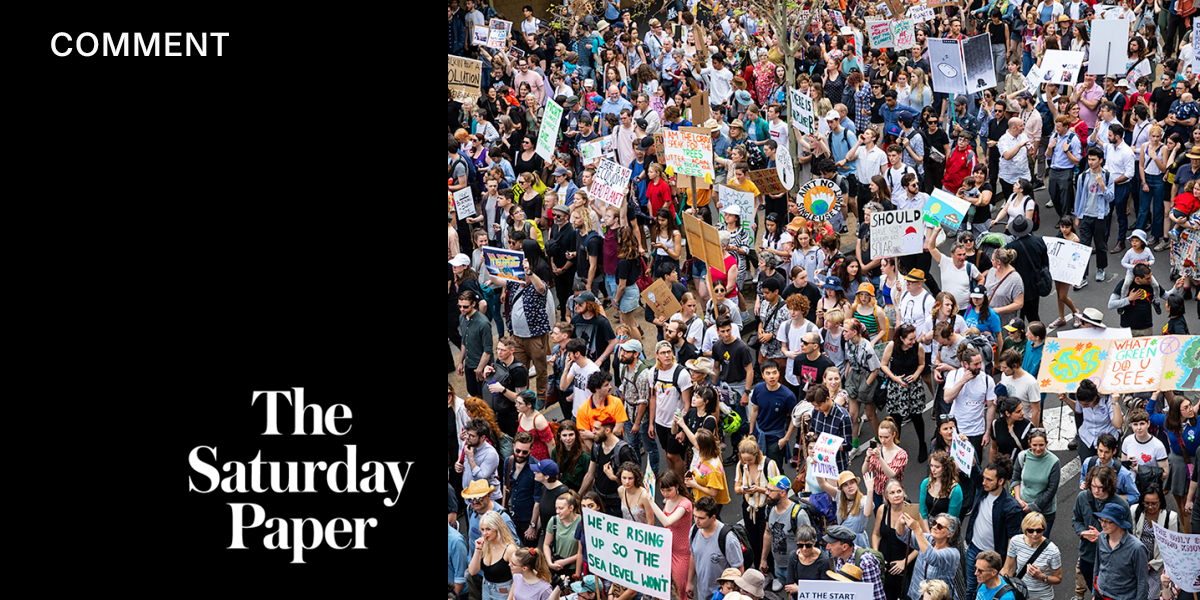
Whether you are living in a disaster-prone area, or are a first responder, or a mental health professional, or a climate striker, or someone who just worries about their kids playing sport in the summer, it’s clear that our mental health crisis and the climate crisis are intersecting, creating a perfect storm for our hearts and minds.
Lifeline 13 11 14
This article was first published in the print edition of The Saturday Paper on
November 8, 2025 as “The lonely fear of this climate catastrophe”.
For almost a decade, The Saturday Paper has published Australia’s leading writers and thinkers.
We have pursued stories that are ignored elsewhere, covering them with sensitivity and depth.
We have done this on refugee policy, on government integrity, on robo-debt, on aged care,
on climate change, on the pandemic.
All our journalism is fiercely independent. It relies on the support of readers.
By subscribing to The Saturday Paper, you are ensuring that we can continue to produce essential,
issue-defining coverage, to dig out stories that take time, to doggedly hold to account
politicians and the political class.
There are very few titles that have the freedom and the space to produce journalism like this.
In a country with a concentration of media ownership unlike anything else in the world,
it is vitally important. Your subscription helps make it possible.
Send this article to a friend for free.
Share this subscriber exclusive article with a friend or family member using share credits.

Used 1 of … credits
use share credits to share this article with friend or family.
You’ve shared all of your credits for this month. They will refresh on December 1. If you would like to share more, you can buy a gift subscription for a friend.
SHARE WITH A FRIEND
? CREDITS REMAIN
SHARE WITH A SUBSCRIBER
UNLIMITED
Loading…
Comment
The moment for bold climate action is now