
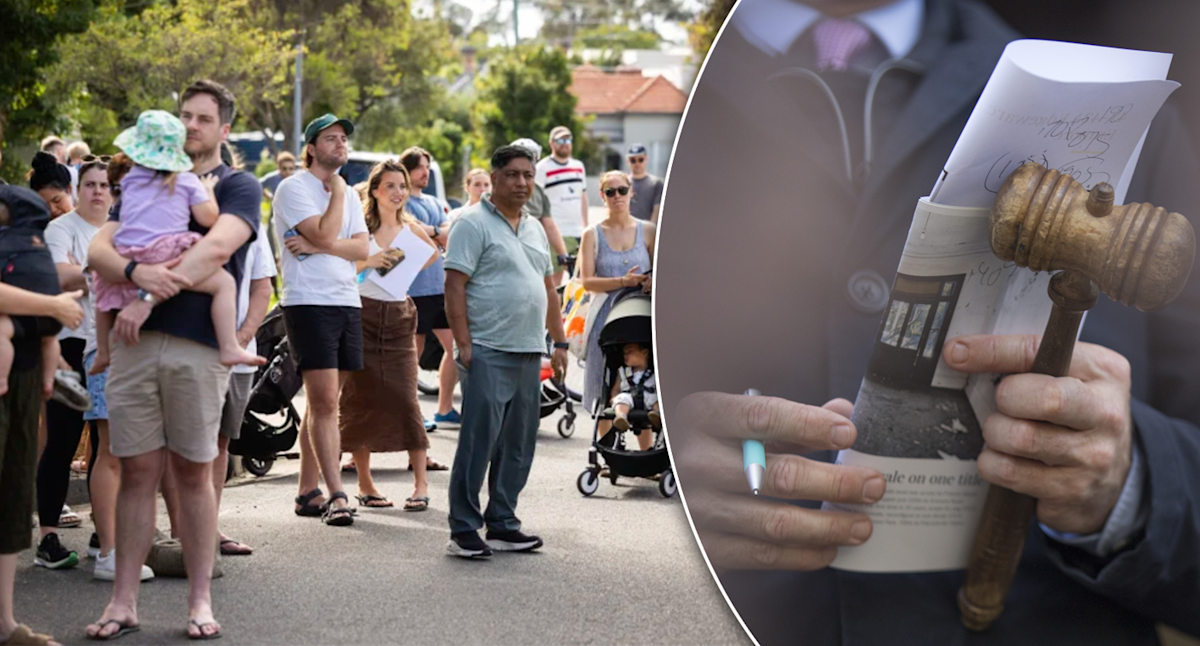
 There is a serious ‘mental toll’ that underquoting can take on house hunters. (Source: Domain/Getty)
For years it’s been an open secret of the real estate industry and the bane of hopeful house buyers everywhere. But as authorities look to remove a loophole being exploited for rampant underquoting of new house listings, those in the industry say more needs to be done to stamp out the practice.
Despite a push to clamp down on underquoting in recent years, it’s still going on, says Melbourne-based property finance broker David Meadows. It’s wasting people’s weekends and taking a genuine “mental toll” on those trying to enter the market, he told Yahoo Finance.
“You would want the advertised price range to be reflective of what the reserve price is,” Meadows said. But frequently that still isn’t the case. “It’s well known in the industry”.
RELATED
“We went to an auction for a client in Hawthorne a few weeks back. The property was advertised for about $1.55 million to 1.6 million.
“It opened the bidding at $1.65 and the agent still didn’t say it was on the market. So what does that tell you?”
The house ended up selling for about $1.92 million, he said. “Which is close to 20 per cent above the advertised price range. And that’s not an outlier, that’s just another weekend in Hawthorne.”
While not every real estate agent is guilty of the practice, those who do underquote can drive attention and people away from auctions of properties that are more honestly advertised. And that can make it hard for other agents doing the right thing.
“I actually know a lot of great agents who are ethical and don’t like underquoting, but their competitors all do it,” Meadows said.
In recent years, the Victorian state government has been clamping down on instances of underquoting.
Earlier this year, 20 inspectors working with the Consumer Affairs Underquoting Taskforce attended 20 auctions during an Autumn blitz one Saturday in suburbs around Melbourne, looking for instances of blatant underquoting.
The taskforce, which was launched in 2022 and became a permanent fixture last year, has fined more than 200 real estate agents, issuing a total of $2.3 million in penalties and handing out a further 290 official warnings.
Ahead of last weekend, Consumer Affairs released new guidelines, meaning real estate agents will have to take into account – and no longer ignore – specific details about similar properties that recently sold in the area when it comes to justifying their price guide.
Story Continues
Authorities in Victoria have issued more than 200 infringements totalling $2.3 million in fines for underquoting. (Source: Getty) · Getty Images
Under the state’s laws, agents must choose three recently sold houses in the local area to compare against when setting a reasonable estimate of a home’s selling price, which is included in its Statement of Information on a property. However some were clearly taking the mickey, with more than a quarter of the 500-plus complaints received by authorities relating to unreasonable comparable properties being used to inform the stated price guide.
“Statement of Information isn’t a price guide. It’s a it’s a marketing guide,” Meadows told Yahoo Finance.
“It’s designed to bring people in and designed to make them think they have a chance, and then ultimately they go to auction and they discover that the price guide wasn’t really reflective of what the price for the property was.”
Interestingly, more than a third of complaints came from other real estate agents.
Now, stricter guidelines means agents have to consider certain factors including whether a property was recently renovated or not, if a near-identical property in the same estate or complex recently sold, and similarities or differences in school catchment zones and proximity to amenities and public facilities.
Meadows welcomes the new rules, and encouraged the ongoing efforts to crack down on the practice of underquoting, but questioned how much impact the latest changes will really have.
“It’s a step in the right direction,” he said. “Though real change will only happen when reserve prices can’t be set on the day of auction.”
Despite the risk of getting caught, the more people a real estate agent can drive to an auction on a Saturday morning, the more urgency they can create among buyers who can actually afford the higher price.
“Competition creates a sense of urgency. And if there’s 100 people there, and 99 of them can’t afford to buy the property, you’ll never be able to tell anyway, right?” Meadows said.
“It forces people to make financial decisions that they wouldn’t typically make if they weren’t under that high pressure environment.”
With more than a decade in the industry, Meadows said he had seen the “mental toll” that underquoting can take on house hunters who frequently have their hopes dashed by unrealistic advertisements.
“I understand that agents work on behalf of the vendor, and it’s their job to maximise the sale price, and that’s fine, but equally they also have an ethical obligation which is to the potential buyers of the property not to waste their Saturdays for months on end,” he said.
In Victoria, agents who underquote risk penalties of more than $40,000 and potential loss of sales commissions. Meanwhile companies face penalties of up to $50 million under Australian Consumer Law.
NSW has also been cracking down on the practice in recent years, with NSW Fair Trading also threatening hefty fines to agents who are caught deliberately low-balling property values.
In Victoria, you can report suspected acts of underquoting here.
Get the latest Yahoo Finance news – follow us on Facebook, LinkedIn and Instagram.