
Infrastructure Victoria, the state’s independent advisory body on infrastructure development, has launched a powerful new case for the extension and upgrade of the cycling networks across Melbourne and regional cities.
Victoria’s Infrastructure Strategy 2025–2055, launched today, has urged the state government to build more high-quality bike routes and to more regularly publish updates to the strategic cycling corridor network.
The new strategy has recommended several important additions and extensions to the existing network, as well as upgrades to increase attractiveness and lower crash risk.
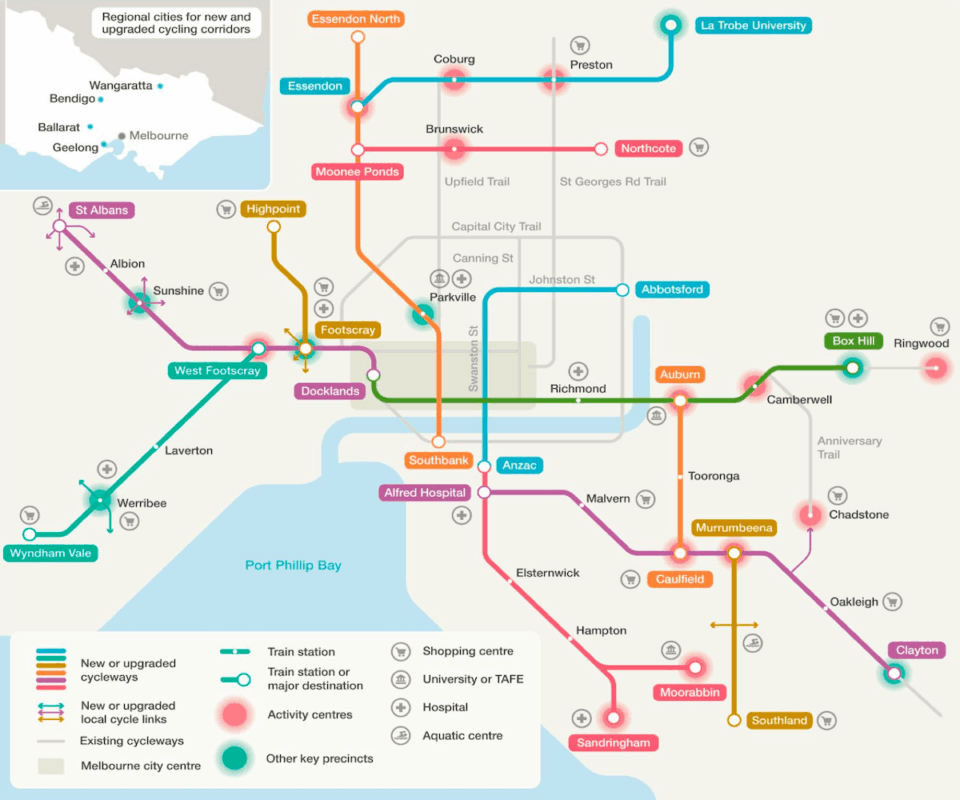
It has identified 12 priority corridors in Melbourne and a further four in each of Geelong, Ballarat, Bendigo and Wangaratta to be funded for delivery in conjunction with councils by 2035.
When built the routes will contribute 250 continuous kilometres of high-standard, new and upgraded bike routes.
Infrastructure Victoria commissioned a series of studies to ‘identify the corridors‘ with the best prospects of ‘attracting users‘ in the next ten years, estimate the ‘costs of delivery‘, and ‘calculate the benefits‘ that would flow to the community.
And when these are built, Infrastructure Victoria says the government should continue to fund the expansion of the network across Melbourne, with additions in Wodonga, Castlemaine, Shepparton and Mildura.
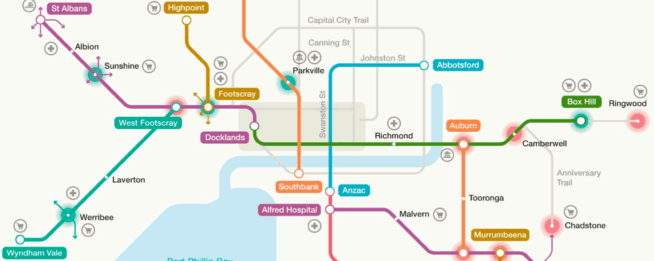
The Melbourne corridors are:
Northcote to Moonee Ponds
Essendon to La Trobe University
Alfred Hospital to Clayton
Box Hill to Docklands
Werribee to Footscray
Abbotsford to Anzac Station
Anzac Station to Sandringham and Moorabbin
St Albans to Docklands
Highpoint to Footscray
Essendon North to Southbank
Caulfield to Auburn
Murrumbeena to Southland
“We estimate that building this safe cycling network in Melbourne and regional cities will cost $500 million to $620 million over 10 years,” the strategy states.
“This includes physical barriers, upgrading traffic signal and new cycle pavements, depending on the location. They do not include additional place-making works, such as landscaping or pedestrian and public transport access.”
Infrastructure Victoria also recommends an additional $55 million be spent to build safe local connections from the new cycling corridors to key destinations in Footscray, Sunshine, St Albans, Werribee and Chadstone. It found that the corridors performed better with these connections.
The strategy says that safe cycling corridors deliver $2.40 to $3.40 in benefits for every dollar spent and up to $4 when delivered together as a network. Short extra links to nearby local destinations can add up to three times more
benefits.
“The arguments for expanding Melbourne’s bike infrastructure just keep getting stronger and stronger,” Bicycle Network CEO Alison McCormack said.
“Infrastructure Victoria has established in this latest report that there is a high level of demand for bike travel in Victoria that is not being properly catered for because our bike networks are disconnected, unattractive and missing entirely in some areas.
“But rigorous analysis in this report shows that bike corridors can deliver economic benefits three to four times more than they cost to build.
“Infrastructure Victoria shows that Melbourne and country Victoria can make tremendous gains in health benefits, lower congestion and a better environment by investing in more bike lanes.
“We can start right now and get 16 of these corridors built in the next 10 years, transforming our cities with liveable streets for the whole community.”
Like our articles?
Become a Member and help fund our advocacy work.
Or become our friend and subscribe to receive our fortnightly newsletter.