
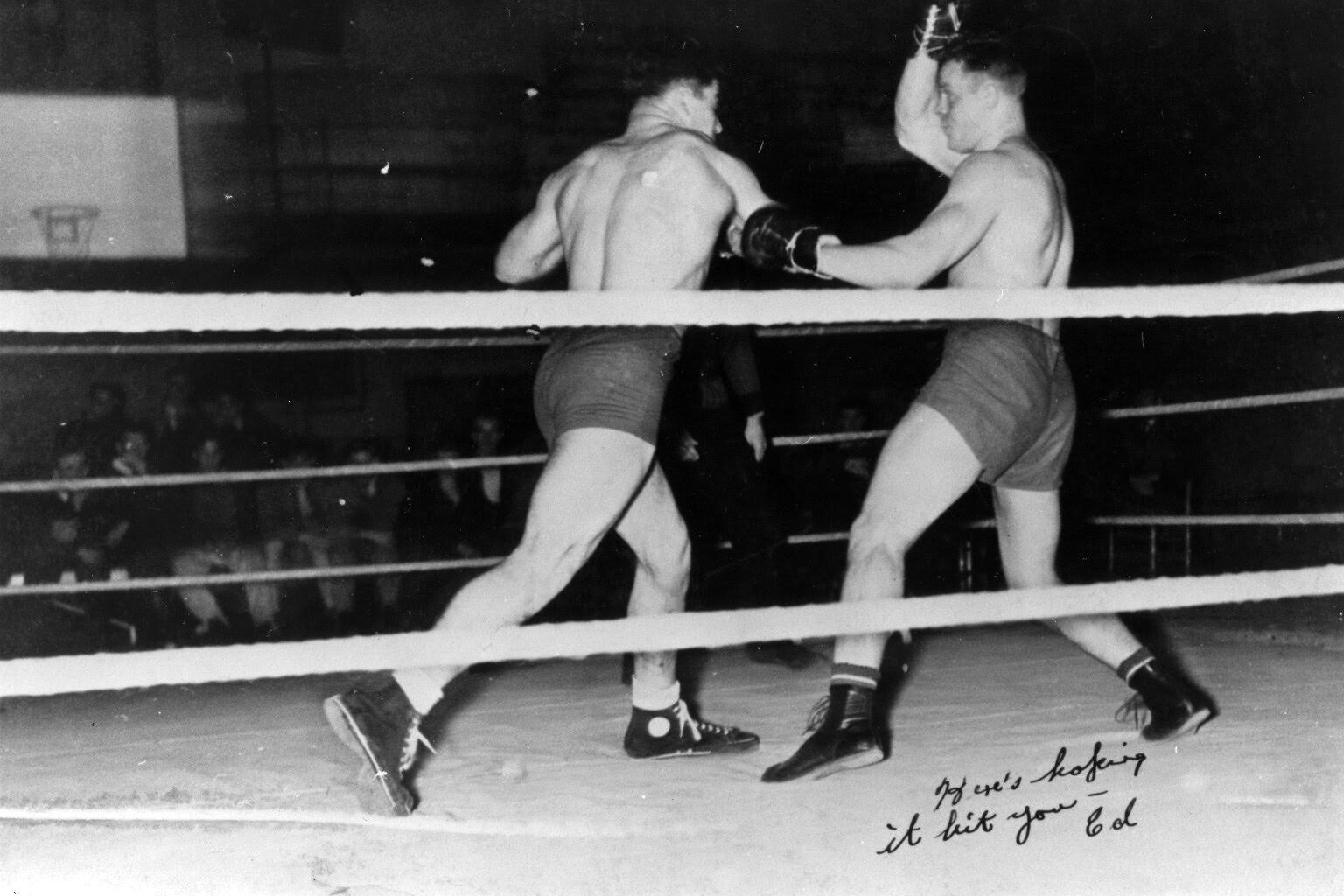
For better or for worse, boxing is a sport where the goal is to beat the pulp out of your opponent. It’s a little surprising to know that, at one time, NC State students were putting on the gloves.
Imagine you’re sitting ringside in the old Thompson Gymnasium — a decade before the construction of Reynolds Coliseum — watching your favorite NC State fighter wailing punches on his Tar Heel opponent. 3,000 fans, piled on top of one another, fill the tiny venue, cheering for every hit.
Such an atmosphere almost seems too good to have existed.
These days, the only fisticuffs between NC State and Carolina students take place on the concourse of Carter-Finley Stadium. But it was the reality lived by NC State students in the 1930s. The NC State boxing team only lasted from 1931 to 1941 and was unable to claim a team title, but it embodied NC State’s historic identity.
On an individual level, a few fighters found success. Most notably in 1932, sophomore Charlie Garner won the Southern Conference belt for the 145-pound weight class, led by head coach Lt. C.H. Elmes.
“Boxing was successful and popular because it came out of the Army tradition, [and NC State] was fully a military training school during World War I,” said NC State sports historian Tim Peeler. “NC State still had a lot of ROTC ties coming into the ’20s, all the way into the ’30s when the Great Depression hit. It was a military style school.”
Relating to the military, a big part of boxing’s appeal also contributed to its downfall: its violent nature.
“College life and life in general, from the 1880s to the 1940s and to the 1950s, was just brutal,” Peeler said. “There were a whole lot of things going on. People got sick and died. There wasn’t the same kind of medical treatment, training facilities or treatments or things like that. Boxing has always been a brutal sport. You’re basically just beating people until one over the other submits. So there were a lot of safety concerns.”
Every sport needs a venue — boxing’s was Thompson Gym, the first ever on-campus arena at NC State, and it was filled with surprises.
“Thompson Gym opened in 1925. It was a multipurpose facility, so it had gymnastics, it had lots of other things going on in there,” Peeler said. “It had a pool in the basement, had a firing range down in the basement as well. But it was not particularly set up for varsity sports, for having a lot of spectators in there. There were only about 3,200 seats in the arena.”
Contributing to the chaos was an elevated indoor track, similar to what exists in Carmichael Gym, that would’ve been a great place to watch a game.
“People would be up there watching the games or watching a match up there,” Peeler said. “It was so close to the action that there were places on the court where you could not shoot a jump shot from, for fear of hitting that track … There were big windows that people could sneak into and try to get there. It was very much a small gym that was not designed to host big events.”
The biggest events included matchups against Duke, North Carolina and other local schools — an important feature of collegiate athletics during that time.
“The schools all reacted to what each other did … Whatever Carolina did, State did. Whatever State did, Carolina did and Duke did. That’s why we have these natural rivalries with Wake Forest, just 20 miles north of us, at that time. Those were the core of everything that was going on … You had to be as local as you could be, mostly, you’re dependent on the train travel.”
When the team disbanded before the season in 1941, it was due to a few factors. Growing negative attitudes about the brutality of the sport, a lack of success and Duke disbanding its program just down the road all played a role.
But NC State boxing had one last hurrah. Fighters from the defunct varsity program entered into an intramural tournament.
“Much interest has been aroused on campus in intramural boxing because of the elimination this year of varsity and freshman intercollegiate teams,” was written in the February 7 issue of Technician.
By the end of it, writers observed, “State’s own golden-glovers put on a show that was the best intramural event this term.”