

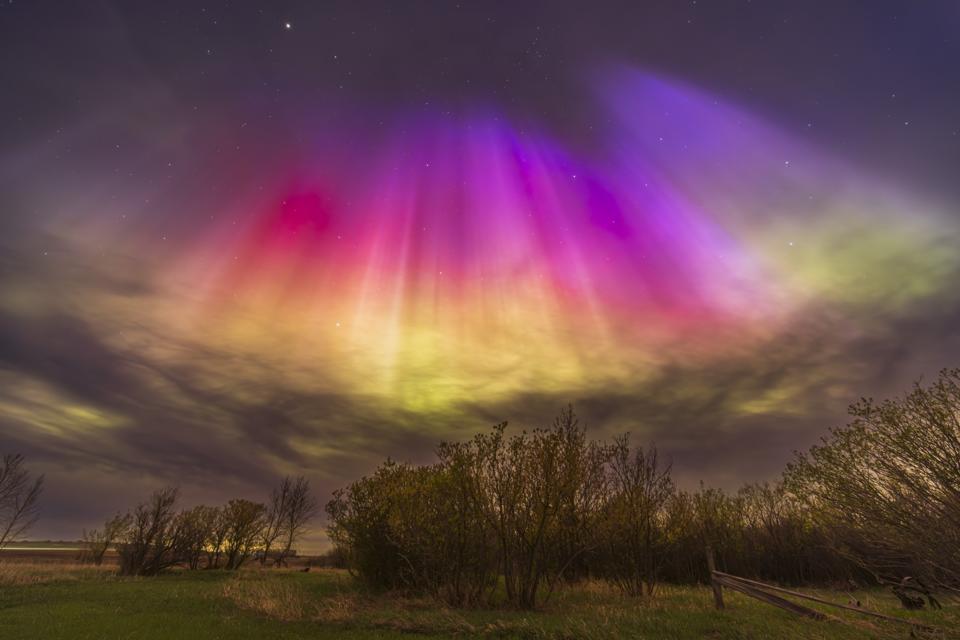
This was the view as a multi-colored curtain of aurora formed to the south in my sky during the great display of Northern Lights on May 10, 2024. The Kp Index peaked at 8 this night bringing the aurora borealis and australis to wide areas of the planet including the tropics. This was from home in southern Alberta at latitude 51° North, where the aurora filled the sky but, as here, was often best and brightest to the south. The colours come from oxygen, nitrogen and sunlight creating the shades of green, red, pink, and blue. This is a single 10-second exposure with the Laowa 15mm lens at f/2.8 on the Canon Ra at ISO 1600. Processed through Adobe DeNoise AI. (Photo by: Alan Dyer/VWPics/Universal Images Group via Getty Images)
VWPics/Universal Images Group via Getty Images
A massive X5.1-class solar flare — the strongest since Oct. 3, 2024, which caused global auroras — has been detected by the Earth-orbiting satellites.
Nothing in 2025 has topped the X2.7 solar flare on May 14, making today’s solar flare the biggest of this year by a wide margin.
It follows a week of X1-class solar flares as particularly active sunspots face Earth. It comes as a “cannibal CME” is expected to strike and interact with Earth’s atmosphere overnight on Tuesday, Nov. 11, 2025.
The potent eruption could cause a geomagnetic storm at Earth in the next few nights, which could mean widespread displays of the northern lights. However, that will happen only if an Earth-directed coronal mass ejection — a cloud of charged particles — is hurled into space in its wake, with a CME’s magnetic field to turning southward upon arrival.
ForbesIn Photos: See Jaw-Dropping Northern Lights Across Planet On Historic NightBy Jamie CarterWhat Is A Solar Flare?
Solar flares are powerful bursts of energy that can impact radio communications, electric power grids, navigation signals, and pose risks to spacecraft and astronauts, according to NASA.
An eruption of electromagnetic radiation in the sun’s atmosphere, a solar flare is caused by twisted magnetic fields, typically above sunspots — cooler, darker regions of the sun’s surface that form when clumps of its magnetic field well up from deep within the sun.
Solar Cycle 25’s Most Powerful Solar Flares
Although an X5.1-class solar flare is relatively rare, there have been stronger events in the current solar cycle, according to NASA.
Oct. 3, 2024 — X9 (the strongest of solar cycle 25, which caused global auroras). May 5, 2024 — X8.7Oct. 1, 2024 — X7.1Feb. 22, 2024 — X6.3May. 11, 2024 — X5.9 (caused global auroras).
Solar flares are graded according to their severity, with B-class, followed by C, M and X, according to NASA. Each letter represents a tenfold increase in energy output. The strongest ever solar flare detected was an estimated X28 on Nov. 4, 2003.
What Happened To ‘Solar Maximum?’
The sun is now thought to be over the peak of its 11-year solar cycle, with “solar maximum” thought to have occurred during October 2024 — the last time there was an X5-class solar flare.
The sudden X5.1-class solar flare may back up theories about the possibility of a double peak in solar cycle 25, which some experts believe. If the theory is correct, Earth may be in for the best Northern Lights season until 2035.
What Causes The Northern Lights
The solar wind causes the Northern Lights — streams of charged particles flowing from the sun and interacting with Earth’s magnetic field. While most are deflected, some particles spiral along magnetic field lines toward the poles, colliding with oxygen and nitrogen atoms high in the atmosphere. These collisions excite the gases, causing them to release energy as shimmering light.
During the sun’s solar maximum period, solar flares and coronal mass ejections are more frequent. It’s the latter that launches massive waves of charged particles toward Earth that, a few days later, can spark geomagnetic storms and displays of aurora.
Wishing you clear skies and wide eyes.