
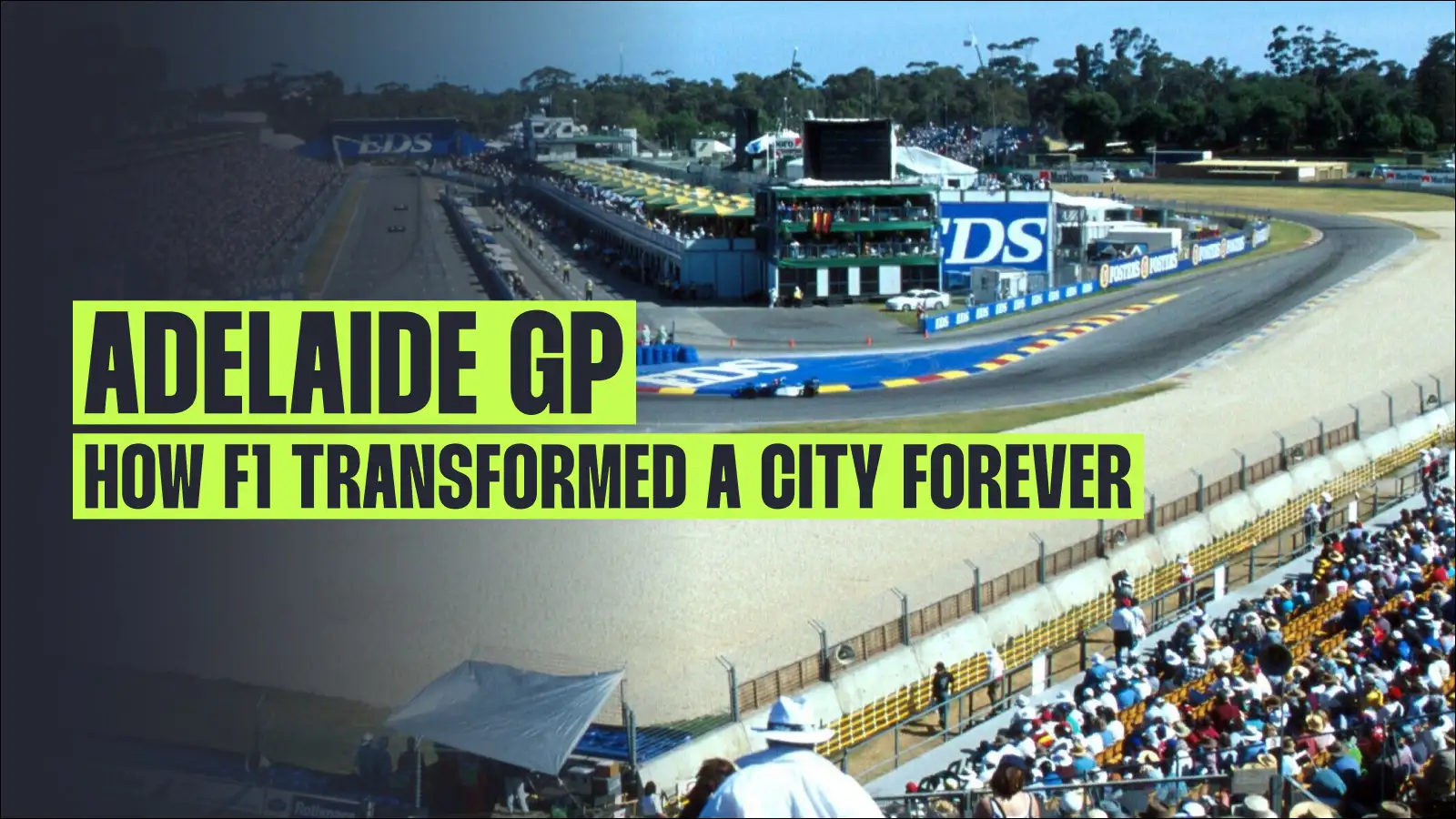
Regarded as one of the finest street circuits Formula 1 has ever raced on, Adelaide played host to the Australian Grand Prix on 11 occasions.
The last of those fell on November 12, 1995, the final race of that year’s season and a date that marked the end of an era for a city that was left transformed by the world championship.
Adelaide came alive thanks to Formula 1
Formula 1 and Adelaide developed a mutual love affair almost immediately. The sleepy South Australian capital sprang to life for the Grand Prix for what was unquestionably the highlight of the year for the million-or-so local residents.
And it was an event that sort of came about by accident, or at least by chance.
Adelaide was settled in 1836, and in the early 1980s, officials were beginning to think about how best to celebrate its sesquicentennial. There was a talk of a roller skating competition.
But, in January 1983, one local, Bill O’Gorman, was a motorsport fan and wrote to then South Australian Premier John Bannon and floated the idea of a grand prix.
Formula 1 had gained traction Down Under courtesy of Alan Jones, and there had been multiple attempts to attract a round of the world championship – Bob Jane already hosted many of the world’s best in a non-championship event at Calder Park each year.
Sandown was thrown into the mix, and it was upgraded such that the World Endurance Championship raced there twice, but the lure of F1 was little more than a bargaining chip to bring in money desperately needed to upgrade the ageing venue (though in truth, things have scarcely improved in the four decades since).
There was even talk of a race around The Rocks in Sydney, a location almost under the Harbour Bridge, though that came to nothing, too.
It was against that backdrop that O’Gorman’s letter was sent; a bright idea, but hardly realistic. If the big smoke of Sydney and Melbourne couldn’t attract F1, how was Adelaide, a city better known for its cricket ground and churches, going to fare any better?
On the other side of the globe, the attitude was much the same. While F1 was a world championship, Australia was a long way away, and in the wrong timezone. And which bit was Adelaide? A race in Australia was hardly given any serious consideration.
Still, after the approval of Premier Bannon, and the Jubilee Committee in charge of the sesquicentennial celebrations, O’Gorman was dispatched to Europe where he met with Bernie Ecclestone and pitched the idea of a race in Adelaide, with government support, in 1986.
Timing is everything, and soon after that meeting in May, F1 ventured to the United States for back-to-back races, the first in Detroit and then on to Dallas.
There, temperatures soared and the track broke up. It was a torturous weekend such that the F1 circus left and vowed never to return.
A few weeks later, O’Gorman was back in the F1 paddock, this time at Brands Hatch, when a voice behind him asked if Adelaide was still interested in a race. There was just one catch; it was for 1985, not 1986. That’s the deal, take it or leave it.
In a world before mobile phones, a late-night call back to Australia got the ball rolling.
Discussions progressed, but those in South Australia got the impression they weren’t being taken seriously. That prompted Bannon, whose knowledge of F1 was essentially zero, to board a flight to London to meet with Ecclestone in person. On the plane, he read what he could in an attempt to educate himself on the world of Formula 1.
In London, Bannon met with Ecclestone, who was summarily impressed that the head of government for South Australia would journey to the other side of the world to meet with him. The pair struck up a relationship, one that remained strong until Bannon’s death in 2015.
After Bannon struck a chord with Ecclestone, it was agreed that Adelaide would host a round of the world championship from 1985, a deal that was ultimately extended until 1996.
It was a popular addition. Relaxed, usually sun soaked, it offered a fun way to end the season with good food and – as South Australia has become known for – good wine.
More on the Australian Grand Prix
👉 Revealed: First glimpse of lavish new Australian GP pit building
👉 30 years on: The full story of Mika Hakkinen’s life-threatening crash in Adelaide
The circuit itself, laid out in the parklands that surrounded the city, was a stone’s throw from the CBD, making access to and from easy and disruption comparatively minimal (not that Adelaide had a ‘rush hour’ so much as a ‘slightly busier 15 minutes’).
The East End of the city all but shut down with street parties breaking out celebrating – and profiteering – from the presence of world class motorsport on the city streets.
Fans would camp out at the airport to meet the drivers as they arrived, and then do the same out front of the local hotels in the hope of getting an autograph.
A local restaurant chain, Fasta Pasta, offered free tickets to school children, helping to capture the imagination of a generation such that Adelaideans of a certain age are now over-represented in the Australian motorsport scene.
But all good things must come to an end, and for the Australian Grand Prix in Adelaide, that came courtesy of the collapse of the State Bank.
The government-owned bank collapsed, with managing director Tim Marcus Clark left carrying the can. But so too was Bannon. As head of the government, the Premier fell on his sword and resigned in 1992. In a state election the following year, the Dean Brown-led Liberal opposition won in a landslide.
The morning after the election, Brown received a phone call from Jeff Kennett, then Premier of Victoria.
Also a Liberal, Kennett dropped the bombshell that the beloved Grand Prix had found a new home from 1997.
Timing is everything, and in the weeks that followed Bannon’s resignation, Ron Walker had met with Ecclestone and a deal was done to move the race across the border.
Initially that was to be with a ‘Pacific Grand Prix’ in 1996, before Melbourne took the Australian GP moniker the following year.
But, with the writing on the wall, officials in Adelaide cut a deal; Adelaide agreed instead to host F1 for the final time in 1995 before selling off its barriers, and grandstands, and anything else it could to Melbourne for 1996. It was better than having worthless assets sitting around.
It softened the blow somewhat, but didn’t take the sting out of the story which grates South Australians to this day. There are few things South Aussies dislike more than Victoria.
The final race, the Grand Finale as it was billed, was meant to be a celebration; one last hurrah in recognition of an event that had transformed Adelaide from a sleepy city known for its cricket ground and churches into a world-class destination.
While Adelaide had offered Formula 1 a low-stress end to the season, it had it turn gained a sense of self, a global confidence that was once so low that it was prepared to celebrate the State’s 150th anniversary with a roller skating competition.
It’s a legacy that has endured.
Adelaide continues to put on motor sport events like nobody else, with its annual touring car event taking in a truncated version of the Adelaide street circuit. There is also the burgeoning Adelaide Motorsport Festival which attracts a host of cars and drivers from the Adelaide F1 era.
There is a cycling event that showcases the state’s winemaking regions, and other events like the Fringe, not to mention the obligatory beer, wine, and schnitzel festivals.
And while an F1 return to Adelaide has been floated on countless occasions, usually by politicians looking for a soundbite and a headline, the simple fact is that chapter has firmly closed.
Not only has the circuit been changed in the decades since, allowing for the passage of the O-Bahn bus service through the parklands and through ‘Banana Bend’, organisers in Melbourne have both a long-term contract and an exclusivity clause.
Still, for 11 glorious years, Adelaide proudly called itself the home of Formula 1 in Australia. It was a period that defined the city, shaped the sport, and is remembered fondly by all who were lucky enough to be part of it.
Melbourne might host the Australian Grand Prix, but its spiritual home remains across the border.
Read next: F1’s most bizarre race revealed: How Ferrari won the same race – twice