
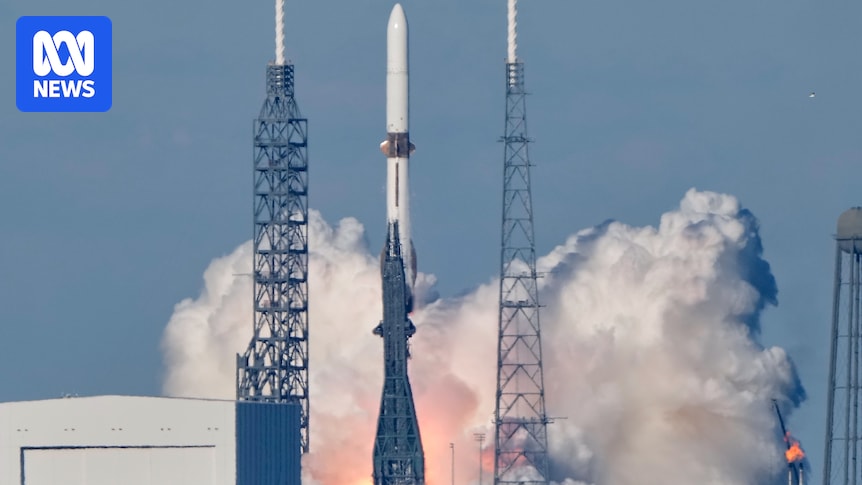
Blue Origin has successfully launched its biggest rocket with a pair of NASA spacecraft destined for Mars.
The 98-metre New Glenn blasted into the sky from Cape Canaveral Space Force Station on Thursday afternoon, local time, sending twin Mars orbiters on a journey to the Red Planet.
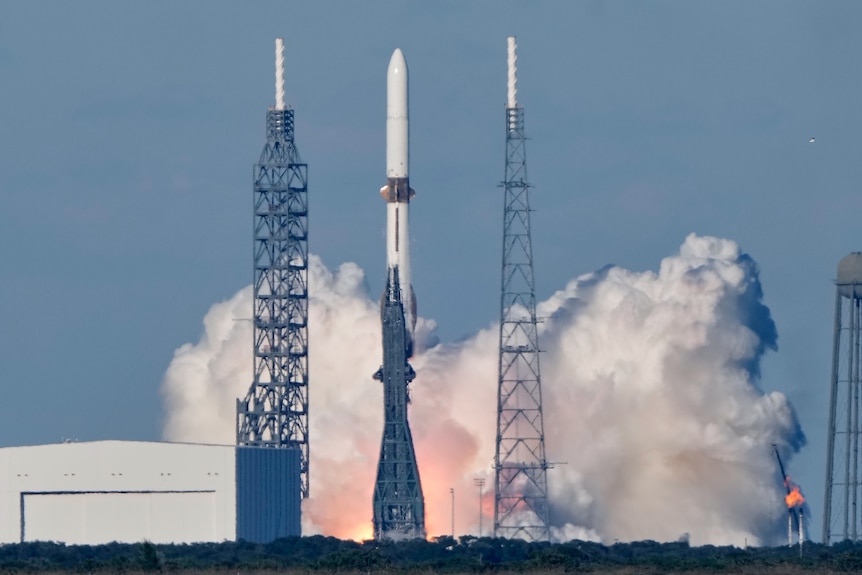
Liftoff was stalled for four days by bad local weather as well as solar storms. (AP: John Raoux)
The launch followed several days of delays due to cloudy skies and a geomagnetic storm.
The space venture of billionaire Amazon founder Jeff Bezos achieved a key engineering objective when its reusable first-stage booster separated from the rocket’s upper stage minutes after launch and flew back to Earth.
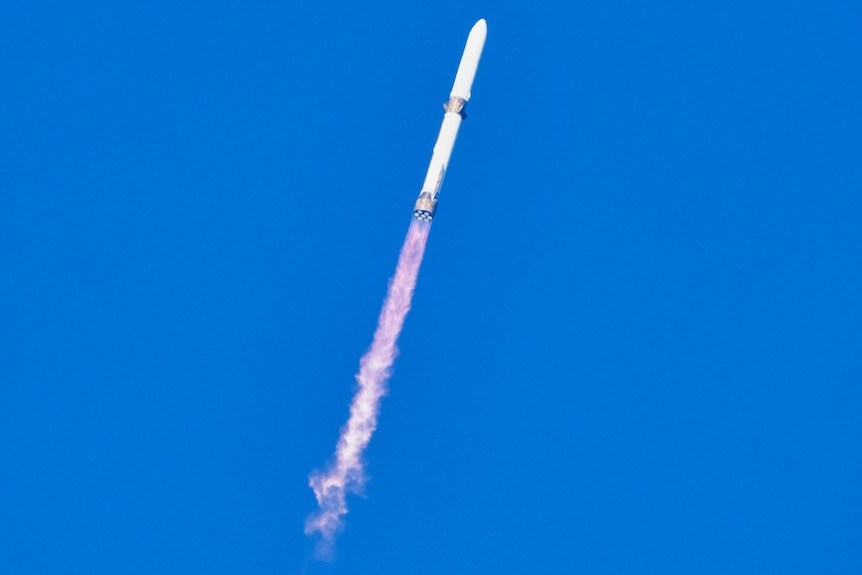
The twin satellites, dubbed Blue and Gold, are due to reach Mars in 2027. (AP: John Raoux)
Cheers erupted in mission control when it touched down safely on a barge in the Atlantic.
An ecstatic Mr Bezos watched the action from Launch Control.
About 20 minutes later, it was confirmed that New Glenn’s upper stage had achieved its primary mission: deployment of NASA’s twin Escapade spacecraft into outer space to embark on a 22-month voyage to Mars.
Blue and Gold head to Red Planet
The dual spacecraft, dubbed Blue and Gold, are due to reach Mars in 2027 and enter synchronised elliptical orbits for an 11-month study of the planet’s space-weather environment.
Blue Origin, founded by Mr Bezos in 2000, has — until recently — been known mainly for a space tourism business that flies wealthy passengers to the edge of space.
The sub-orbital New Shepard rocket ship is a single-stage reusable vehicle that has also carried more than 200 research experiments inside its capsule.
With Thursday’s launch, Escapade became the first science payload delivered into space by Blue Origin for NASA or any other customer.
This is a key milestone for the company in its quest to compete on a more equal footing with Elon Musk’s SpaceX, the world’s leading rocket launch service.
NASA goes on an Escapade
Blue Origin has spent billions of dollars developing New Glenn, a heavy-lift-class rocket designed to become the company’s workhorse vehicle for flying humans and cargo to orbit.
Named after John Glenn, the first American to orbit Earth, the spacecraft produces two times more thrust at lift-off than SpaceX’s Falcon 9 rocket and about the same as SpaceX’s Falcon Heavy vehicle, while offering more cargo room than any of its rivals.
Popstar Katy Perry blasts into space on Blue Origin rocket flight
NASA has spent roughly $US55 million ($88 million) for the Escapade mission — a modest price tag relative to the agency’s multi-billion-dollar space programs — and has paid Blue Origin $US18 million for the New Glenn flight, according to federal procurement data.
Blue Origin also supplies engines for other companies’ rockets, including United Launch Alliance’s Vulcan Centaur, and has been working on a crewed moon lander for NASA’s Artemis lunar exploration program, as well as a space station in collaboration with other entities.
Blue Origin has far to go to catch up with SpaceX, which has launched its Falcon rockets on nearly 280 missions in the past two years, most of them serving Mr Musk’s Starlink satellite business.
Mr Musk’s company is also developing its next-generation Starship rocket, a stainless-steel behemoth designed to be fully reusable and serve an array of missions, including flights to the moon and Mars, and expanding SpaceX’s Starlink satellite network. Starship, once placed into service, would become the world’s most powerful rocket.
AP/Reuters