
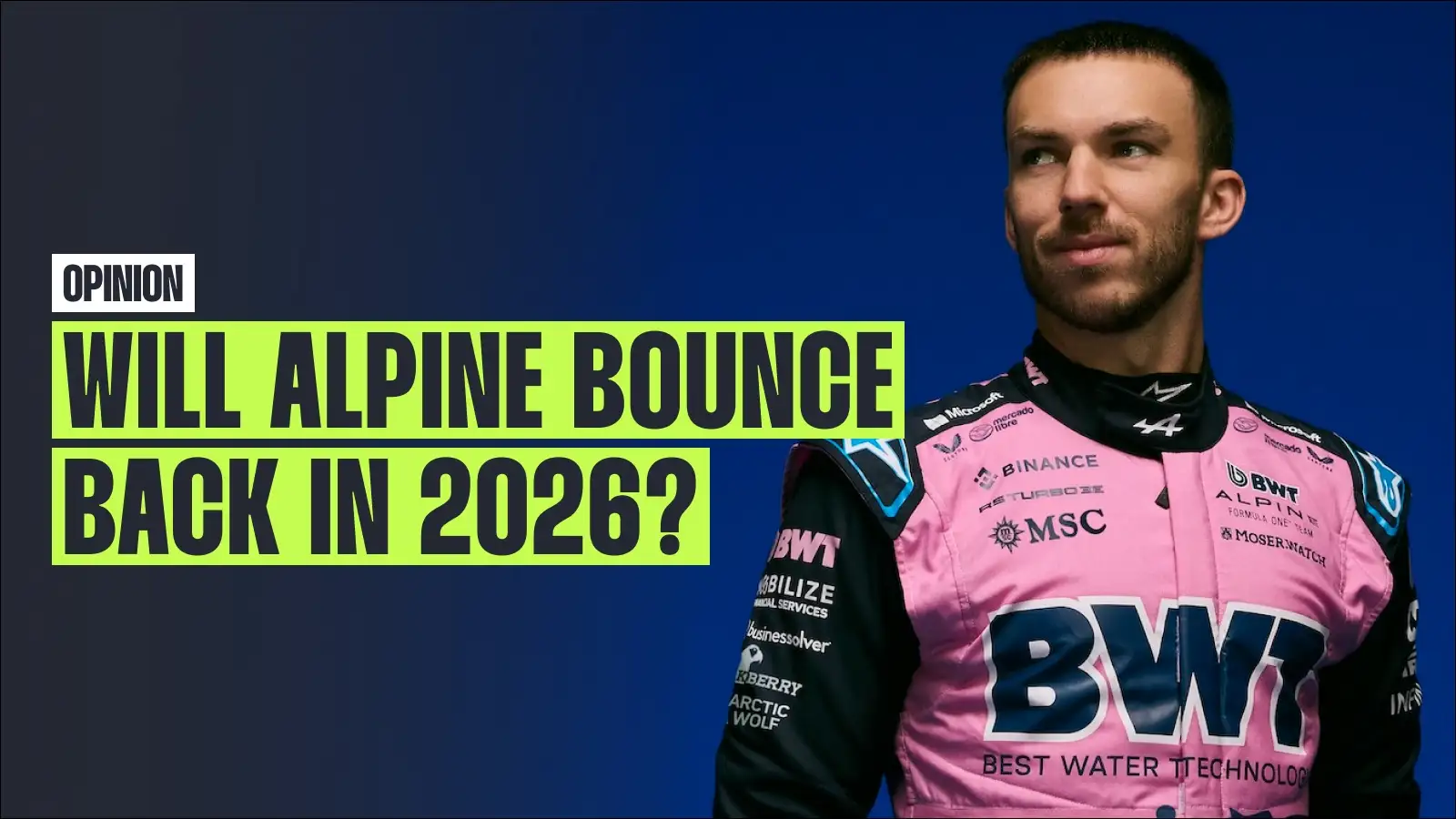
There’s no getting away from it, 2025 has been an awful year for Alpine.
Six races in, they lost team principal Oliver Oakes after his brother was arrested for allegedly “transferring criminal property.” At the same stage, they binned off Jack Doohan to replace him with the more lucrative Franco Colapinto, a decision that has resulted in zero points for the Argentinian.
At the factory level, there was a revolt when the company announced it would be ceasing its power unit manufacturing in Viry-Chatillon after almost 50 years in the sport.
Renault CEO Luca de Meo resigned in the summer, meaning of the three senior figures who led the team in Bahrain, just Flavio Briatore remains and all the controversy he brings.
Barring a minor miracle – and a 40-point swing – Alpine will end the year last in the Constructors’ Championship, a first in the company’s long history and yet, for all the doom that the facts portray, the resetting of the board that 2026 provides has brought some optimism to the Anglo-French team. Here are some of the reasons why Alpine can be optimistic for what comes next
A Mercedes engine puts Alpine back on a level playing field
Right now, anyone claiming to have the best engine for 2026 is simply guessing. The secretive nature of Formula 1 means that no one can truly be sure of the pecking order given how significant the regulation changes are but, even with all this in mind, Mercedes looks the safest bet and perhaps that is because there are the fewest questions surrounding them.
A diagnosis at the other four suppliers suggests each has its own issues. Red Bull Ford Powertrains and Audi are both making Formula 1 engines for the first time. Honda is a dab hand at doing so but has left the familiar home of the back of a Red Bull, and will instead be in the Aston. Ferrari has as much experience and pedigree as anyone but it has been 17 years since one of its engines was in a title-winning car.
Meanwhile, Mercedes’ history when it comes to new engine regulations is there for all to see.
While it may have been a hit to the ego to remove themselves as a power unit supplier, doing so for Alpine will likely remove the biggest anchor that has been weighing them down this season – an underperforming engine.
Any improvements made to the chassis for this campaign were undone any time the Alpine car even saw a straight line and becoming a Mercedes customer will most likely fix that with one of the best in the business.
But Alpine will be one of four teams using Mercedes engines next year meaning that even if the engine is good, that does not guarantee podiums. However, at least they will begin on the same start line as everyone else and not 10 metres back.
Alpine has quietly assembled a competent technical team
While it is driver signings that dominate headlines and fan interest, the stuff assembled behind them is arguably even more important.
Alpine’s senior leadership of late has been as stable as jelly on a rollercoaster but after the chaos of the early season, the team has since settled on a technical team with a very strong CV.
Steve Nielsen became Managing Director in July, returning to the team where he helped win two world titles in his Sporting Director role. Having also worked for the likes of Williams, Caterham and Toro Rosso, Nielsen’s experience working for Formula One and the FIA could also prove to be a useful arrow in Alpine’s quiver.
Under him, they have former Ferrari and McLaren director David Sanchez and Racing Director Dave Greenwood, another member of the 2005 and 2006 title-winning teams.
Briatore, for better or worse, remains the controlling hand over the team in his ‘Executive Advisor’ role but undoubtedly has sway in the paddock.
All of this suggests that there may not have been huge fanfare for it but Alpine has assembled a very competent technical team to guide what they hope will be a major recovery. In attempting that, they have another card up their sleeves – time.
An early switch to 2026 could give Alpine a head start
The major regulation switch-up in 2026 meant 2025 was always going to feel like the second film of a trilogy.
With so much focus being given to next season, teams have given up development on their 2025 car far sooner than normal but even then, Alpine switched tracks almost as soon as the train left the station.
The downside of that decision is being seen now with the team scoring just two points in the last eight races but Nielsen is hopeful the rewards are still to come.
“The short answer is I wish we were more competitive now,” he told Motorsport.com. ”I just hope that the pain we’re going through now is vindicated next year when we produce a much more competitive car.
“But to be clear, the parallel development of two cars…most teams only have access to one wind tunnel. And it’s governed by regulation anyway. For us to keep our 2025 car in the wind tunnel means we cannot put our 2026 car in.
“So, you can do both, but it becomes a very inefficient way of working because to take one model out and put another one in, it’s downtime for the tunnel. You lose hours and days doing that, recalibration and so on.
“So we felt the best option for us to make the biggest step was not to develop this year’s car.
By sacrificing their 2025 season, Alpine has given itself the best opportunity of a winning start to 2026 but only in Bahrain will we discover if it has worked.
More on Alpine from PlanetF1.com
👉 Alpine boss reveals how Franco Colapinto earned F1 2026 reprieve
👉 Break-in at Alpine F1’s engine facility triggers industrial espionage fears
👉 Is this the end of Jack Doohan’s F1 dream?
A competent driver and a lucrative one with room to grow
Charles Leclerc may often take the prize for ‘Man Who Most Looks Like He Is Trapped In A Nightmare’ but Pierre Gasly could run him close.
Since leaving the Red Bull second team to move to Enstone, he has seen his former outfit rise up the table while Alpine has been sinking like a stone.
But when blame is to be handed out for the 2025 season, it is hard to lay any of it at the Frenchman’s door. He has 22 points this season, just six short of Yuki Tsunoda and three more than Gabriel Bortoleto, despite driving one of the two worst cars on the grid. By the time of the first race next season, Gasly will be 30 and one of the most experienced members of the grid.
Gasly then is clearly a safe pair of hands for the team to trust their 2026 challenger with. As for the other side of the garage, that is less certain.
Franco Colapinto’s Williams debut put him on the Formula 1 map but even towards the end of his time at Grove, the Argentinian found it difficult to maintain that early momentum. Since making a big-money move to Alpine, it has been a disaster with Colapinto still on the same points as the demoted Doohan.
The sponsors Colapinto brings give him a credible case to continue but there comes a time when money is not enough.
Judging him on this season alone is perhaps harsh given the Alpine car’s weakness but if the team do have ambitions of finishing high up the table, they will need two drivers to do so.
Will Alpine’s 2025 gamble work?
The million-dollar question for Alpine, though, is this – will it work?
2025 marks 20 years since Fernando Alonso’s and Renault’s first title win, but the team has never looked further away from those glory days.
Getting all their ducks in a row is crucial to any hope of an F1 recovery, but ultimately the proof is in the pudding. Come the end of qualifying in Bahrain, we’ll know whether this really is a team on the comeback trail or just facing another false start.
Read next: Have we all been wrong about Lando Norris?