
The demands of the packed schedule on the professional circuit have been criticised countless times by the world’s best players, but they’re not the only ones being impacted, according to former British star Tim Henman.
Concerns about the calendar are frequently raised around grand slam events as some top-ranked athletes bow out earlier than experts and their team expected.
The feeling of being “burned out” is often cited as a reason by those athletes who have exited early, while others are forced to depart the tournament due to injury.
READ MORE: Demon confronts ‘dark places’ as Sinner streak extends
READ MORE: Cycling hasn’t felt the same since Cadel. He has a theory for why
READ MORE: Why Curnow foreshadowed AFL’s money making ploy
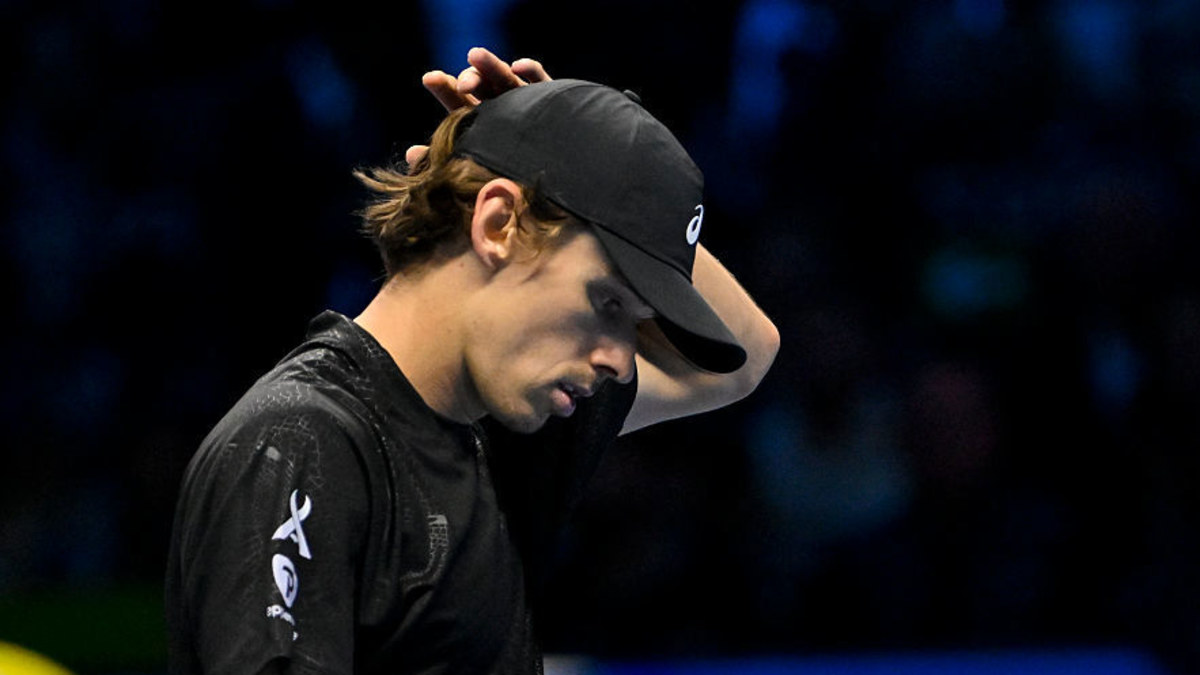
Australia’s Alex de Minaur is one of the many athletes to comment on the matter this season, declaring that “players’ careers are going to get shorter because they’re going to burn out mentally” after he was dismissed in the second round of the French Open.
Iga Swiatek has previously declared the current demands are “exhausting” while world No.10 Jack Draper also raised awareness about the mental struggles players face.
Alex de Minaur reacts against Jannik Sinner during the Nitto ATP Semi Finals 2025. Getty
But ATP chairman Andrea Gaudenzi told Sky Sports that while he has taken the concerns raised by the athletes into account, it is ultimately up to the players to decide their yearly calendar.
“In tennis, a player can play up and down as they wish” Gaudenzi said.
“I take [mental and physical wellbeing] very seriously but we don’t fully control their behaviour.
“You need to be tempted by not the money of exhibitions but your ranking and big titles.
“If you are a top player you should start scheduling the Grand Slams, the Masters and when you need to play, you play down in the 500 and 250 events.
“It’s about balancing week after week and it is difficult to build a perfect calendar. Some will play 80 matches with 15 tournaments, some will play 80 matches with 30 tournaments.”
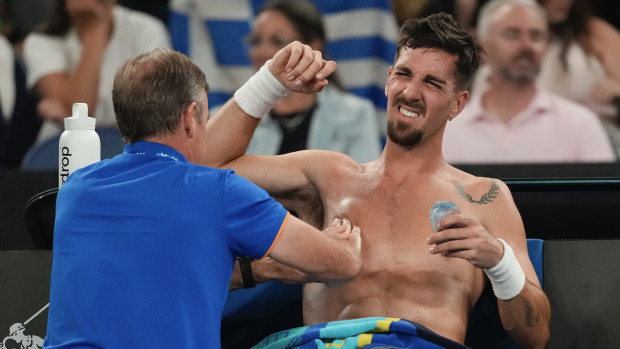
Thanasi Kokkinakis receives treatment during his match against Jack Draper at the Australian Open. AP
Gaudenzi added that he does not believe “you can associate the injuries” of several stars to their heavy workload as it is an “inevitable” factor in any spot.
However, Henman, a former world No.4, fears fan enthusiasm is being impact as a result of the demanding tennis schedule.
“Historically on the ATP Tour there have been 12 tournaments in four weeks in February,” Henman said in response to Gaudenzi’s interview on Sky Sports.
“What does that mean when you have Jannik Sinner here, Carlos Alcaraz there, Alexander Zverev and Novak Djokovic?
“It doesn’t provide a clear narrative for the fans so certain weeks where there is no tennis is a good thing for everybody. It gives the players an opportunity to rest and it gives fans the chance to build the excitement about the next event on the calendar.
“F1 is pretty easy to follow. Every couple of weekends there is a race and after 20-odd races you add up the points. You then have gaps in between.
“I think we have great assets in tennis, led by the four Grand Slams.
“The Masters 1000 events are good concepts to get the best players but I think they should be eight or nine days, not 12. Then you can build that product.”