
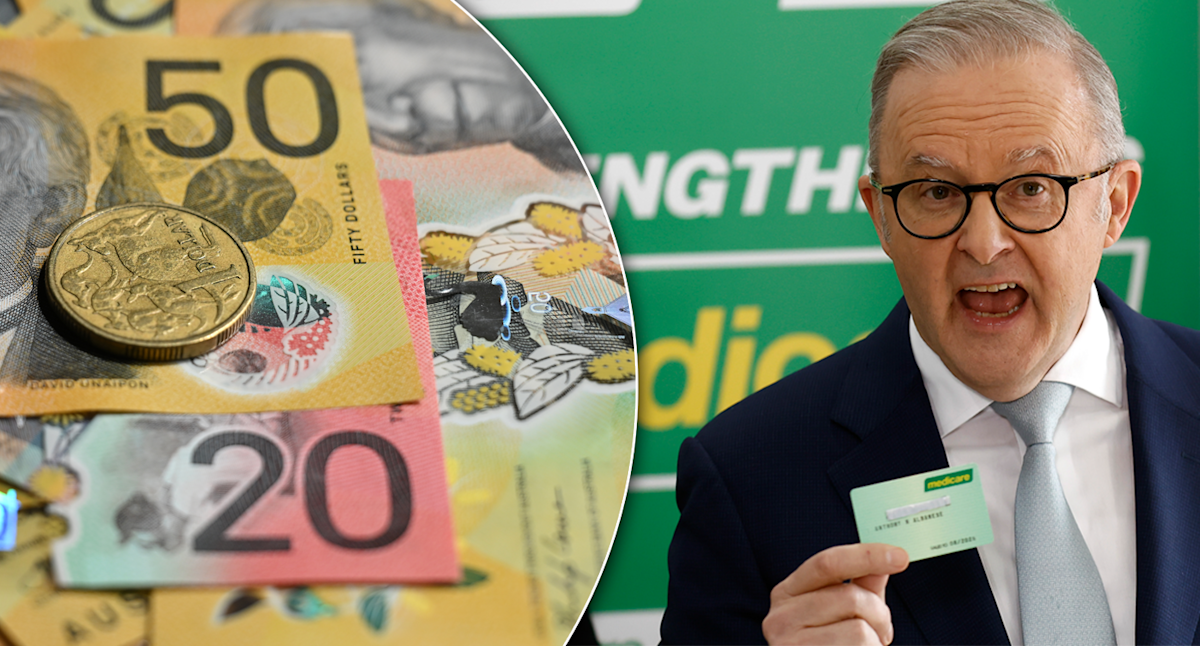
 Aussies can expect the biggest ‘price shock’ in years when health insurance changes come into effect next year. (Source: Getty/AAP)
Australians are being warned to brace for the highest health insurance price rise in years. Private health insurance premiums will increase on April 1 next year for some 15 million insured Australians.
Private health insurers submitted their proposed premium changes to Federal Health Minister Mark Butler for review last week. Experts at Money.com.au are predicting premium rises of between 3.9 to 4.4 per cent in 2026, which would add up to $216 a year to a family policy.
Money.com.au general manager of health insurance Chris Whitelaw told Yahoo Finance the price rise would be a “shock” for many policyholders and may lead some Aussies to cancel their insurance altogether.
RELATED
“It’s just one more thing. It’s another $100, $200, whatever the impact is on that particular policy, and it’s just more money that people don’t really have at the moment,” he said.
“You’re going to see people on single incomes, small families with minimal disposable income. It’s just another increase which they are going to struggle to find the money to cover it.
“The other groups, they’re going to start to really review the cover and see, am I actually getting any value out of it or why do I have it?”
Whitelaw said premium increases had been below health inflation for years and 2026 may be the year they return to a more “normal” growth cycle.
It comes as Australians downgrading or exiting the private health system altogether has been a prospect the industry has been concerned about, he added.
Overall health insurance membership rates have been holding steady, with 45.4 per cent of the population holding hospital cover and 55.1 per cent holding extras cover.
Private Healthcare Australia findings showed more than 216,000 policies were downgraded in the first half of 2024.
The predicted 3.9 to 4.4 per cent premium rise, would see singles with a combined policy pay an extra $127 to $144 a year. This is based on an average single policy costing $3,264 a year.
Families would face an additional $191 to $216 annual cost, based on the average family policy costing $4,908 a year.
This year, health insurance premiums rose by an approved 3.73 per cent, after Health Minister Mark Butler rejected steeper proposed increases of 5 and 6 per cent. This marked the biggest annual hike since 2019, with the previous year’s average increase 3.03 per cent.
Story Continues
Money.com.au’s Chris Whitelaw expects Aussies will downgrade or cancel their health insurance in response to the price hike. (Source: Money.com.au/Getty)
Individual insurers are able to apply higher or lower increases to the average. Most of the major funds increased premiums above this average, with BUPA premiums up 5.1 per cent, Medibank 3.99 per cent, NIB 5.79 per cent and HCF 4.95 per cent.
The Health Minister will get the final say on all annual premium rises and is likely to announce the increase early next year.
Whitelaw said now was the time for policyholders to look at their plan and inclusions, and reassess whether they were getting value for money.
“So if you’re a 30-year-old person who’s in reasonably good physical condition, do you need to be covered for a joint replacement? Is that likely in your future?” he told Yahoo Finance.
“If you’re like myself and my wife, where our kids are grown up, we’re definitely not going to be going for kids again. So is pregnancy required?”
Whitelaw said it was important to review your extras coverage as well and make sure you were using them.
“Your health insurance has two components. The hospital, that’s your bad situation, you never want to use it, but it’s there for safety. The extras, that’s where you get the value, and that’s where you can actually really get some good return,” he said.
Whitelaw said it could also be worth seeing if you can prepay your premiums ahead of the April 1 price rise, but you’ll need to have the upfront cash at hand.
You can also use the government’s PrivateHealth.gov.au website to compare health funds, or comparison websites.
Get the latest Yahoo Finance news – follow us on Facebook, LinkedIn and Instagram.