

Feed neighbors and fuel reporting. Your gift keeps local journalism free and sends 3 meals through the Vermont Foodbank.

Feed neighbors and fuel reporting
Your gift keeps local journalism free and sends 3 meals through the Vermont Foodbank.
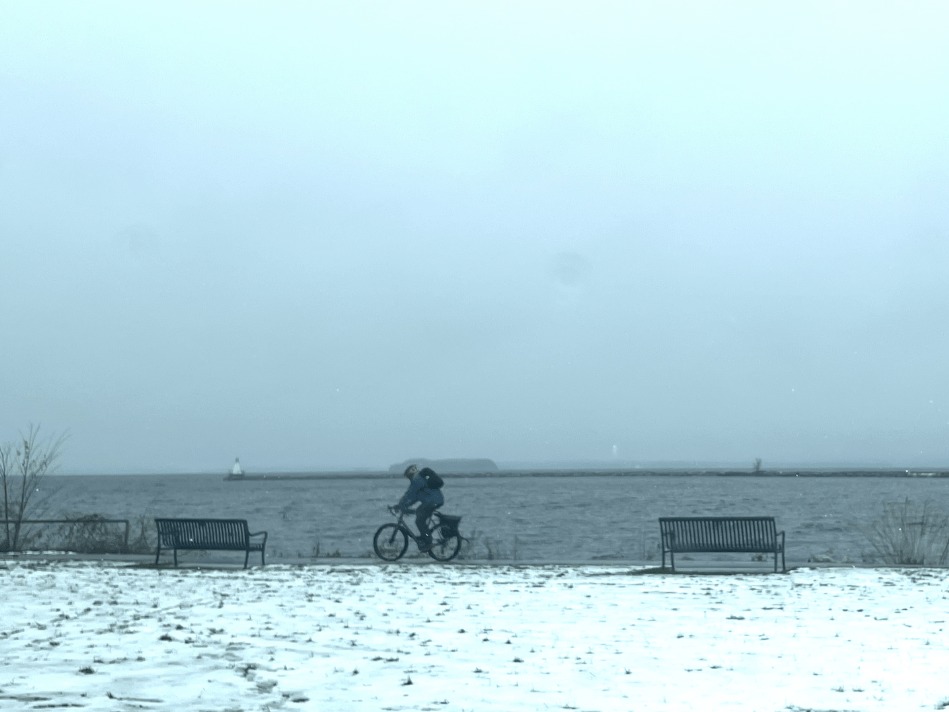 A cyclist rode through snowy conditions near Perkins Pier in Burlington Nov. 12. Photo by Fiona Medeiros
Fiona Medeiros is a reporter with the Community News Service, part of the University of Vermont’s Reporting & Documentary Storytelling program.
Winter rushed in last week with parts of Chittenden County seeing nearly a half a foot of snow. But that’s no obstacle for the year-round cyclists who see winter as merely an invitation to swap their nice, expensive rides for ‘beater bikes’, and to remember to charge their lights.
Help us reach 1,200 members by Thanksgiving!
Your donation keeps fact-based Vermont reporting free and feeds a neighbor for a day through the Vermont Foodbank.
Whether it’s to and from work, picking up the kids or running errands, year-round cyclists prove that it can be done without using a car. While snow shovels have already been put to use in Vermont, winter’s official start date is Dec. 21. Average temperatures typically drop in December, and Vermont sees its earliest sunset and fewest daylight hours.
Still, traveling via bike — even in such unwelcoming conditions — can be a practical way to get outside while reducing emissions in the process, fans of year-round biking say.
More and more people seem interested in staying on their bikes through the winter these days, including people who are dedicated to lowering their reliance on fossil fuels, said Deb Kraft, mechanic and communications coordinator at Old Spokes Home, a non-profit bikeshop and Burlington staple.
Adaptations are necessary, though. Personal preparedness and bike maintenance are important to successfully transition to winter riding, a time when there is less visibility and more grit to get between your gears, according to Kraft. Some folks even don their ski and snowboard attire out on the road.
A sign at the store outlined a list of specific tips and warned that bike travel can take 30% longer in winter conditions.
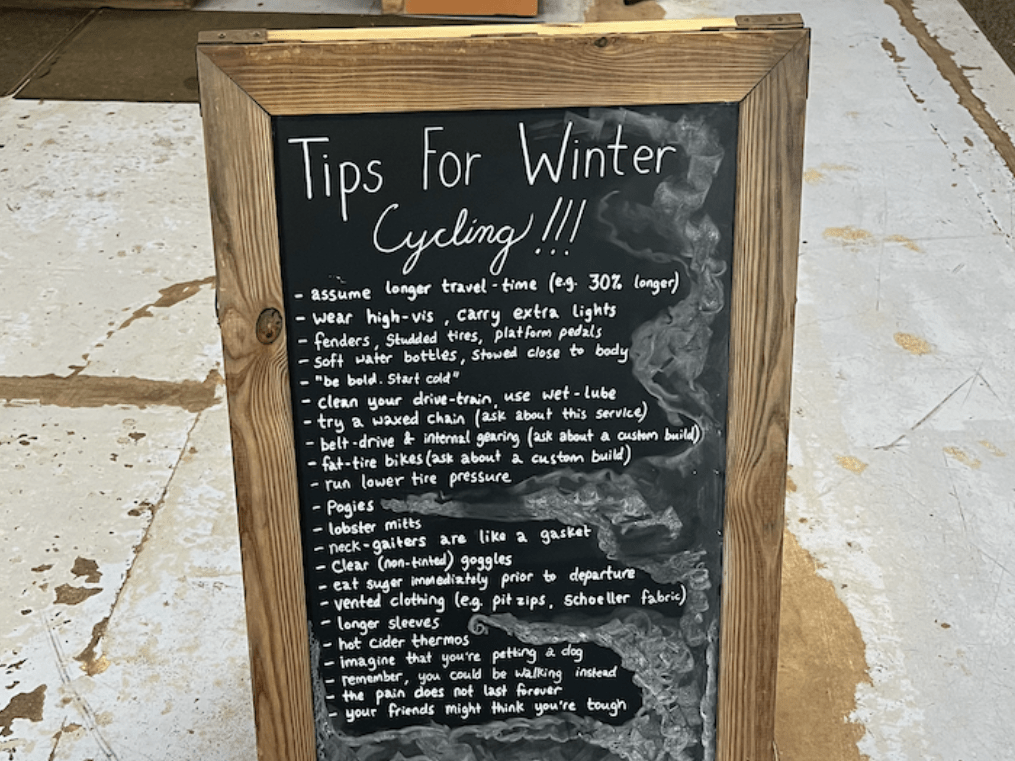 A list of winter cycling tips at the Old Spokes Home in Burlington. Photo by Fiona Medeiros
Consider adding extra lighting, a fender and studded tires. Running bike tires at lower pressure might also be a good move, depending on travel routes and bike type. Fat tire bikes are also a popular choice for the winter. Dressing in layers that can be added or removed is another strategy.
“Wear less clothes than you think you need if you have an uphill portion in your commute,” said Val Cyr, communications specialist at Local Motion, a Burlington-based nonprofit.
It’s important to prepare thoroughly for both cold and wet conditions, with rain pants and waterproof shoe covers good options for protective measures. Riding an e-bike to get places with a bit less sweating involved is another option, though winter temps can present charging challenges for e-bike batteries.
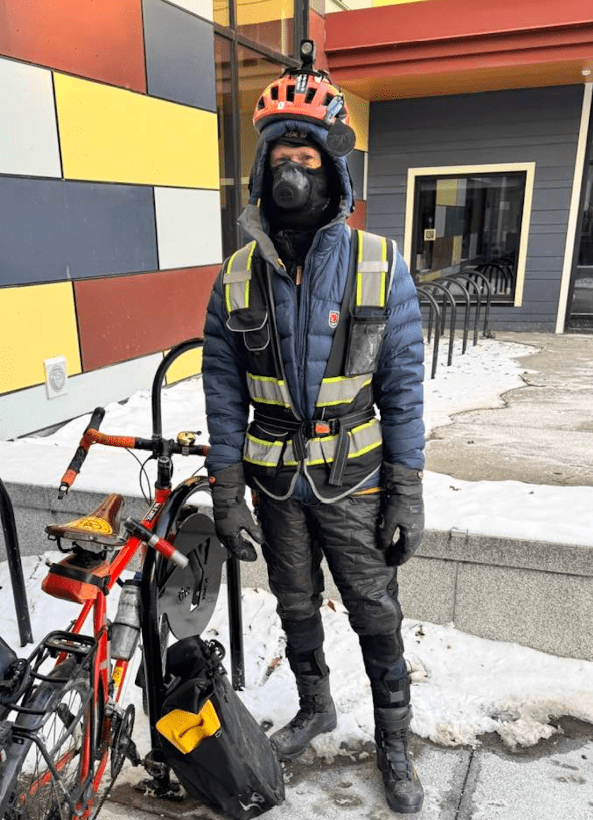 Peter Burns in his winter cycling getup. Photo courtesy Peter Burns
Both Cyr and Burlington-area bike legend, Peter Burns, contribute to Local Motion’s blog. At 69, Burns jokes that he was one of the “original three” winter cyclists in Burlington. He traces winter biking back to the 1980s when “winters were snowier and colder.”
Having biked through the past fifteen winters, “technology is such that I can ride every day, except in a blizzard,” Burns said.
He has seen gear come a long way, with modern luxuries like electric mittens coming in handy when the mercury drops. Other warmth accessories include heated saddles and handlebar mitts. “Dress for the weather that’s actually out there,” he counseled, “not the weather you hope for.”
Burns advises a gradual approach to folks curious about transitioning to all-seasons cycling. One option is to ride as late into the winter and start as early in the spring as they feel comfortable. “Don’t approach it as all-or-nothing,” Burns said.
Local Motion and Old Spokes Home are strong networks with resources for all-seasons cycling, including winter biking seminars, tips and encouragement. Local Motion hosts a year-round group bike ride, typically on the last Tuesday of every month, without stopping for winter.
Local Motion also works statewide to improve accessibility for cyclists and walkers with safer road design, more trails and community advocacy.
Local Motion recently partnered with volunteers in a pilot project to put up tall cones along Burlington’s North Avenue bike lane to improve safety and bike/pedestrian access over 6,000 feet of protected lane.
In general, conditions on winter roads vary and the outside portions of roads may not be salted. It is imperative to go slowly and give plenty of space for wider turns and slower stops than riders may be accustomed to in warmer seasons, cycling advocates say.
Biking safely in the winter, in addition to possibly extending trip time when the conditions are icy and snowy, also may require more planning ahead.
Despite Vermont’s harsh winter climate, cycling remains an ecologically-friendly way to move from place to place. Over the years, Burns has pedaled through his share of dismal weather and managed to navigate both biting cold and spitting snow.
“I made the trips,” said Burns. “It wasn’t all that fun, but I made them.”
Before you go: VTDigger exists because of reader donations. We’ve never charged subscription fees or received federal funding. Our reporting is free for everyone because our supporters believe that an informed public matters.
But here’s the truth: Each month, more than 500,000 people read VTDigger, but fewer than 2% donate. We need your help to close that gap and keep providing the public service Vermonters rely on.
Your gift isn’t extra. It’s essential. It keeps our journalism independent and freely accessible to all Vermonters.
And this season, it does double duty: powering VTDigger’s newsroom and providing three meals to a neighbor through the Vermont Foodbank.

Sky Barsch, CEO, VTDigger