
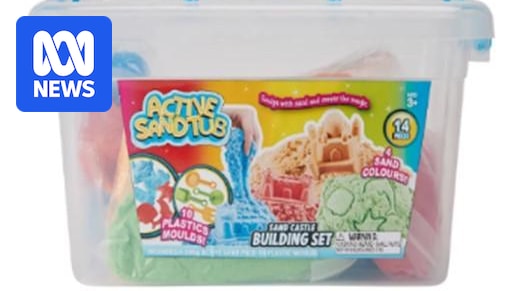
A national recall of 32 coloured sand products that may contain asbestos has highlighted cracks in the system to remove these items from mass online marketplaces, according to one of Australia’s leading specialists on artificial intelligence.
A seller had the “14 Piece Sand Castle Building Set” listed on eBay Australia on Wednesday — three days after the Australian Competition and Consumer Commission had issued a national recall for the Active Sandtub “14 piece Sand Castle Building Set” sold in Kmart and Target.
This “14 Piece Sand Castle Building Set” appeared on eBay days after a recall was issued for a four-colour “Active Sandtub 14 piece Sand Castle Building Set” sold at Kmart and Target. (eBay Australia)
When the ABC alerted eBay Australia to the listing, the item was removed.
eBay Australia only removed the product listing hours after being contacted by the ABC. (eBay Australia)
An eBay Australia spokesperson said the platform used artificial intelligence to stay informed of product recalls and to flag items listed for sale that might be subject to any ACCC notice so that they could be removed.
“Our AI tools proactively monitor and take action on product-safety alerts and recalls published in databases around the world … so we can swiftly enforce product safety measures,” the spokesperson said in a statement to the ABC.
“This proactive approach enabled us to identify three product recalls for asbestos-contaminated coloured and decorative sand items, and our security team conducted global sweeps and removals in response.
“We use a combination of block-filter algorithms for unsafe items and AI-supported monitoring by in-house specialists.”
Professor Toby Walsh, the chief scientist at the University of NSW’s AI Institute, told the ABC that retailers using artificial intelligence to monitor product recalls and control their sales output presented a risk.
“eBay don’t have a full understanding of exactly what they’re selling — things are listed under different names in different categories,” he told the ABC.
“It’s a quite hard problem for them, even if they know a particular product has been recalled and is dangerous and there’s a notice out on it … to connect that with the items that are actually listed for sale in their databases.”
The eBay website allows individuals and retailers to sell items to customers who either pay a fixed price or enter into an online auction.
Sellers create their own item descriptions and there is no requirement for them to list identifying product codes, which are used by regulators in recall notices.
Read more about the coloured sand recall
The ABC also sent a series of questions to Amazon, Temu, and Shein, requesting details about their efforts to ensure the recalled products were not for sale on their platforms.
Only Temu had responded by the time of publication. A spokesperson said the website did not sell “the specific coloured sand product subject to the ACCC recall” and that a review of similar items was underway.
“Temu does not allow products containing asbestos. Sellers must follow our platform rules and comply with all applicable laws and regulations,” the spokesperson said in a statement.
“When a potentially non-compliant item is identified, we remove it immediately and take appropriate action.”
Asbestos sand contamination a fluke discovery in a lab
In the last week the ACCC has issued multiple recall notices for coloured sand products made in China over asbestos contamination concerns.
On Tuesday the ABC revealed that asbestos in the children’s play items was only discovered by chance in an Australian laboratory that conducted sample examinations for staff training and machine testing.
Product testing has since detected traces of asbestos — tremolite and chrysotile — in different batches of the sand.
Authorities determined that because they were in states that were unlikely to form fibres they were considered “very low-risk”.
The recall has seen dozens of schools closed in recent days and schools in the ACT, South Australia and Tasmania will remain closed this week.
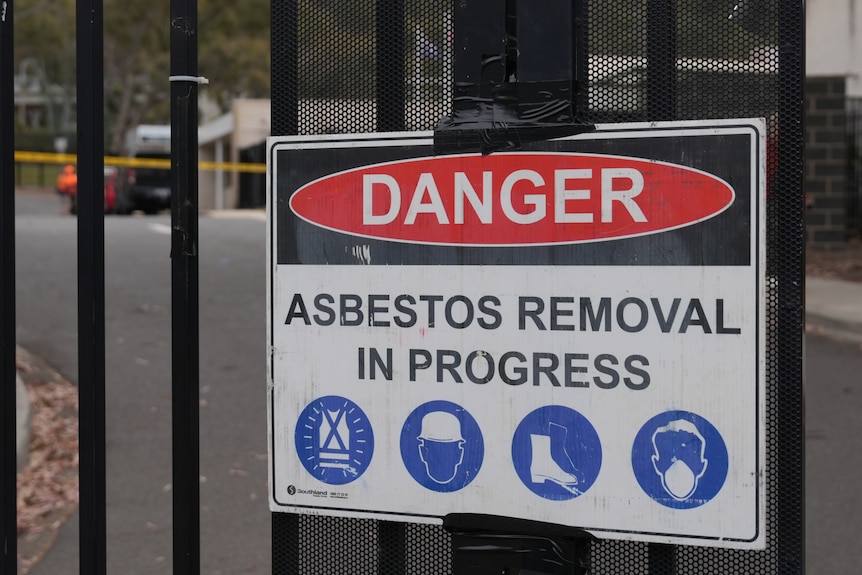
Dozens of schools across the country were closed for deep cleaning and the removal of sand products after the recall was issued. (ABC News: Mark Moore)
South Australian Education Minister Blair Boyer has called for a national inquiry into how the products were imported into Australia.
Federal Employment Minister Amanda Rishworth said the Home Affairs Department would treat the import of all kinetic sand into Australia as high-risk.
The ACCC said it was working with “online marketplaces” to enforce the recalls.
“The ACCC has engaged with online marketplaces to advise them of the recalls, ask that they ensure the products are not listed for sale, conduct a risk assessment regarding these types of products more generally and contact consumers that purchased these products to notify them that they have been recalled,” an ACCC spokesperson said in a statement to the ABC.
“The ACCC urges businesses to check if they are affected by the current recalls, noting this information may be updated.
“If a business sells a consumer good after it has been voluntarily recalled, it may have engaged in misleading or deceptive conduct. Fines and penalties apply for breaches of the [Australian Consumer Law].”
Professor Walsh said that the size of major retail platforms such as eBay and Amazon made it more difficult for product control on their websites.
“If you’re a small company with an online presence selling stuff online, you can look through your own catalogue. With Amazon and eBay, there are too many products, too many listings for them to have human eyes look at what they’re doing,” he said.
“They’re completely dependent on the accuracy of the AI to spot the products for them.
“Given that things are falling between the cracks, you do have to ask the question whether they put enough effort into making the AI accurate enough.”What to know about the coloured sand recall
The eBay Australia spokesperson said measures taken to remove products flagged by its internal AI systems needed to be periodically reviewed.
The ACCC said it advised businesses against only using AI to act on product safety concerns.
“Online marketplaces and retailers should not rely only on AI tools to identify unsafe products,” a spokesperson told the ABC.
“The ACCC has encouraged online marketplaces who are signatories to the Australian Product Safety Pledge to investigate new technologies, including AI, to improve how they monitor for unsafe products and remove listings.”