
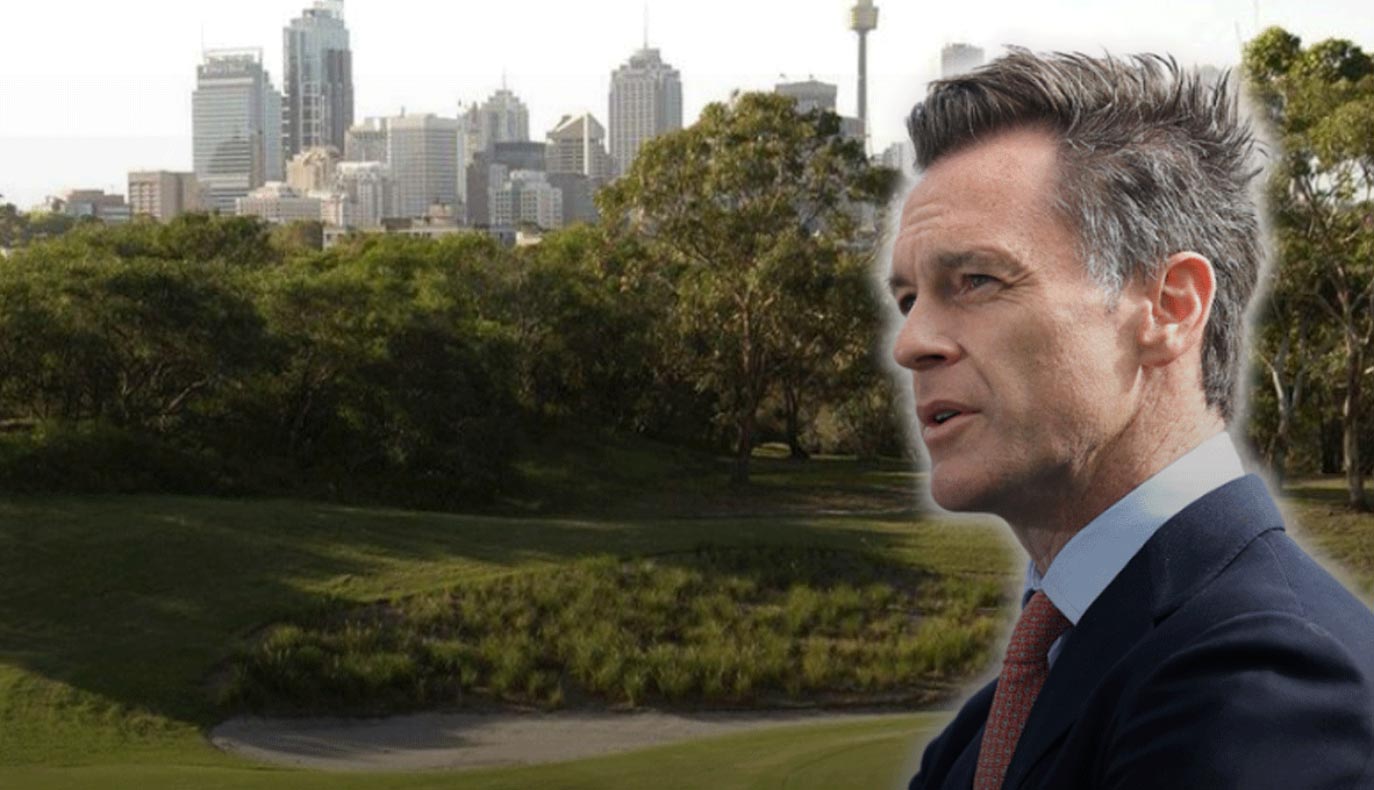
Moore Park Golf Course has always been more than turf and tees. It is one of Sydney’s busiest public golf venues, a lifeline for thousands of everyday players, a training ground for juniors, and a rare slice of open sporting space in the heart of the city. Yet the Minns Government and Sydney Lord Mayor Clover Moore appear determined to cut it in half, even as new documents make their push look reckless, expensive, and built on political spin rather than facts.
RELATED: Draft plans revealed for the $50m halving of Sydney’s Moore Park Golf Course
A report the government tried to keep hidden, uncovered by The Daily Telegraph, shows the state was warned that carving up Moore Park could cost taxpayers almost $250 million and carry what consultants described as “significant financial risk”. This stands in stark contrast to Premier Chris Minns’ repeated claims that his plan to slash the course to nine holes can be delivered for just $50 million.
The contrast is not a rounding error. It is a $200 million gap, and it goes to the heart of a debate where the biggest losers are the golfers – young and old – who rely on Moore Park and the public who will shoulder the cost of bad policy.
A report buried, not broken
The business case, delivered in February and involving input from ten consultancy firms, examined four realistic ways forward for Moore Park. None cost less than $150 million, according to the Telegraph report. The preferred option priced the overhaul at $245.8 million, including an operational shortfall of $23 million over an eight-year rollout.
Yet that preferred option never included the stripped back $50 million vision Minns now promotes. That bargain figure appears nowhere in the document. It was not modelled. It was not costed. It was not even entertained.
RELATED: NSW Government announced plans to halve Moore Park before financial impacts were finalised
Instead, the report states openly that underinvestment in the so called new park would likely deter visitation and risk failure. It warned that any attempt to deliver a low budget version would undermine the entire project.
Despite this, the Minns Government tried for months to block the report from public release, citing cabinet in confidence. The Upper House eventually forced its hand. Only then did the public see the truth: the government had been asking taxpayers to trust a price tag that its own consultants never tested and never endorsed.
Shadow Treasurer Damien Tudehope told The Daily Telegraph that the public had been misled. Opposition planning spokesman Scott Farlow said the government knew all along that the option delivering the greatest benefit was leaving Moore Park Golf Course untouched.
They are not wrong. The business case makes it clear. None of the proposed redevelopment options outperformed the existing operation, which brings in strong financial returns for Greater Sydney Parklands without requiring major capital investment. Moore Park currently generates around $7.2 million annually from golf activities alone. Cutting it in half not only guts that revenue stream but also jeopardises the financial sustainability of the entire parklands authority.
The risk is spelled out plainly in the report: “As the responsible entity for the stewardship and management of the Moore Park Golf Club and broader Centennial Parklands, this risk is significant with very serious consequences.”
MORE: NSW Government used ‘inflated’ figures to justify halving Moore Park Golf Course
A solution worse than the problem
Minns argues that Sydney’s growing population needs more green space. Few disagree. More open space is a good thing. The problem is the choice of target. Moore Park already provides green space. It is used heavily. It is inclusive. It is open to the public seven days a week. It is one of the most accessible courses in Australia, both in cost and location.
Destroying half of it to remake a park that already exists, with far less economic return, is the definition of wasteful.
The report’s preferred plan would have created 18 hectares of recreational space, including playgrounds, fitness stations, a BMX circuit, multipurpose courts, a nature fitness course, a discovery trail, and community greens. It also would have rebuilt the golf offering around a 12-hole layout, a 50 percent expansion of the driving range to 90 bays, and an 18-hole mini golf facility.
Even that plan was expensive and risky. But at least it was costed.
The Minns Government plan, now on public exhibition, removes the BMX and pump track, chops the course to nine holes instead of twelve, keeps the mini golf, expands the driving range, and promises 20 hectares of new parkland. Somehow this version is supposed to cost $50 million.
The problem is simple. It cannot. Not when the original business case showed that even the most modest version of the project would cost triple that number.
MORE: Golf Australia’s James Sutherland to NSW premier Chris Minns on Moore Park: ‘Let’s talk’
Even access alone will blow the budget apart. The report said the project required significant improvements to pedestrian connections, including a new overhead bridge across South Dowling Street to link park users to the site. Yet the Minns Government has not costed such a bridge. The existing pedestrian bridge, mentioned by a government spokesman, is inadequate and was never considered sufficient by the consultants.
Ignoring key infrastructure was not an oversight. It was a way to protect the $50 million narrative.
Golf Australia CEO James Sutherland has called for more discussion on the future of Moore Park, a calm suggestion in an increasingly chaotic debate. Public golfer Liz Melville was blunter, telling The Daily Telegraph that reducing Moore Park to nine holes is a step in the wrong direction.
“This is a valuable place and it is an asset that encourages people to get out and socialise, regardless of age,” she said. “There are not many other golf courses around here where you have that public access.”
She is right. Moore Park is often the first course new golfers try. It is a key feeder for the sport. It is a daily home for thousands of workers and students who cannot travel to suburban or private courses. It is a cultural landmark as much as a sporting one.
Clover Moore’s war on golf
Sydney Lord Mayor Clover Moore has long targeted Moore Park as a political trophy. Her push to convert half the course into parkland has never been based on usage data or fact. Public participation at Moore Park is rising, not falling. The city is not short on park space. It is short on sporting space. Yet Moore has framed golf as an indulgence, a claim that ignores the diversity of users who rely on the course.
Young players, casual golfers, women, seniors, new Australians, and school groups are part of the Moore Park community every day. Equity is not achieved by removing options. It is achieved by providing more of them.
The Minns Government has now tied itself to the mayor’s long running crusade. The result is a plan built on political convenience instead of logic.
MORE: “THIS ISN’T THE SOLUTION”: Sporting legends join fight to save Moore Park’s 18-hole layout
The real question….
Does Sydney need more open space? Yes. Should that space be created by destroying the city’s most popular public golf course? No.
The secret report proves the financial case for cutting Moore Park has collapsed. It was never strong. Now it is unworkable.
What remains is a government pressing ahead because the politics matter more than the outcome.
Moore Park Golf Course deserves better. Golfers deserve better. Taxpayers deserve far better.
If Minns and Moore want to build new parks, they should do it honestly. Do it with real funding. Do it where it makes sense. Do it without wrecking a historic, successful, and vital sporting asset.
Moore Park is not the problem. The problem is a government trying to pretend that a $245 million project can cost $50 million if it just closes its eyes long enough.
The numbers say otherwise. The golfers say otherwise. And now, thanks to a report the government tried to bury, the public can see why.