
There is a lot of anxious talk in share markets about whether we’re in the midst of an AI bubble.
We are, of course — it seems impossible for the profits from AI to be enough for a decent return on the huge amounts being invested in it.
But no-one knows when the bubble will deflate, and investors don’t want to miss the last bit of froth, so they hang on, hoping to time their exit perfectly, which is impossible.
In a way, asset price bubbles have a purpose: they provide the money for a new burst of technology with the opportunity for a group of optimists to sacrifice their wealth for the benefit of the rest of us.
Loading…The legacies of burst bubbles
The dot com bubble of the 90s left us with the internet after it crashed, the railroad bubble of the late 19th century left America with railroads, Tokyo’s real estate bubble in the 1980s left Japan with some great buildings and the tulip mania of 1637 left us with … well, nice flowers.
The AI bubble we’re in now will leave us with AI, which could be great, but it could also change human society more profoundly than any previous technology since the wheel.
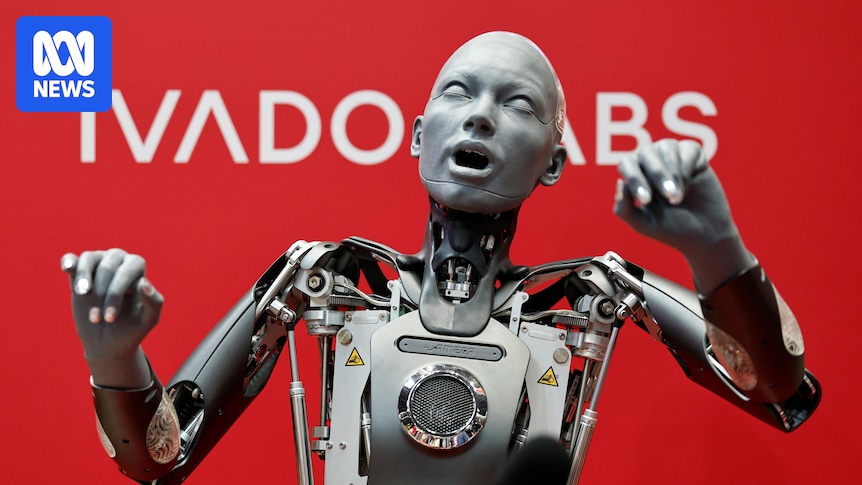
I’m not thinking about AI assistants that do internet searches for us at the moment, but about humanoid robots.
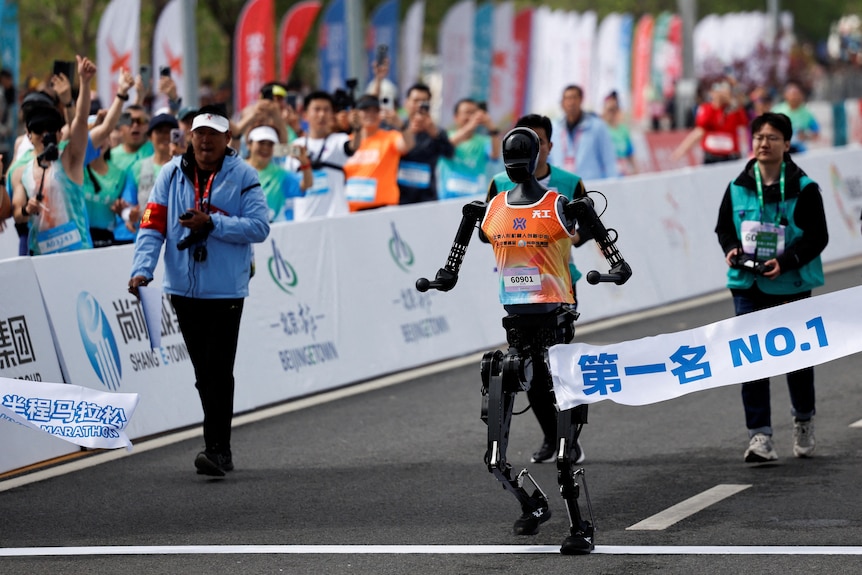
There is now a global race to build humanoids that can walk, talk, reason, lift, carry, fetch, stack and generally operate in a human environment.
There are at least a dozen companies around the world working on machines that are plainly designed to bring about a new era of labour that can be owned, not employed.
That is, we are heading into a new era of chattel labour, otherwise known as slavery, but when it involves machines that word doesn’t apply.
None of the work on humanoid robots is happening in secret. (Reuters: Kim Kyung-Hoon)
Humanoid robot shipments begin
Capital always wants labour that delivers maximum output at minimum cost, with maximum control and minimum friction and employers will be looking forward to having human-like machines to provide that.
In fact, shipments of them have started. UBTECH Robotics of China has begun large-scale shipments of its Walker S2 humanoid robots, sending several hundred units to customers in the automotive and logistics sectors.
The Shenzhen-based company said it had an order pipeline of more than 800 million yuan (about A$173 million) and is delivering 500 humanoid robots this year to industrial firms like BYD, Geely Auto, FAW-Volkswagen, Dongfeng Liuzhou Motor, and Foxconn, for their production lines and warehouses.
By the way, the Walker S2 has a self-directed battery-swapping mechanism that allows it to replace its own power pack without human assistance and keep working.

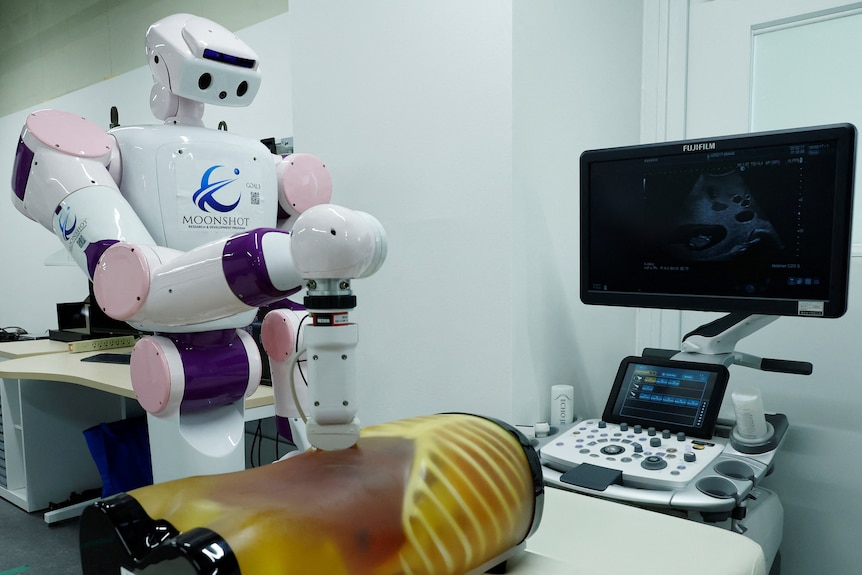
Elon Musk says Optimus, a humanoid robot, will make “an incredible surgeon”. (Reuters: Kevin Lamarque)
None of the work on humanoid robots is happening in secret, far from it: there are lots of YouTube videos of these things running, dancing, walking on uneven surfaces, doing housework, cooking meals, watering the garden and carrying things.
There’s one video showing a Chinese army of them, marching in serried ranks straight out of the movie I, Robot.
Some of them have beautiful female faces and bodies that are covered in tight dresses, presumably for the future robot companion market.
The developers seem to have solved the initial problems of getting them to be stable standing on two legs (although a Russian one famously fell over on stage last week as it was introduced to an audience agog that Russia had actually pulled it off — they hadn’t).
And then there’s the biggest challenge of all — hands.
A few weeks ago, Shadow Robot, a London-based robotics company, announced it had developed a robot hand that has 24 joints driven by 20 motors and can pick up small objects like a pencil.
Elon Musk, the CEO of Tesla, which is well-advanced on a humanoid robot called Optimus, said Optimus would make “an incredible surgeon”.
Loading…A longer timeline
Then again, Rodney Brooks, the Australian roboticist who started a consumer robot company called iRobot, wrote an essay in September explaining why humanoid robots would not learn how to be dexterous and said the whole industry would take much longer than it thinks.
But there is a lot of money now going into proving him wrong, and it’s getting hard not to think that the world’s capitalists are eagerly anticipating a new era of labour they can own instead of employ.
Robots, like slaves were, are part of capital rather than labour — that is, in corporate language they are capex (capital expenditure), not opex (operating expense) like payroll.
Why the EU’s been accused of caving to big tech on AI
And remember that slavery provided the foundations of global economies for thousands of years, and formed the economic basis of the Egyptian, Greek, Roman and more recently the British Empire as well as the United States.
The price of an African person sold to a sugar plantation owner in the West Indies in the 18th century was about the same in today’s money as a robot is likely to cost when they hit the market in a few years’ time: $50,000 to $100,000, although that is likely to come down rapidly as manufacturing scales.
Think about it like this: capitalism has been without slave labour for a bit less than 200 years out of about 7,000 years of human commerce, so less than 3 per cent of the time.
That’s not very long, and business owners still seem to be struggling to come to grips with its absence.
After slavery and serfdom were abolished and employers had to start paying workers, they brutally oppressed them at first. There was child labour, long hours and widespread misery.
Karl Marx and unionism changed that in the late 19th century — “workers of the world unite!” — prompting strikes, pickets and revolutions in Russia and China among other places.
Industrial relations in the late 19th and early 20th centuries were a constant battleground of post-slavery conflict, as workers fought for their rights and businessmen tried to maintain the power of ownership over labour.
In 1907 the Harvester judgement in Australia began the end of that war.
It was a world-leading ruling on the payment and treatment of workers, because it established for the first time the principle of a living wage.
Loading More ubiquitous than the smartphone
If robots that look human really can do the housework, shopping and gardening, as well as recite every poem ever written, teach us history and provide relationship advice — not to mention a relationship itself — and do it all for less than $10,000 each they will become the greatest consumer product in history, potentially more ubiquitous than the smartphone.
But if they really can remove our gall bladder and replace a heart valve, as well as serve in a shop or restaurant, check us in at the airport, lay bricks and repair a car — creating a “world of sustainable abundance” — will that be wonderful as Musk predicts, or a social and economic nightmare?
We simply don’t know — whether it will happen or what it will be like.
There is now a global race to build humanoids that can walk, talk, reason, lift, carry, fetch and stack. (Reuters: Tingshu Wang)
One big problem is that tax systems are primarily built around taxing the income from human labour, mainly by taxing the individuals earning it. If work shifts to machines that are capital instead of labour, then the structure of taxation will have to be rethought.
Not only that, the fundamental social contract will have to be reconsidered since most people currently live on half to two-thirds of the income from selling their labour that’s left after paying tax.
If labour income shrinks and capital income explodes, some form of wholesale redistribution will be unavoidable, either early, through calm policymaking, or later, as a result of social conflict.
There are several plausible models being discussed: a universal basic income that is financed by taxes on robot-driven productivity, sovereign or social wealth funds, owning shares in the robotics and AI sector, that pay cash dividends to everyone, shorter work weeks, spreading remaining human jobs more evenly, and significant retraining, though training alone can’t absorb the impact if robots become truly general-purpose.
Mass early retirement
The fundamental challenge is that our tax system is built around the assumption that labour is the primary source of income. When labour shrinks, so does the tax base, and we don’t have tax structures designed for trillion-dollar robot fleets.
More than that, our whole lives revolve around work.
Loading…
It provides routine, purpose, identity, and community. If millions are no longer required to work, we must find alternative sources of meaning: self-education, creativity, civic life, or things we haven’t thought of yet.
We are used to the idea of retirement, but mass early retirement is a whole different matter.
Capital’s yearning for machine labour is obviously not a conscious desire to reintroduce slavery, it’s simply an extension of the normal corporate impulse for control, predictability, and low cost.
Slavery delivered those things through violence; robots deliver them through engineering. The moral difference is absolute.
But the economic implications are similar.
Humanoid robots represent the first credible pathway for capital to operate with minimal reliance on human labour.
It is historically unprecedented — and could be explosive if mishandled.
Alan Kohler is finance presenter and columnist on ABC News and he also writes for Intelligent Investor.