
Doing this job, it is important to avoid what is known as recency bias — when current or very recent events are elevated to unjustified importance compared with things that happened in the past. All too often, what we describe as unprecedented in fact has plenty of precedents.
Bearing that in mind, and having thought about it a lot, I am prepared to describe the run-up to Rachel Reeves’s second budget as the messiest and most confused I can remember. It has harmed consumer confidence, cooled the property market and hit economic activity in a way I cannot remember before. Not only that, but it has gone on for a very long time, at least five months in all.
I do not say this lightly, because there are other candidates, one of them the run-up to the chancellor’s first budget just over a year ago. That was also very messy, and people and businesses made decisions they now regret as it approached, expecting things to happen that did not transpire. This one, though, beats it.
• David Smith: Job market hit by budget fears while still reeling from past one
I could go back further: Nigel Lawson, Margaret Thatcher’s second chancellor and an intellectual heavyweight, presented his first budget on March 13, 1984. It cemented his reputation as a radical tax reformer.
Just under two weeks earlier, however, almost the entire content of his budget was obtained by The Guardian. It was an expensive leak, because one measure was the abolition of life assurance premium relief — tax relief on life insurance policies — and people responded by rushing to take out such policies before the budget. If they did so, they could receive tax relief on their premiums for the next 40 years.
This was an unauthorised leak, and you can have some innocent fun by looking at Lawson’s private office files on the Margaret Thatcher Foundation website and the attempt by the Treasury permanent secretary to find the offender. It turned out that many people in the Treasury had access to the budget secrets. I don’t think the leaker was ever caught.

Nigel Lawson with the budget box outside 11 Downing Street in 1984
HULTON-DEUTSCH COLLECTION/CORBIS
It did not prevent the 1984 budget from being a highly successful one, setting the tone for fiscal policy, in what became a tax-cutting period, for the rest of the decade.
Twelve years later, with the Tories still in charge, the Daily Mirror, then edited by Piers Morgan, received 36 documents that provided the details of Kenneth Clarke’s November 1996 budget. Morgan, perhaps strangely, did not publish them, or their details, saying he had a “public duty to return such sensitive documents”.
Most of what we regard as very messy budgets are the announcements themselves, rather than the lead-up to them, although George Osborne’s “omnishambles” budget of 2012 had a bit of both. His most controversial announcement, leaving aside the pasty tax, was cutting the top, or additional, rate of income tax from 50 to 45 per cent. It was leaked beforehand, though not with the certainty that characterised the 1984 budget leak.
We remember, too, the September 2022 mini-budget under Liz Truss, which included the abolition of that 45 per cent top rate, as well as plenty of other measures. Interestingly, many of the details of that budget were circulating in Tory circles for days before the budget, and economists close to her advised unsuccessfully that it should be toned down. Again, though, the shambles mainly involved the budget itself, not the lead-up to it.
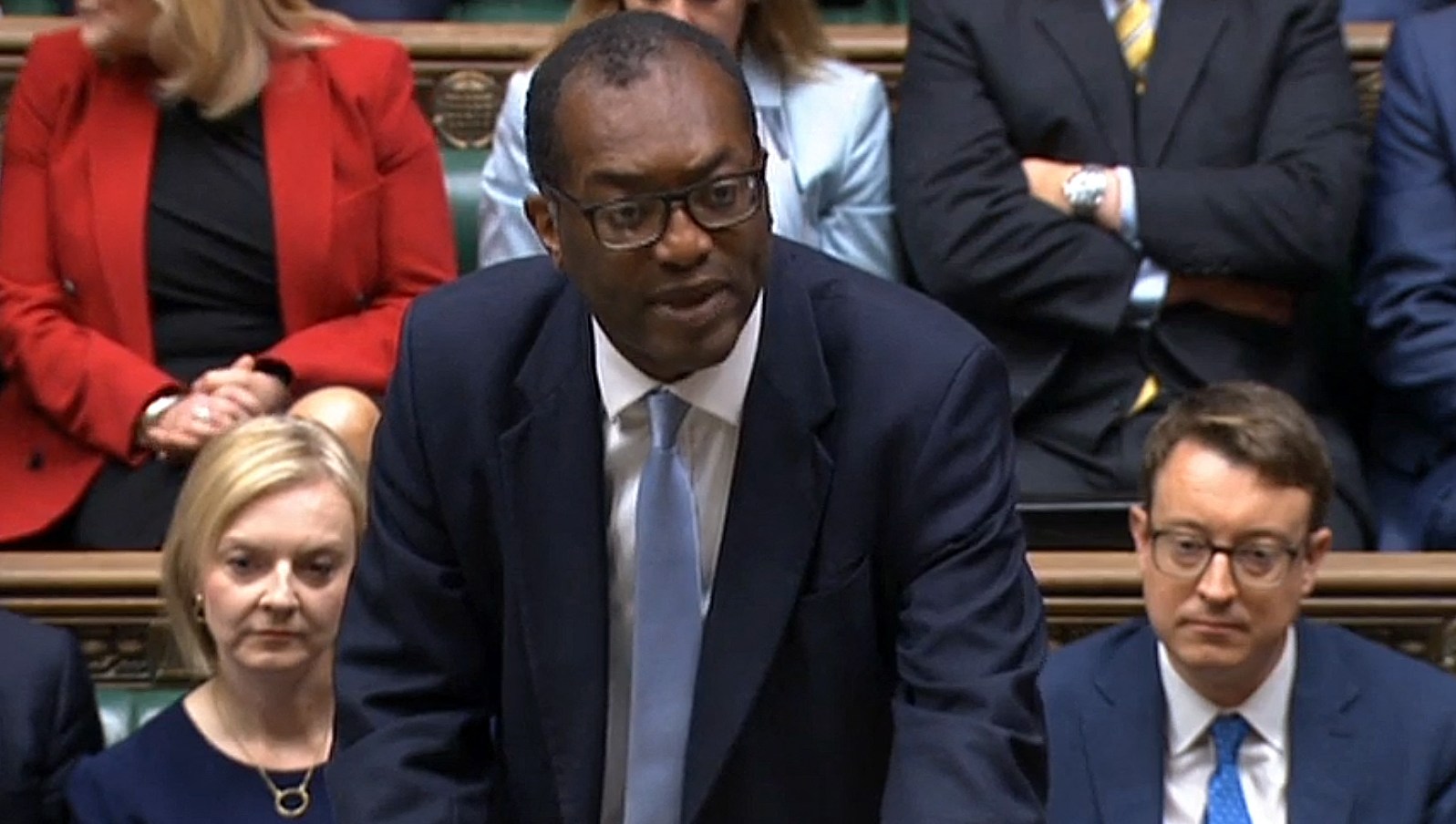
Kwasi Kwarteng delivered the disastrous 2022 mini-budget flanked by Liz Truss, the prime minister, and Simon Clarke, the secretary of state for housing and levelling up
PRU/AFP/GETTY IMAGES
What has made the run-up to this year’s budget so notable for the wrong reasons is that it has created an enormous amount of economic uncertainty, as highlighted recently by Andy Haldane, former chief economist at the Bank of England. He accused Reeves of playing a “bad hand … poorly” and “sucking all life” out of the economy.
That has been due to massive amounts of pre-budget speculation on just about every tax we have. Some of this is pure media speculation, but quite a lot has been whispered in the ears of journalists by people close to the process.
• Rachel Reeves knows this budget puts a target on her back
It is almost as though we have been witnesses to a massive exercise in running ideas up the flagpole to test the response. Most of all, we were led to expect a manifesto-busting rise in income tax, teed up by the chancellor at a specially arranged Downing Street event — until the political backlash against it, including from within the Labour Party, gathered strength. That reason for the reversal is far more plausible than the idea of a late change of forecast from the Office for Budget Responsibility (OBR).
A chancellor who was prepared to bite the bullet and break a manifesto pledge has been left to cobble together a budget with many smaller tax increases, some delayed, which may merely show that quite a few of those pre-budget rumours were right. There is no tax strategy, just a desperate lurch from one budget to the next.
Is there any method in all this pre-budget madness? One theory is that the Treasury was keen to let the income tax story run because it was greeted favourably in the market for UK government bonds, or gilts. By driving down gilt yields in the period in which the OBR takes its interest-rate readings, this could have lowered its projections for the size of the fiscal hole that the chancellor has to fill.
That looks rather too Machiavellian and clever, however, and the fall in gilt yields during the period when the OBR took its readings, the ten days to October 21, reflected international as well as UK factors. That fall has now been largely reversed.
For all the messiness and confusion, you could say that all the pre-budget chat has had a similar effect, ultimately, to the old tradition of purdah. Then we did not know what was going to be in the budget because, barring leaks, nothing was said. Now we do not really know because too much has been said, leaving everybody confused about what will see the light of day.
That will change in the coming days as the budget is briefed — no modern chancellor wants to risk too many surprises — barring any rabbits left for the speech itself.
Then we will have to see whether the pre-budget damage to the economy from all the nonsense is followed by damage from the budget itself. The fact that some of this week’s measures will be delayed — such as extending the freeze on income tax allowances and thresholds beyond 2028 — will limit the immediate hit, bad though the policy is. But, after a disastrous build-up, we must wait to see the extent of the pain.
PS
I was going to call a halt to your budget ideas last weekend, but they have still been flooding in. This is the last time, at least before the budget.
Julien Hofer thinks we should keep people in work for longer by offering less generous tax relief for pensions and raising the normal retirement age. Public sector workers should be paid more, he says, in return for accepting lower future pensions, though he acknowledges that the immediate impact of this would be to increase government spending.
He also has the interesting thought that too much of our spending leaks out of the country, particularly to US businesses such as Amazon, Uber and Airbnb. The answer, he suggests, is “very heavy taxation” on their activities.
Martin Wood tells me he was born during the Second World War, so in calling for the state pension triple lock to be abolished and replaced by increases of 2.5 per cent annually for the next four years, I am guessing that he is arguing against his own self-interest.
He also favours increasing VAT to 22 per cent, while retaining the 5 per cent and zero rates, and bringing down the threshold at which people start paying 45 per cent income tax to £100,000, while at the same time ending the mechanism (withdrawal of allowances) that gives us a 60 per cent marginal rate at this level.
Kevin Davies — also, he tells me, of retirement age — thinks oldies like him should pay a national insurance-style payment into a ring-fenced fund that covers the cost of care home and nursing home fees at a basic level. With a similar ambition, my colleague Rishi Sunak once introduced a health and social care levy, to be paid by everybody, but it was scrapped (not by him).
Read Rishi Sunak’s columns for The Sunday Times
Reflecting on what has been an interesting exercise, and with apologies to those whose ideas did not make the cut, there has been a lot of good sense from the many armchair chancellors who got in touch. There has also been a lot more boldness than we have come to expect, and need, from politicians.