

November 24, 2025 — 5:00am
Save
You have reached your maximum number of saved items.
Remove items from your saved list to add more.
Save this article for later
Add articles to your saved list and come back to them anytime.
Got it
The first meal I have in Taiwan is paid for by a stranger. I sit down, eat some delicious vegetarian dumplings, and when it comes time to pay, the owner explains to me in Mandarin (which I don’t speak) that someone has already paid my bill.
Naturally, this is followed by some confusion. I insist on paying, but she continues to refuse my money, which turns into a bad game of charades as it often does when you travel. It isn’t until the rest of the restaurant gets involved that someone explains how the people sitting next to me have paid for my meal on the way out. They don’t do so for praise, acknowledgement, or even to see my reaction; they simply want me to enjoy my time in Taiwan.
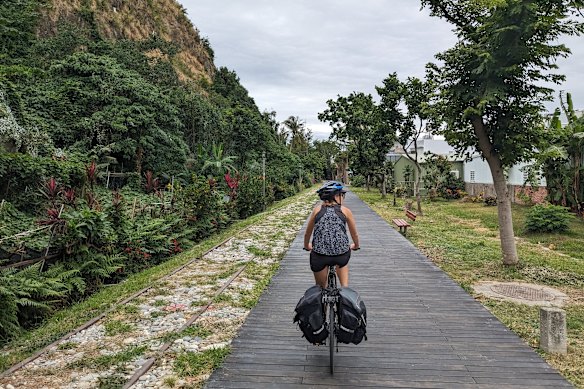 Cycling in Taiwan: an adventure made easier by friendly locals and excellent infrastructure.
Paul Marshall
This small act of dumpling-related generosity (my favourite kind of generosity) is indicative of my time in Taiwan. There is not a single encounter that leaves me with a sour taste in my mouth which is remarkable, given that I am circumventing the country on a bicycle.
Yes, a bicycle, a mode of transportation that exposes you to the best (and worst) that a country has to offer. In Taiwan, the best involves stunning natural landscapes, incredible food, and the overwhelming generosity of locals, while the worst can be summed up by the time I step in a deep puddle and have to dry my shoe with old newspapers.
Cycling around Taiwan might sound like a relatively adventurous – some might say foolish – thing to do, but it’s actually quite common, thanks to Taiwan Cycling Route No.1. What this route lacks in creativity with its name, it makes up for in cycling infrastructure, with a mixture of dedicated bike paths and quiet roads signposted all around the country.
The official starting point for the journey is at Songshan Station in Taipei then, as you hit the Keelung River, you have an important choice to make: left or right. Clockwise, or counterclockwise. I pick left, heading down Taiwan’s west coast first, where you’ll find the riding easier. It puts the wind at your back as you begin the 978-kilometre journey around the country and helps build your endurance. Some cyclists can do it nine days, although for most it’s best done over two weeks. That way you can stop, take your time, and enjoy the country, as opposed to racing through it.
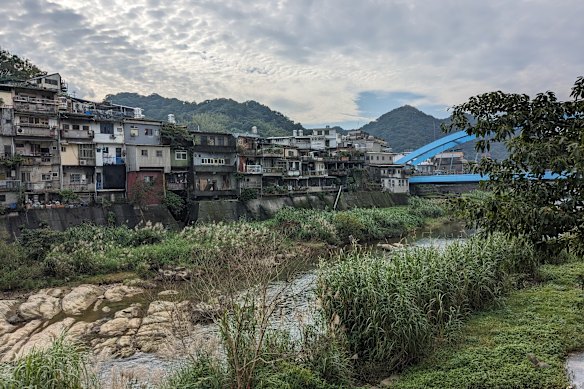 Homes on the Keelung River.Paul Marshall
People say the West Coast is ugly. I say what it lacks in looks, it makes up for in personality. Sure, there are stretches of the ride that are denser, more industrial, and have a few more wind turbines than you would see in the east, but it gives you all the more opportunity to mingle with great locals.
At my first stop outside Taipei, I’m cycling around town searching for my accommodation when a random person zoots past on his scooter and says “follow me”, before zooting off again. Anywhere else, and I’d have some questions but in Taiwan, it is the most natural thing in the world to follow this stranger without fear or doubt as he leads us to our guest house. I still have no idea who this man is or how he knows where I’m staying. He simply smiles, waves, and gives me the ubiquitous “bye-bye” that you’ll hear all over the country.
These are the sorts of encounters you’ll have in Taiwan, where people are not only absurdly kind but also way too casual about their kindness. Like the guy I meet in a bar in Hualien, who buys me a bottle of wine because it is his birthday, then basically ignores me for the rest of the night as he celebrates with his mates.
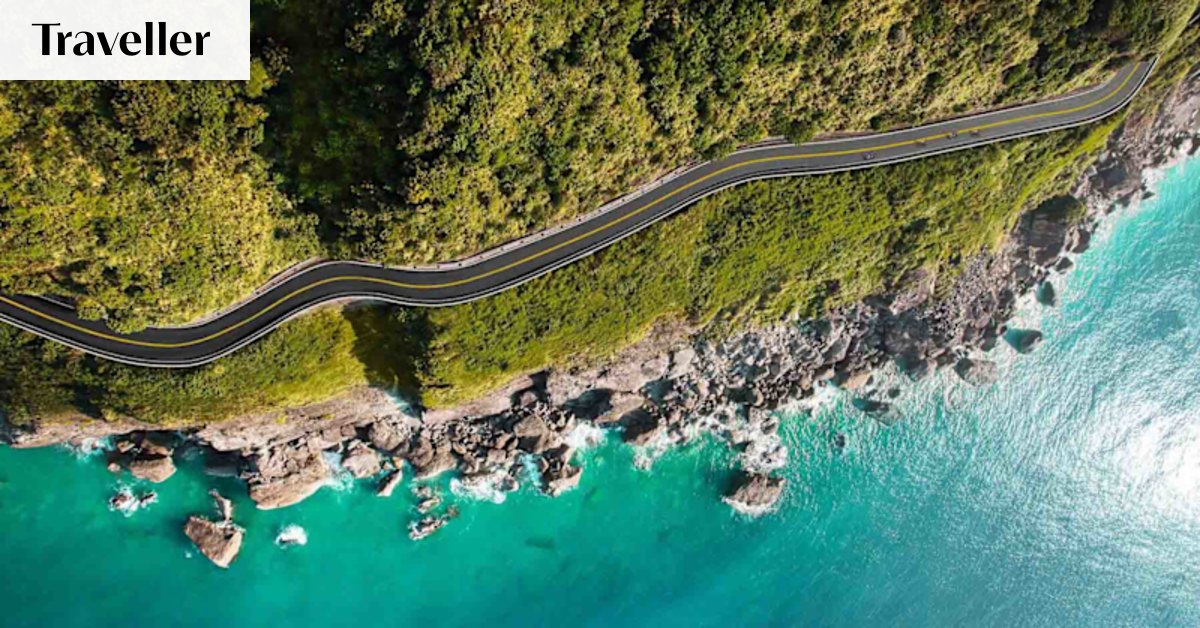
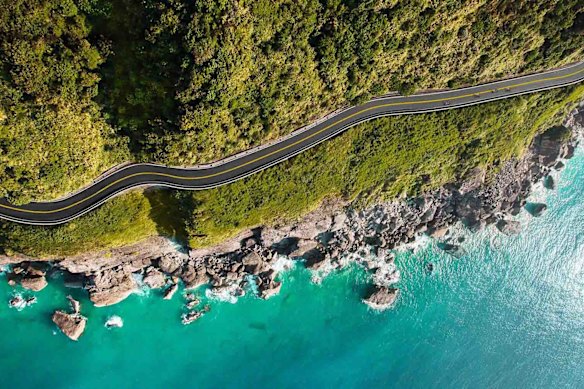 Suhua Highway on the east coast, between towns Su’ao and Hualien City, part of Taiwan Cycling Route No. 1.Taiwan Tourism Administration
If there is one major argument for cycling around Taiwan, it’s that, much like my grandma, Taiwanese people are feeders, and Taiwan is low-key one of the best foodie destinations in the world, with a cuisine that encapsulates so much more than what Chinese food in Australia taught me to expect. I’ve been to China, to Hong Kong, and the food here is remarkably different, thanks to the heavy Japanese influence and that of their 16 officially recognised indigenous tribes.
You’ll still be able to find dumplings and dandan noodles, but you’ll also encounter sushi that is just as good (if not better) than sushi in Japan. “Soup” is not a word I associate with dessert, yet in Fangliao, a town some 400 kilometres from Taipei and my last stop on the West Coast, I’m dragged into a famous dessert restaurant and develop an addiction to slurping sweet potato, yam, and sweetened condensed milk.
The restaurants are excellent and night markets in Taiwan border on a special kind of brilliance, but what really sets the food apart is the emphasis on vegetarian cuisine, thanks to Taiwan’s many Buddhist vegetarians.
My favourite of these is CHEKU, a restaurant in Chishang run by a young couple who turn tofu into magic and use the region’s famous rice to create the best risotto you’ll find outside of Italy. This restaurant alone makes Chishang a worthy stop on the east-coast leg of your journey, but it’s also a gorgeous town of morning mist, rice paddies, and great coffee.
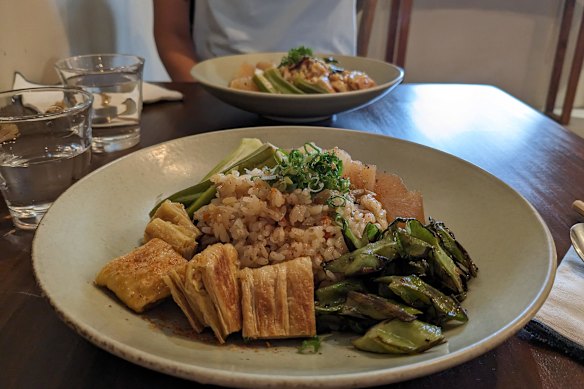 The vegetarian cuisine is outrageously good.
Paul Marshall
Some of the best meals I have in Taiwan are mostly guilt-free, as nothing has to die for my dinner. Although, it’s hard not to hear the siren’s song of pork buns and beef noodle soups on occasion. There is something remarkably satisfying about getting halfway through a meal before realising there isn’t a single piece of meat on the plate.
Taiwan’s excellent cycling infrastructure makes it easy to choose which parts of the ride you want to do. The trains are absurdly affordable, with a trip halfway around the country costing less than you’d spend catching public transport to work each day in Sydney or Melbourne.
They also have bike racks you can book, too, which means if you’re ever tired, waterlogged, or simply don’t quite feel like schlepping up and over a 700-metre elevation, you can pop your bikes on a train and cruise to your next stop.
In saying that, once you hit the east coast, you’re not going to want to skip a thing. It’s one of those enchanting parts of the world where you have to stop every five minutes to take a photo. It’s unlike anywhere I’ve been and each time we climb another hill or round another corner, I remind myself how lucky I am to be here.
Related Article
But the natural beauty can’t compare with that of the people. It’s worth the journey just to experience the exceptional hospitality of this underrated destination.
The details
Fly
China Airlines flies direct to Taipei from Sydney or Melbourne, with EVA flying direct from Brisbane. See china-airlines.com; evaair.com
Ride
Several companies organise rental bicycles. The excellent MatthewBike offers touring bikes that can be rented for about $330 for 15 days. Includes panniers, locks, helmets, and just about everything else you could ever need for the adventure. See mathewbike.com
The writer travelled at their own expense.
Sign up for the Traveller Deals newsletter
Get exclusive travel deals delivered straight to your inbox. Sign up now.
Save
You have reached your maximum number of saved items.
Remove items from your saved list to add more.
 Paul Marshall is a Sydney-based travel writer who left his heart on the Banana Pancake Trail. With more than 10 years’ experience in the film, television, and video game industries, he now writes about his former life as a digital nomad and is always plotting his next escape. Whether it’s cycling across Korea or living in a Japanese fishing village, he loves a little-known destination and an offbeat adventure.Connect via email.Traveller GuidesFrom our partners