
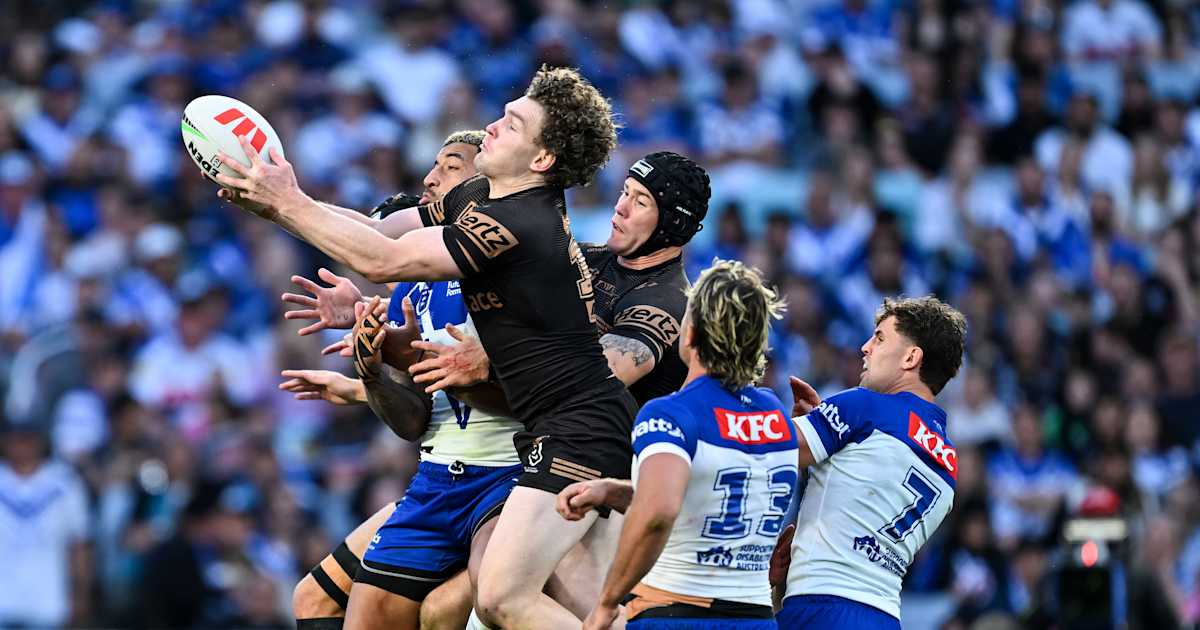
Want to win a trip to Vegas for the opening NRL round? Be sure to submit your best Captains Call for a chance.
01
NRL positions: A complete guide
Rugby league and rugby union share the same roots, but their on-field roles have evolved into two distinct systems — league’s faster, six-tackle structure drives more defined playmaker and power-runner positions, while union’s ruck-and-maul engine room creates specialised roles across the full 15.
As both codes continue to grow in Australia, Red Bull’s partnership with the NRL highlights the brand’s commitment to high-intensity sport and athlete performance, celebrating the speed, skill and physicality that define modern rugby.
Rugby League was a breakaway game from rugby union founded in 1908 and as such many of the positions are similar between the two sports, but some have changed drastically over the years.
Rugby league has two less players on the field (13) than the 15 man rugby union game, with flankers not a part of the rugby league forward pack. However, given the way the games are played, there are some stark differences in some of the positions on the field.
Rugby League involves six tackle sets with play-the-balls and the defensive line has to retreat 10 metres every play or risk being penalised by the referee for being off-side.
In rugby union, teams get unlimited amounts of rucks with the ball, with the defensive line having to be behind the last man’s feet and back five metres from the scrums, while they can also steal the ball on the ground once the ball carrier has let go as long, as they keep their feet and come through the gate.
Read on for the rugby union and rugby league positions explained.
The rugby league fullback wears jersey No.1, and is the last line of defence at the back and a key marshall of the defensive line, given he can see where the gaps are and help his defenders plug them, while he also needs to make cover tackles if breaks are made and field the kicks at the end of every set.
The modern rugby league fullback has also become a third playmaker to the halves and stars like Reece Walsh also have a strong kicking and passing game, as well as brilliant running skills to finish off tries and set them up for their wingers.
The rugby union fullback wears jersey No.15 and is also a key defensive marshal for the front line.
However, in the 15-man game, fullbacks can expect a lot more kicking and need to be excellent under the high ball, while ideally also possessing a huge boot to get field position for their own team.
In attack they are designed to be a link player and pop up anywhere in the backline to create an overlap and feed their wingers out wide.
In rugby league the wingers wear jersey numbers No.2 and No.5 and are situated on the far side of each touch line to act as the finishers for try-scoring movements.
They also play a key role in helping the fullback field kicks in defence and tackle their opposition wingers to deny tries for the opposition.
However, in modern rugby league, wingers have become like an extra prop, helping to make tough carries out of the back-field and give the forwards a break.
They also leap for tries on the last tackle of sets and help diffuse the same raids from the opposition.
In rugby union, wingers wear jerseys No.11 and No.14 and are responsible for finishing tries in the corners and defending them on the edges.
They are also required to work with each other and the fullback in the back three to field and return kicks and sometimes kick the ball back to achieve field position.
Wingers can be both fast and small or big in rugby union and can beat players with their power or footwork depending on the team and players’ skill set.
Liam Martin makes a break into open ground
© NRL
In rugby league there are two centres wearing jerseys No.3 and No.4 and they hold a crucial role of working with their second-rowers and wingers to defend the edges of the defensive line.
Situated on opposite sides of the field, centres rarely work together in league, but they are a key link player between their forwards and halves on the inside and their wingers and fullback on the outside.
Centre is the hardest position to defend in rugby league and crucial to create chances in attack and stop them in defence.
In rugby union, centres wear jerseys No.12 and No.13 and are called the inside centre and outside centre respectively. The inside centre stands outside the fly half, which used to be called five-eighth.
The inside centre also used to be called second five-eighth and was a playmaker and link between the halves and the outside backs. However, the modern inside centre has also become a battering ram and needs to get over the advantage line in attack to set the tone for the backline, while also stopping the opposition in defence.
The outside centre is considered the hardest position to defend, given the space opposition teams create on the edge and they need to make split second decisions on whether to come in or stay out.
In attack the outside centre needs to have a decisive running game and the ability to both hit holes and score tries themselves and set them up for their wingers and fullback.
In rugby league there are two halves called the halfback and five-eighth and they wear jersey No.7 and No.6 respectively.
The combination used to play with the halfback passing to the five-eighth to set the outside backs up. However, in modern rugby league they both stand on either side of the ruck and have their side of the field to command, while also having a license to roam if they see opportunities on either side of the field.
The halfback is considered the chief playmaker and is in charge of the kicking game and marshalling the troops, but the best ones also have a running game.
The five-eighth is considered more of a running player and uses their instincts to take opportunities when they present themselves. However, the best five-eighths also have strong kicking and passing skills to create opportunities for their outside men.
In rugby union, the scrum half or halfback wears’ No.9 and the fly half or five-eighth wears jersey No.10.
The halfback is considered the link player between the backs and the forwards and is in charge of marshalling their forwards and clearing the ruck with passes off the deck to the fly half.
The best halfback’s also have a strong running game and can box kick, which involves kicking around the corner over the ruck for their wingers and fullback to chase.
The fly half is like the rugby league halfback and five-eighth in that they catch the ball one off the ruck and are in charge of creating opportunities with their passing, running and kicking games for the rest of the team.
Most good fly half’s are also goal kickers and excellent kickers in general play to give their team field position and it is arguably the most important position on the field like a quarterback in NFL.
In rugby league the props wear jerseys No.8 and No.10 and are the engine room for the team in both attack and defence.
Props are in charge of making the tough carries at the start of each set and make the most tackles with the hooker and lock in the middle of the field.
The modern prop also has a huge engine and can play big minutes as well as having passing skills like Payne Haas.
Premierships are often built on the back of the hard work of the front-rowers and few halves can play well behind a beaten front row.
In rugby union, the props wear jerseys No.1 and No.3 and are the anchors of the scrum and the pillars for the rucks.
Given scrums are much more contested in rugby union, props need to have strong necks to stand the weight of the scrum and are also key lifters in the line-out.
Props are key to every clean-out in rugby union and need to be there to support the ball carrier to ensure the opposition don’t steal the ball on the ground.
The best props are also great ball carriers and can break the defensive line with their running and offloading games.

Reece Walsh and Izack Tago meet in the air
© NRL
In rugby league the hooker wears No.9 and is very different to rugby union.
While they both pack in the middle of the scrum, the rugby league hooker is more like the halfback in rugby union in that they are small and low to the ground and are responsible for clearing the rucks with their passing off the deck.
The best hookers also have creativity in attack with their passing and running games and are charged with getting quick ruck speed and their forwards over the gain line.
Hookers also regularly top the tackle count, given they are directly in the middle of the field where the action often is.
In rugby union, hookers wear No.2 and are bigger but also built low to the ground for their work in the scrums.
They are responsible for rucking the ball back in the scrum and throwing the ball in the line-outs.
The best hookers are built like their props, but act as a link player in attack and a pillar of the ruck defence.
They also are responsible for scoring tries off mauls and controlling the ball at the back of mauls, as they roll to the line and they need to be defensively sound to stop the opposition pack from getting over the gain line.
In rugby league the second-rowers wear jerseys No.11 and No.12 and are the link player between the halves and the centres.
Like the centres, they have a huge job to defend on the edges and often need to help the smaller halves with their defensive workloads, as that is where the traffic normally goes.
The best second-rowers are tireless workhorses in defence and offer creativity with their passing, but their most important job is to run lines for the halves to put them through holes or act as decoys to set the outside men free.
Second-rowers in rugby league typically have very big motors and make a lot of tackles.
In rugby union, the second-rowers wear jerseys No.4 and No.5 and are typically the tallest players on the field, so they can be lifted and win the line-outs.
Second-rowers are also crucial to the scrum and are the key players to push behind the front row in the scrums.
The best second-rowers also have a strong running game and are brutal in defence, while also often being first to the clear-outs of each ruck.
They also have a key role to control the middle of the mauls and drag their team forward. In the modern game they also often jump for kick-offs or are lifted like they are in the line-outs.
In rugby league there is only one player at lock and no flankers and he wears jersey No.13.
The lock defends in the middle of the field and typically has to be a great defender and make plenty of tackles.
In attack the lock has a roving commission to pop up on either side of the ruck and act as a link player between the forwards and the backs.
The best locks have strong running games and also creativity with their passing games to act as a second five-eighth at times.
In rugby union the back row consists of a No.8 and two flankers that wear No.6 and No.7.
The No.8 is like the lock in rugby league and is a link man between the forwards and the backs.
The No.8 pushes from the back of the scrum and is in charge of controlling the ball at the back of the scrum and sometimes the mauls.
The best No.8’s also have the ability to break the defensive line and get their team over the gain line, while also acting as a try-scoring option from broken field play.
No.8’s are typically big and do a lot of work in defence and carrying the ball into the teeth of the defence, while they are also crucial in clear-outs of the rucks.
The flankers are split between the open side and the blindside. The No.7 is the open side flanker and sits on the side of the scrum with more of the field to work with. The No.6 is the blindside and is on the side of the scrum with less field to play with.
The open side is often low to the ground and is responsible for stealing the ball in rucks and acting as a link player between forwards and backs and is often first to each breakdown. The blindside flanker is often a bit taller and a third line-out option with the second-rowers.
The best No.6’s also have powerful running games and are brutal in defence to set the tone in that department.
Bronson Xerri crashes over for a try
© NRL
In the end, while rugby league and rugby union share a common heritage and familiar jersey numbers, the two codes have evolved into distinct worlds with very different demands on every position.
League’s speed, structured sets and 13-man formations place a premium on game tempo, defensive systems and multi-skilled ball-runners. Union’s contested scrums, line-outs, rucks and 15-player depth create a far more layered ecosystem of roles, from specialist set-piece technicians to tactical kickers and breakdown warriors.
Understanding how each position functions across both codes not only highlights the unique strategy and skill sets at play, but also deepens the appreciation of why players rarely transition seamlessly between them.
Two games born from the same roots – but now standing as two very different expressions of toughness, tactics and talent.