
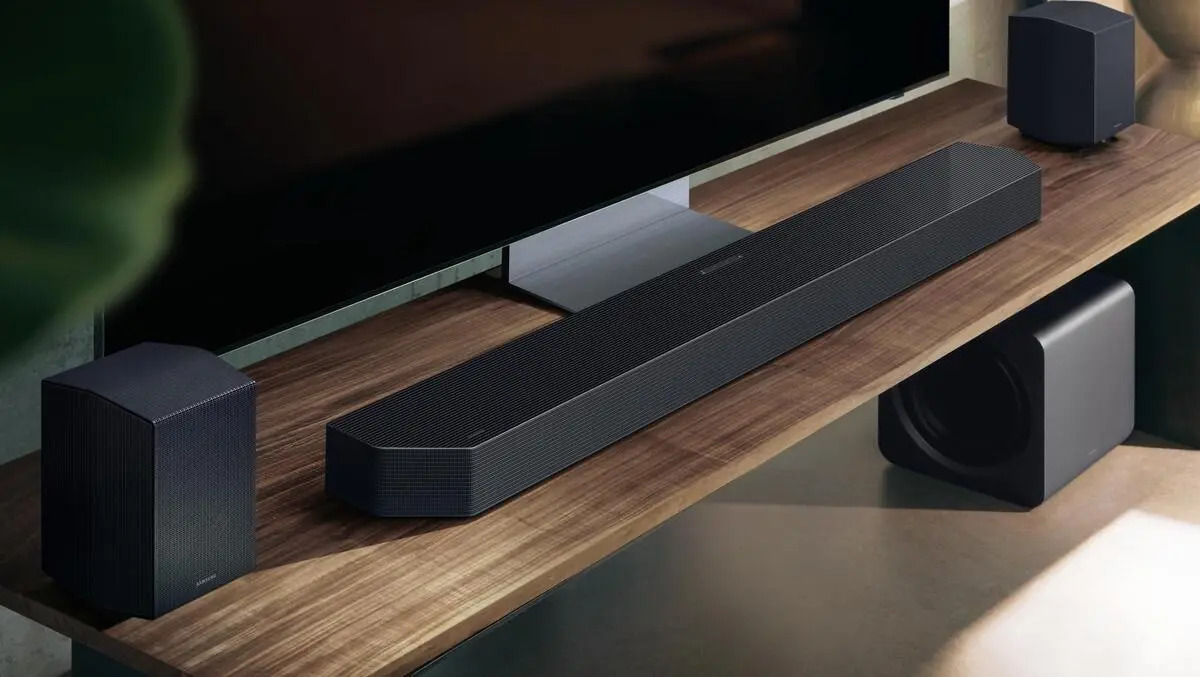
Samsung is positioning the Q990F as its most ambitious soundbar to date, a system engineered to close the gap between a single-unit home audio setup and the scale of a dedicated theatre. The 11.1.4-channel system arrives with a densely built main bar, upgraded wireless rears and a subwoofer designed for precision rather than brute force.
Central to Samsung’s argument is that this generation marks a rare leap in control, clarity and spatial accuracy – much of it down to how the company has reworked bass handling through AI.
That shift began several years before the Q990F reached production. Samsung’s audio lab had been trying to correct the way small speaker drivers distort when pushed to their limits, originally relying on a mathematical model to predict and counteract those imperfections.
Only later did the team begin replacing that model with a neural network trained to recognise and correct distortion in real time.
As Allan Devantier, Vice President and Head of Samsung Audio Lab, put it, “It would be great if I could point to a single ‘aha’ moment, but really, it was a journey/ In 2016, we developed a complex nonlinear model of how our speakers behaved. In introducing AI, we have developed our AI-powered Dynamic Bass Control to leverage a neural network rather than the nonlinear model to do the same job – but even better.”
The result, Samsung says, is bass that stays clean where older soundbars break apart – allowing the Q990F to handle deep, sustained effects without the familiar rattle or bloom that gives away a compact enclosure.
The company argues that this stability is part of what allows the Q990F to scale up convincingly for action-heavy films and modern game soundtracks, both of which demand high output without sacrificing clarity.
But Samsung stresses that numbers and algorithms aren’t what define the final character of the system.
The Q990F was tuned through a lengthy listening process across three adjustable rooms at the company’s California Audio Lab.

Devantier said this was essential for eliminating the inconsistencies that plague soundbars in real homes, where ceiling height, wall reflections and soft furnishings can radically alter a system’s performance.
“Everyone on our team is a music and movie lover. We do exhaustive measurements to progress performance but what I think sets us apart is how carefully we do the final tuning using our ears,” he said.
Double-blind testing, where engineers and listeners do not know which product or tuning they are hearing, was used to validate those decisions and remove bias.
One of the most significant hardware changes is at the back of the room. The Q990F’s rear speakers each carry both forward-firing and up-firing drivers, actively contributing to the Atmos height layer rather than relying purely on reflections from the front of the room. The aim is to recreate the sense of vertical space and lateral spread found in cinemas, where side-wall and overhead arrays surround the audience.
“The surround speakers… have front-firing speakers pointed directly at the audience, and speakers pointed toward the ceiling,” Devantier explained. “These speakers work with the side-firing speakers and the up-firing speakers in the main soundbar… When they do that well, the sense of ‘space’ in the home starts to approach that of the cinema.”
Although the rears connect wirelessly, Samsung emphasises that the challenge isn’t removing cables – it’s making the sound arriving from behind integrate seamlessly with the front channels. “The hardest part is getting the speakers in the back of the room to work together with the soundbar at the front of the room in perfect harmony,” Devantier said. The company claims the Q990F’s timing and level calibration allow the system to maintain a continuous bubble of sound rather than the disjointed front-back separation common in cheaper setups.
The bar also supports Samsung’s Q-Symphony feature, allowing compatible TVs to join in as part of the front array. This approach uses the TV’s speakers to widen the central image and to fill gaps that appear when a soundbar alone attempts to project dialogue and mid-range effects across a large space.
While the Q990F is aimed squarely at home cinema, immersive music has become a growing focus. With support for Roon and major lossless streaming platforms, Samsung expects more listeners to use high-end soundbars for music rather than reserving them for films alone.
“I am excited that Lossless Audio and Immersive Music are gaining traction with the streaming services,” Devantier said. He framed the Q990F as the continuation of a long-term mission: “When we introduced the world’s first immersive soundbar back in 2017, we wanted to create a product that could compete with home theatre systems with discrete speakers. Today we are also talking about music in that context and that has me really excited.”
Samsung’s message is clear: the Q990F isn’t just a refinement but a consolidation of years of modelling, retraining, retuning and rethinking. In the company’s view, this is the point where a soundbar stops behaving like a compromise – and starts acting like a system built to take on much larger ones.