
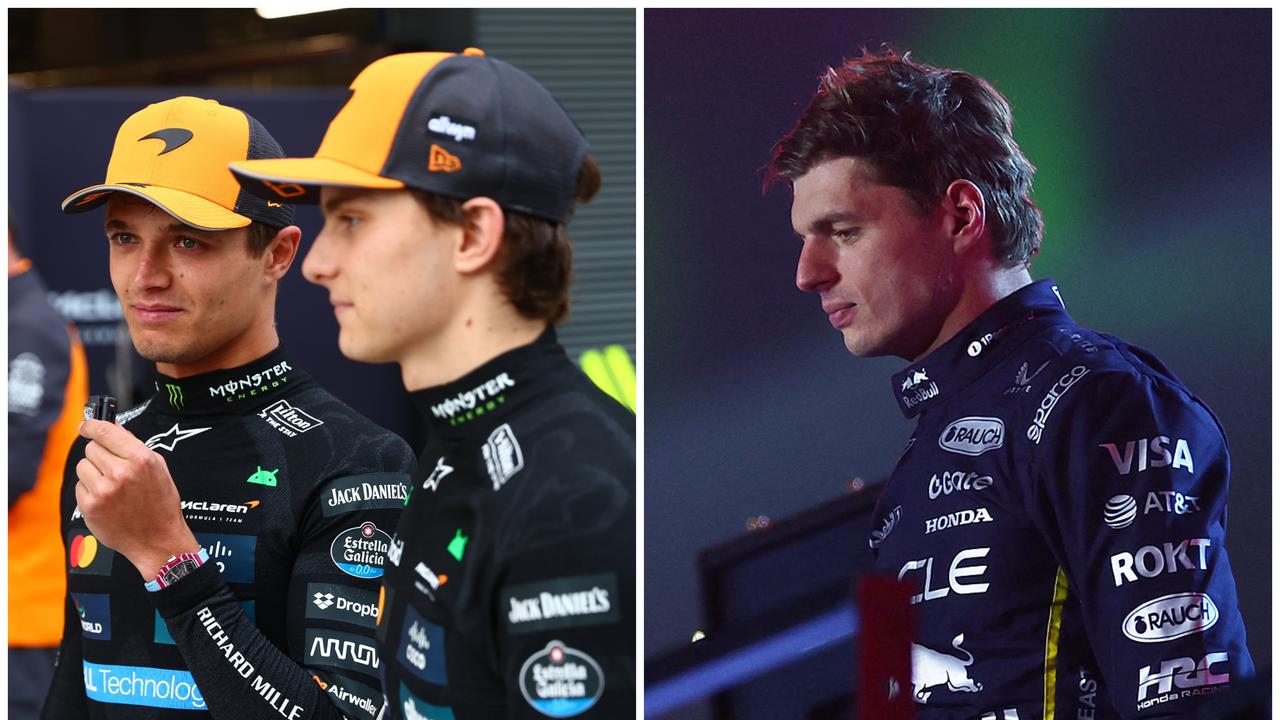
Just as Lando Norris lunged for the Formula 1 drivers championship, the trophy was yanked a little further into the distance.
McLaren’s double disqualification from the Las Vegas Grand Prix turned what was set to be a comfortable 30-point advantage into a 24-point lead.
The change seems small, but in context it’s enormous.
Fox Sports, available on Kayo Sports, is the only place to watch every practice, qualifying session and race in the 2025 FIA Formula One World Championship™ LIVE in 4K. New to Kayo? Join now and get your first month for just $1.
It’s no longer just teammate Oscar Piastri he heads. It’s also Max Verstappen, who’s now less than a race win behind the leader.
Verstappen is the sport’s top performer in the second half of the season, and he’s in career-best form.

Norris’s margin is still healthy, and for that reason he’s still the title favourite.
But having the reigning world champion in striking distance has fundamentally changed the game.
And it’s changed the game not just for Norris but for Piastri too.
McLaren duo disqualified | 03:26
WHY VERSTAPPEN MATTERS
The 2025 Formula 1 season has been one of phases rather than conflict.
Piastri, Verstappen and Norris have all taken turns at seizing the ascendancy and struggling, but no combination of them has spent an extended period at the top in direct competition.
The fight for the championship has been as much about the drivers fighting their own form — or, in Verstappen’s case, his uncompetitive car — as it has been about them beating each other.
It seemed that Norris would power to the title as the man in the ascendancy at the right moment. Peaking at the right time is crucial in a season as long as this, and the Englishman has nailed his timing.
It would be unfair to argue that Norris winning the title this way — as he could still do — is in any way underwhelming. He would do so by interpreting the rhythm of the season better than anyone else.
But the most exciting championships, the most consequential championships, are those won by defeating the incumbent directly.
Beating Verstappen in a straight duel would give the title more meaning. Norris’s chapter in F1 history would be significant as the man who did not simply take over from the Dutchman but who deposed him.
This is what is so exciting about the prospect of Verstappen being in the battle, even as an outsider.
But there is a second element that makes Verstappen’s rise back into the frame so intriguing and that layers on further meaning to this battle.
Whenever Norris has attempted to take the fight to Verstappen, the Dutchman has won — and pushed the Englishman around in the process.
We saw only the latest episode in Las Vegas.
Anticipating a typically aggressive first-turn move from the inside line, Norris immediately darted across from pole position to block Verstappen, so much so that the Dutchman had to fractionally lift to avoid contact.
But it was a move made in vain. Norris missed his braking zone on the dirty side of the grid and slithered off track, losing a place not only to Verstappen but to George Russell as well.
It’s interesting, though, that the seeds of this incident may have been sown by Verstappen getting under Norris’s skin on the formation lap.
As they exited the chicane and rounded the final bend, Norris was told to do five burnouts to warm up his tyres for the start.
Instead he radioed back a complaint that Verstappen wasn’t following him closely enough.
“He’s taking the piss with how big of a gap he’s leaving,” he said. “It’s way over the allowed allowance.”
The reply was brief but noncommittal: “We see that, Lando.”
But the Briton seemed preoccupied by the Red Bull Racing car shrinking in his mirrors.
“Yeah, come on! He’s just taking the piss here. You can’t do this. It’s 10 car lengths, no?”
He gets the same reply from his engineer, who then relays further instructions about preparing the car for the start.
There’s nothing in the sporting regulations that specify how closely drivers have to follow each other on a normal formation lap, but in his fascination Norris did only three of his five burnouts.
Verstappen, meanwhile, completed all five of his, ensuring his tyres were warmer off the line.
Whether it was a deliberate ploy from the reigning champion to have Norris stationary for longer on the grid isn’t the point.
The fact Norris seemed more focused on the Dutchman than on himself is what’s important.
Lando firms title hopes despite Max win | 03:03
F1’S SIMMERING RIVALRY
Norris’s rivalry with close friend Verstappen dates back to last year’s Austrian Grand Prix, their first battle for the lead.
This was at a time that Norris’s longshot championship challenge seemed fanciful, with Verstappen having won seven of the opening 10 grands prix.
Norris had the pace late, but Verstappen’s defences had him stumped.
Eventually they spectacularly collided. Norris limped back to pit lane and retired, while Verstappen pitted and finished fifth. It was ruled Verstappen’s fault, and he was duly penalised.
But while Norris was critical in the immediate aftermath, bizarrely he ended up making excuses on behalf of his friend and rival at the following grand prix, apparently unwilling to stick up for his own interests.
Their next battle was in Austin, where Verstappen outwitted Norris with a better understanding of the rule book as the Briton attempted to pass for third, forcing the McLaren driver off the track in a way he knew would attract a five-second penalty.
In Mexico their duel boiled over, with Verstappen launching several wildly ambitious and borderline dangerous moves on the McLaren driver. While he was clearly in the wrong, it was an extension of him exploiting what by then appeared to have become a psychological advantage over his would-be challenger.
Verstappen’s behaviour seemed to say that he could do whatever he wanted and that Norris would simply have to cope.
These power dynamics can be difficult to break once they’re established, and there’s evidence this season that they continue to lurk in the background.
Think back to this year’s Miami Grand Prix, where he attempted to deprive Verstappen of the lead off the line but was bullied off the track and fell several positions down the order.
We subsequently got a direct comparison between the way Verstappen and Piastri duel each other and the way the Dutchman and the Englishman sparred.
Whereas Piastri was incisive and forced Verstappen into a tactical an error, Norris was blunter in his approaches, costing him race-losing time to his teammate until Verstappen’s tyres gave up and opened the door.
“It’s the way it is with Max — it’s crash or don’t pass,” Norris said at the time.
Oscar on start: “Barged out of the way” | 01:56
THE FUNDAMENTAL DIFFERENCE
We got our latest chapter in this duel in Las Vegas, where a Norris mistake, seemingly borne of distraction, gifted Verstappen the lead.
The Briton wasn’t convinced he would’ve had the pace to win even if he’d kept the lead, but given the importance of clear air to tyre management, it’s not out of the question — notwithstanding the eventual disqualification. If nothing else, the error meant the question was never answered.
The roots of this power dynamic are worth considering.
Verstappen has established a reputation for himself as a driver who will inevitably make the overtake or who will be impossible to pass.
Eventually every driver knows what they’re in for when he appears in their mirrors or comes into view ahead of them on the track. Subconsciously or not, they race him differently.
It seems to have shaped the way they race each other in Verstappen’s favour.
But there’s a deeper psychological element at play.
Norris sees himself as simply a different sort of racing driver.
“What people want you to believe is you have to think you’re the best in the world, you have to think you can beat everyone,” Norris told the Guardian earlier this year. “That is a great attitude to have but I don’t think it’s the only attitude you have to have if you want to be a champion.
“I just don’t think you have to have that to be a world champion. I want to prove you can be a world champion and not have it.
“There are certain things I would not do that other champions have done. I don’t have as much of a killer instinct as probably most of the drivers or most champions because I was just not brought up that way.”
This is obviously not the way Verstappen thinks.
That difference, combined with the history between them, is the baggage Norris takes into the final two rounds of the championship as Verstappen attempts to overhaul his title lead.
Analysing pivotal Piastri lap 1 hit | 04:52
NORRIS’S RISK, PIASTRI’S OPPORTUNITY
Imagine this scenario in Qatar.
Norris has qualified on pole with Verstappen alongside him on the front row. Piastri starts third, directly behind him.
Piastri gets a great start, Verstappen a very good one, and they both challenge Norris into the first braking zone.
Which driver does Norris block?
It’d be a difficult scenario in any context, but with the title on the line and with their history — and given Verstappen’s form relative to Piastri — you can only assume his focus will be as strongly on Verstappen as it was on the formation lap in Las Vegas.
Here, then, is where Piastri’s title chance could find revival.
After the wild points swing against him since the Dutch Grand Prix, after his poor form in Austin and Mexico City and after his total inability to generate some momentum in Brazil and Las Vegas, a three-way fight could be the circuit breaker he needs.
There are two possibilities worth contemplating.
The first is simply that the randomising effect of having a third driver in the battle can only be a good thing for the Australian at a time his championship challenge seems spent.
Norris has the most to lose given that his points lead really should deliver him the title. He’ll have to think carefully about every risk he takes now there’s twice the chance he could be punished for an error.
Piastri, having appeared to accept after Las Vegas that he’ll need luck to win the championship — that he has nothing to lose — can race with more freedom.
And with Verstappen also in the mix, the chance of a big swing in his favour — or, of course, against him — is raised.
The other possibility, though, is that Piastri is the happy beneficiary of the next chapter of Norris and Verstappen’s sporadic rivalry.
Verstappen’s approach is clear: in Norris’s words, it’s crash or don’t pass.
It’s difficult to imagine Norris playing the numbers game to the finish in Abu Dhabi, even when title lead is big enough for him to finish no higher than third for the rest of the season and still win the championship. It’s too risky to give up points.
But that means facing what for almost two years has been his kryptonite: no-compromise Verstappen and his killer instinct in the heat of battle.
Maybe Norris pulls it off, and maybe that’s the moment he not only wins the world championship but makes himself Verstappen’s successor.
Maybe that’s the moment his maiden title is imbued with additional, legacy-making meaning.
Or maybe this rivalry ends up exactly where it started, with the two drivers colliding, gifting an advantage to Piastri, who carries no such baggage into the final two rounds.
That’s the new context of this championship battle.
Norris’s points lead has changed only marginally, but his task is more complicated.
And after having looked out for the count after the chequered flag in Las Vegas, it’s given Verstappen and Piastri a final chance to beat him to it.