
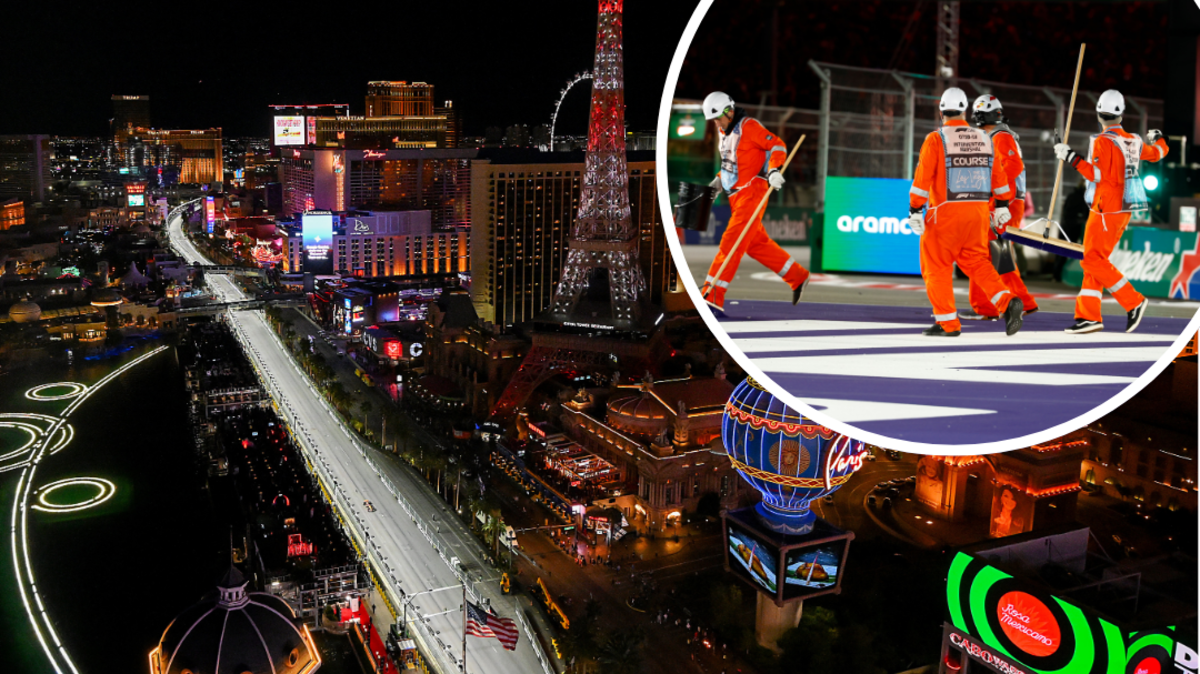
The Las Vegas Grand Prix is Formula 1‘s crown jewel of spectacle. But beneath the neon glow, consistent concerns around track safety have put the race’s future in doubt.
Despite drivers commending the drop off in required off-track demands, they highlighted the laundry list of issues that have presented themselves in the three years running on the iconic Las Vegas Strip.
Fernando Alonso was the first to deliver a blunt assessment of the Las Vegas street circuit, branding the track surface “not F1 standard”.
READ MORE: ‘Violent’ Everton star sent off for slapping teammate
READ MORE: Former AFL ‘prodigy’ wins league contract after code switch
READ MORE: ‘Maybe we got that wrong’: Coach admits Boland mistake
“The race circuit is fun, because it’s high speed, but I think the type of asphalt is not Formula 1 standard,” Alonso said.
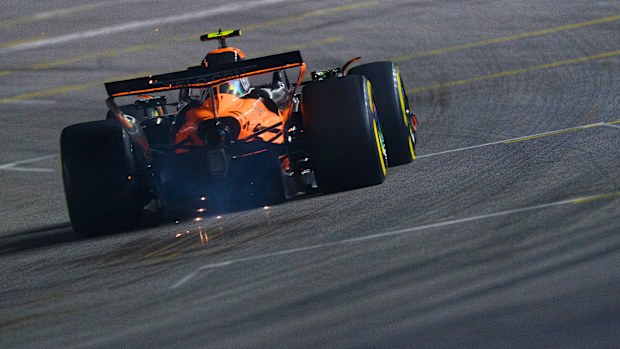
Lando Norris was disqualified for excessive plank wear after the Las Vegas track was “too bumpy”. Getty
“To be honest, it’s too slippery and we cannot put the tyres in temperature and there is no grip. It’s extremely bumpy, at the limit of being safe to race.”
He argued that the issue now needs to be addressed at governing body level.
“So I think for the future we need to talk with the FIA if this is acceptable or not for the following years,” he added.
This problem can be factored into McLaren copping their double disqualification in Las Vegas, the rear skid blocks on their cars being worn on the “bumpy” track.
During the race in Sin City, marshals were seen running on the track as cars were driving past – causing many to have deja vu to Liam Lawson’s incident in Mexico.
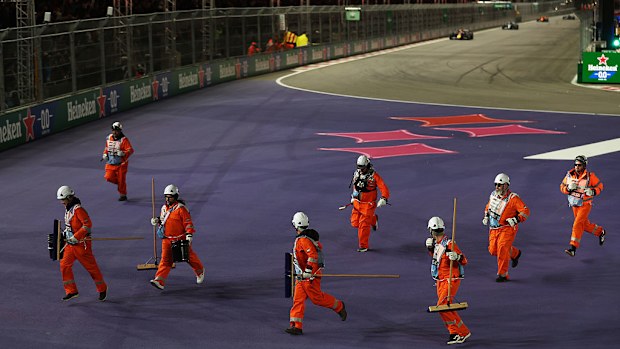
Marshals were cleaning up debris on track during the opening laps of the race. Getty
“This must not happen. This is a situation [marshals on the track] that is absolutely unacceptable,” former F1 race director Niels Wittich told Sky Germany.
“But for it to take so long that the cars are basically already coming back around on their flying lap, a double yellow flag is not enough anymore at that point.”
Although the FIA defended its handling of the situation, saying they did not need to deploy the virtual safety car based on the fact that marshals did not have to cross the track, many have questioned why it took so long for the personnel to get behind the barriers.
“That is simply wrong, and I can’t understand how this has now happened for the second time this year,” Wittich added.
Another major safety concern emerged in a support category race. During the F1 Academy outing, an incident with a large crane on track sparked major concern after it drove right into the direct line of drivers coming past. The crane caused the field to slow down considerably.
The manhole issue of 2023, where driving was ceased after just nine minutes due to a manhole being sucked out of the ground and into Carlos Sainz’ Ferrari underbody, also reared its head again.
During the second practice that was eventually suspended, two red flags were waved after a marshal spotted the drain covers lifting as cars drove over and track officials worked through the night to weld 15 manholes shut before Friday.
Drivers have also reacted to the calendar slot that Las Vegas fills and the hefty amount of travel that teams, drivers and media are required to do in a three-weekend time slot.
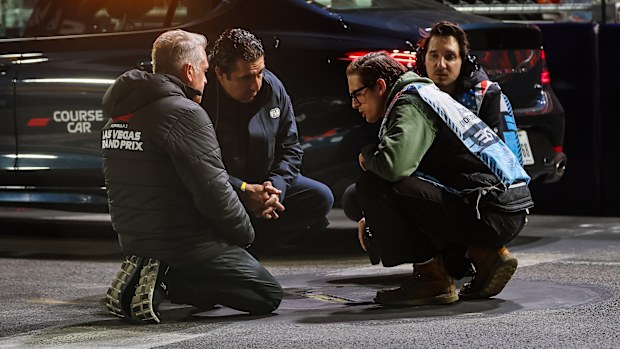
Track officials worked through the night to have the track ready for qualifying. Getty
Alonso explained that “no other sport would accept” the obscenely long travel distance to and from the United States, especially for race 22 of a 24 race season.
“To come here with the time difference and how far it is from Europe and Brazil two weeks ago and we go to Qatar now straight…it’s a 17-hour plane and 13 hours’ time difference. I don’t think any other sport in the world will accept that,” Alonso reiterated.
“So, I mean, circuit okay, asphalt and moment in the calendar, for me it’s…borderline.”
Drivers call for ‘urgent’ meeting
The relationship between F1 drivers and their governing body is not getting any better.
The Grand Prix Drivers Association (GPDA) has called for an urgent meeting between themselves and the FIA race stewards.
Directors Sainz and George Russell are leading the calls for action, believing that their governing body needs to review recent penalties handed to drivers, for the integrity of racing.
The meeting is set for the Qatar Grand Prix weekend and will detail a ‘list’ of incidents they believe needs further explaining on their penalty severity, specifically making note of Oscar Piastri’s 10-second penalty in Brazil.
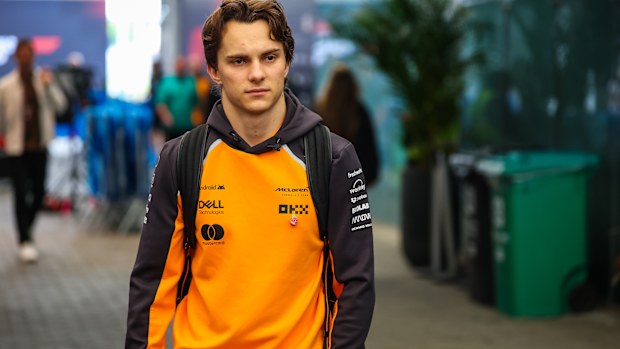
Oscar Piastri took sole responsibility for the lap one incident in Brazil. Getty
Speaking to media in Las Vegas, Sainz said that the Australian had no fault with the collision with Mercedes’ Kimi Antonelli, but was made to take the blame due to the race steward’s understanding of the racing guidelines.
“Everyone that’s really raced a race car knows he [Piastri] could have done nothing to avoid an accident there and he got away with a 10-second penalty,” said Sainz.
“It’s something that I don’t understand.
“I didn’t understand my Zandvoort penalty,” Sainz added.
“I didn’t understand why Ollie [Bearman] got a penalty when we both collided in Monza. He was not deserving of that penalty and I told him straight out of the race. I didn’t understand how I caught a 10-second in Austin. And then the Brazil situation.
“There’s been not one but multiple incidents this year that for me are far from where the sport should be.”
Sainz reiterated that he was struggling with the way race stewards have interpreted a locked brake, Russell agreeing that a lock up did not necessarily mean the driver was “out of control.”
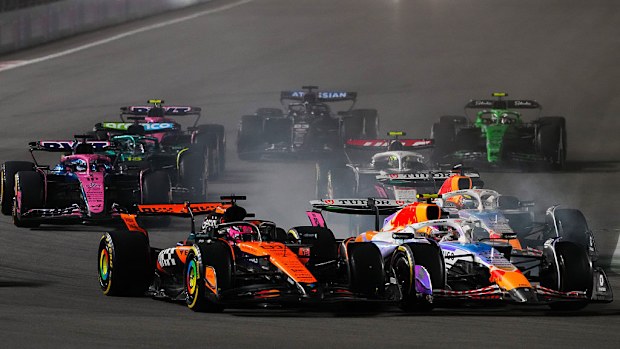
Liam Lawson locked up in Vegas, leaving Piastri an unlucky victim. Getty
A driver locking up means they have had a snap of oversteer into a corner, leaving them to drift out of the driving line. On the first lap, a lock-up can see a driver careen into the side of a competitor unintentionally due to how close the grid is through the first corners.
“Whenever we see a lock-up, a steward immediately interprets that as out of control,” argued Sainz.
“A lock-up not always means out of control. You can lock up and still make the apex.
“I locked up in Austin in reaction to a move that Kimi did and Oscar locks up in Brazil in reaction too.
“It’s not like we were out of control and we were going to miss the apex, crash and create a massive accident. So I think the way those lock-ups are interpreted in terms of ‘out of control’ I think is also something that must be reviewed.”
Russell, who oversees the GDPA alongside Sainz, added: “There’s a bit of a wording, or a view, that if a car is locking up it’s deemed to be out of control.
“This corner in Brazil is totally cambered into the corner, the inside of the car is always going to be unloaded and that tyre is not even on the ground, so that tyre is locking but you’re totally in control.
“So that’s why it has to be guidelines and you have to treat every single corner, every circuit, every incident totally different.”
Making note of a number of incidents this year, Sainz reiterated that drivers had been penalised for multiple incidents that did not justify a penalty.
Russell made the suggestion of a travelling set of ‘permanent stewards’ that may improve the ever-changing situation and discrepancies.
Currently, the FIA employs a localised set of race stewards in every country they race to join their permanent FIA staff.
This means different incidents are being perceived in different lights and the rotating staff have discrepancies.
Some argue that Piastri must have sighed relief after the incident between Lawson and himself in Las Vegas was deemed a ‘racing incident’ and not investigated further, as the Australian was penalised for the same collision a race before in Brazil.
The FIA and its leader
The FIA election, set for December 12, has been hotly discussed as the candidate requirements have been found to disallow any other candidates other than current president Mohammed Ben Sulayem to nominate themselves.
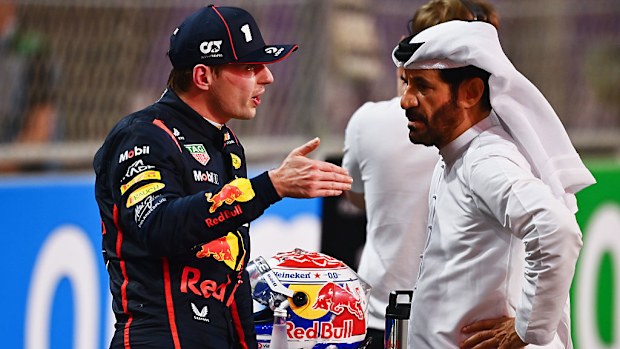
Max Verstappen has frequently spoken to the FIA president about his concerns. Formula 1 via Getty Images
Currently, to be in the running for FIA President, you need to compile 10 officials to join your assembled presidential list; including six vice presidents for sport from FIA-approved World Motor Sport Council candidates in specific regions.
Sulayem was the only one able to create a list of seven vice presidents as South America only has one current vice president available, Fabiana Ecclestone, Bernie Ecclestone‘s wife.
She has always been part of Sulayem’s candidate list, meaning that no-one else is able to create a fully-formed election record.
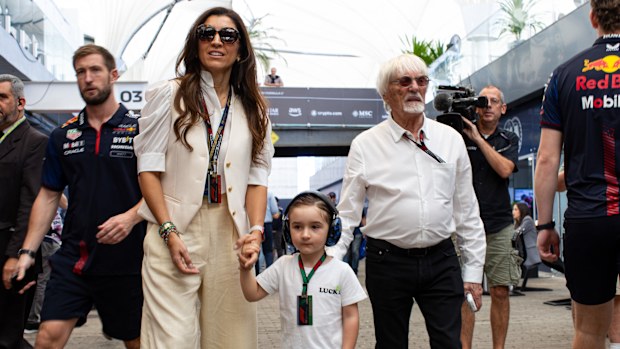
Fabiana Eccelstone is the only vice president from South America. Getty
Thus, the FIA formally confirmed Sulayem as the only eligible contender for next month’s presidential election, leaving the incumbent on course for an unopposed return to office.
This process has been whacked as corrupt and presenting the “illusion of democracy” by other standing candidates who have been blocked due to this loophole.
Tim Mayer, former FIA senior steward who looked to elect himself but could not, said, “When elections are decided before ballots are cast, that’s not democracy – that’s theatre.”
Sulayem has recently struggled with mounting pressure from the drivers to loosen his grip of their behaviour outside of the car. But now, drivers are calling for a meeting regarding the ‘guidelines’ to racing incidents, believing they are being interpreted through a black and white lens.
They argue there needs to be the ability for context to change the penalty rulings, for example, Piastri’s “no-fault” action in the Brazil incident.
Williams driver Alex Albon added to the discussion, reiterating, “There’s no ignorance in [the FIA’s] approach to it. There is an open-minded ‘OK, please, let’s work on this together and find a solution.’
“It’s not this ‘you versus us’ approach.”