
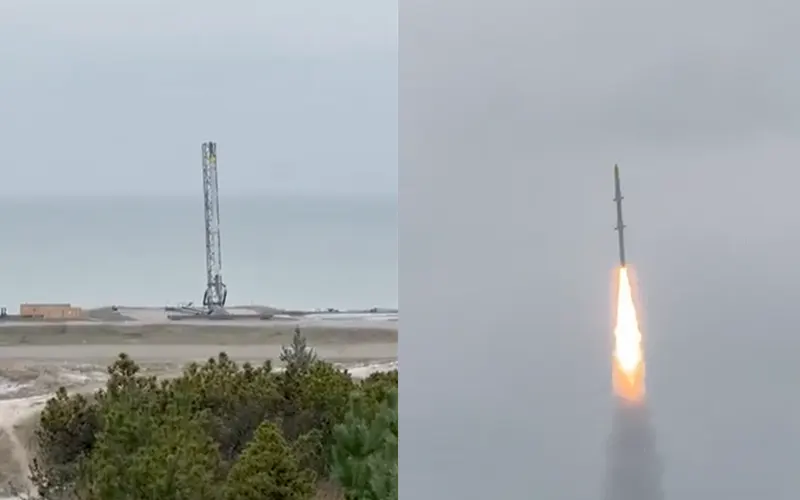
 Credit Cezary Tomczyk (X)
A consortium of Polish state-owned and private companies has successfully tested a three-stage suborbital rocket being developed to carry research payloads above the Kármán line, the internationally recognised boundary between Earth’s atmosphere and space.
The project began in early 2020 and received roughly 18.6 million zł (€4.1 million) in EU funding through the European Regional Development Fund. The consortium is led by state-owned aerospace company WZL-1, and includes the Military Institute of Armament Technology (WITU) of the Ministry of Defence, and defence manufacturer ZPS Gamrat. While initially intended to carry payloads into space, WITU has stated that the technology could also be used for the development of anti-aircraft and tactical missiles.
Testing of the launch system began in April 2025 with the successful flight of a single-stage variant of the rocket. The test was designed to validate the solid-propellant rocket motor and flight systems that will form part of the full three-stage vehicle. On 24 October 2024, Poland’s Deputy Minister of National Defence, Cezary Tomczyk, announced the first successful flight of the complete three-stage rocket from the Central Air Force Training Range in Ustka.
According to Tomczyk, the rocket reached a planned altitude of 65 kilometres, achieving all of the flight’s intended objectives.
While still unconfirmed, the flight was the second successful suborbital rocket flight from the Ustka facility last week. While Polish rocket builder SpaceForest has not yet confirmed it publicly, reports indicate that the company completed the first successful flight of its PERUN suborbital rocket on 22 November. The successful flight follows two aborted tests in 2023 and a redesign of the propulsion system, which was co-financed by the European Space Agency.
In July 2024, another Polish suborbital rocket, the ILR-33 Amber 2K developed by the Łukasiewicz Institute of Aviation, became the first domestically built Polish rocket to reach space. Launched from the Andøya Space Centre in Norway, it reached an altitude of 101 kilometres, powered by a hybrid core stage and two solid-fuel boosters.
Keep European Spaceflight Independent
Your donation will help European Spaceflight to continue digging into the stories others miss. Every euro keeps our reporting alive.