
This time the Ipsos survey puts Labour ahead not only on the economy but in every major area except law and order.
I have been on Labour’s campaign committee and seen polling where voters preferred Labour’s policies.
Labour still lost because voters did not believe the party could manage the economy.
Economic credibility is everything.
Polls taken 12 months out are no more predictive than a coin toss.
But one thing can be said with confidence: if voters trust Labour more than National on the economy, the coalition will lose.
That National has managed to lose its historic reputation for economic management is an extraordinary achievement in fiscal and political mismanagement.
Part of the problem is that no one can quite explain what the Government’s economic objective is.
Prime Minister Christopher Luxon has his foot on the accelerator, chanting “growth, growth, growth,” yet GDP per person has been shrinking.
Finance Minister Nicola Willis has her foot on the brake, insisting the priority is “returning the books to surplus” yet the Treasury forecasts ongoing deficits as far as the eye can see.
The Government’s fortunes now depend on the Reserve Bank’s decisions.
When it considers interest rates, the central bank looks not only at the data but at the credibility of government policy.
The coalition is spending and borrowing more than Labour.
Pointing out that Labour had been on track to spend and borrow even more is not the killer argument National imagines.
When the polls turn, politicians tend to respond in one of two ways: panic or desertion. MPs start looking for the nearest life raft.
New Zealand First voted for the Regulatory Standards Bill declaring: “The bill will promote accountability and open government, efficiency in regulation, the rule of law, strong property rights, an independent judiciary and equality before the law”.
Seven days later Winston Peters announced his party would campaign to repeal it.
What changed? The Ipsos poll.
Who doubts that the country’s most experienced waka-jumper might change sides yet again?
In the next 12 months mortgage holders will gain over a billion dollars in interest-rate reductions.
Dairy farmers will have an extra $4.5 billion from the payout. The economy may feel very different.
If the coalition parties approach the next election as another MMP race – focusing on their differences and criticising one another – the coalition risks losing power.
The winning strategy is to turn the next election into a de facto First Past the Post run-off: a stable National–Act–New Zealand First coalition versus the chaos of a Labour–Green–Te Pāti Māori government.
The challenge is that Luxon has not articulated a coherent economic programme or anything more inspiring than “growth, growth, growth”. He is not setting the agenda.
The Government is attacked simultaneously for using too much urgency and for having “no plan and no vision”.
The Ardern–Hipkins Government was all sizzle and no sausage. The coalition is all sausage and no sizzle.
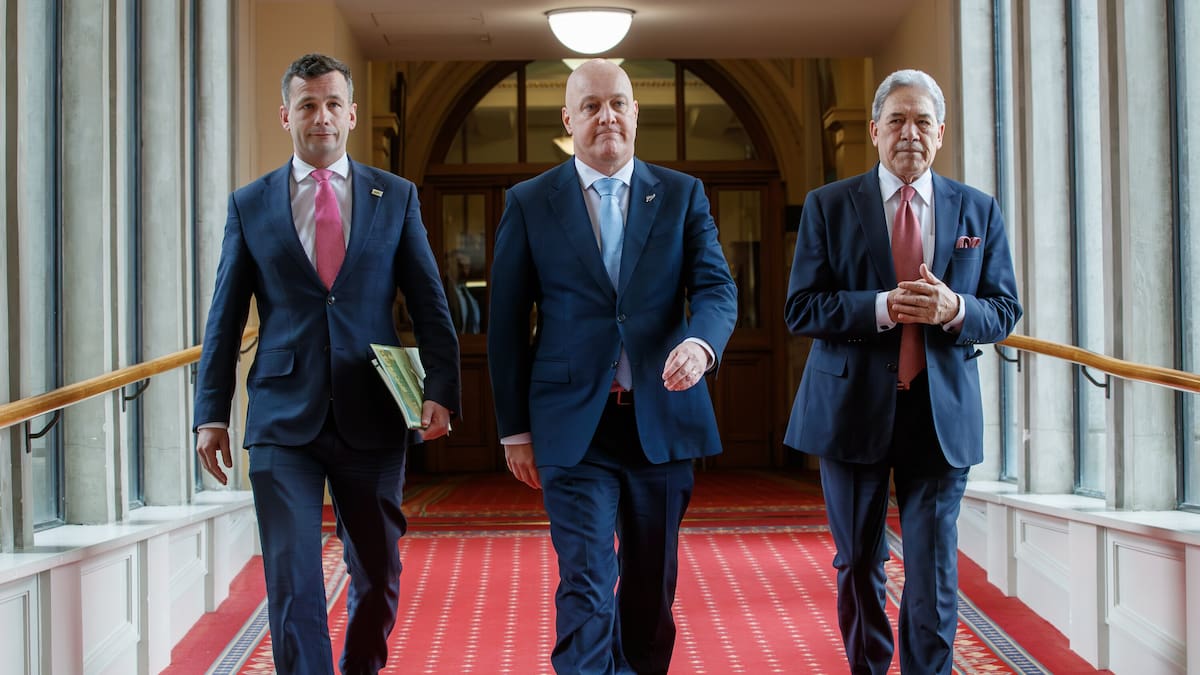
Peters and David Seymour have each hauled their parties out of the wilderness and into government. They are exceptional campaigners.
Instead of despairing over National’s absence of any marketing strategy, they should form themselves into the coalition’s campaign committee.
Their first task: lifting Luxon’s dire preferred-Prime-Minister polling.
Governments rarely win unless the Prime Minister is the country’s preferred choice.
Luxon’s weakness can be turned into his strength. His lack of political instinct should be sold as an asset.
As Peters can put it: “New Zealand doesn’t need another politician. It needs a manager – and Christopher Luxon is that manager.”
Seymour can reinforce the point: “Inspirational politics has pushed New Zealand to the edge. Christopher Luxon’s practical, businesslike approach is pulling it back.”
The preferred-Prime-Minister poll is not, as National thinks, a popularity contest, it’s a competence ranking. Luxon does not even need to be liked, just seen as the best person to be PM.
Marketing Luxon as a non-politician should be easy because it is true.
Peters and Seymour need to recognise that no other prime minister would give them the freedom Luxon has.
Their task is to build a coalition message centred on stability versus chaos.
If the coalition stays united, all three parties will poll well, and the Government will be re-elected.
In a year’s time, Peters and Seymour can again be tossing a coin to decide who gets the first turn as Deputy Prime Minister.
Catch up on the debates that dominated the week by signing up to our Opinion newsletter – a weekly round-up of our best commentary.