
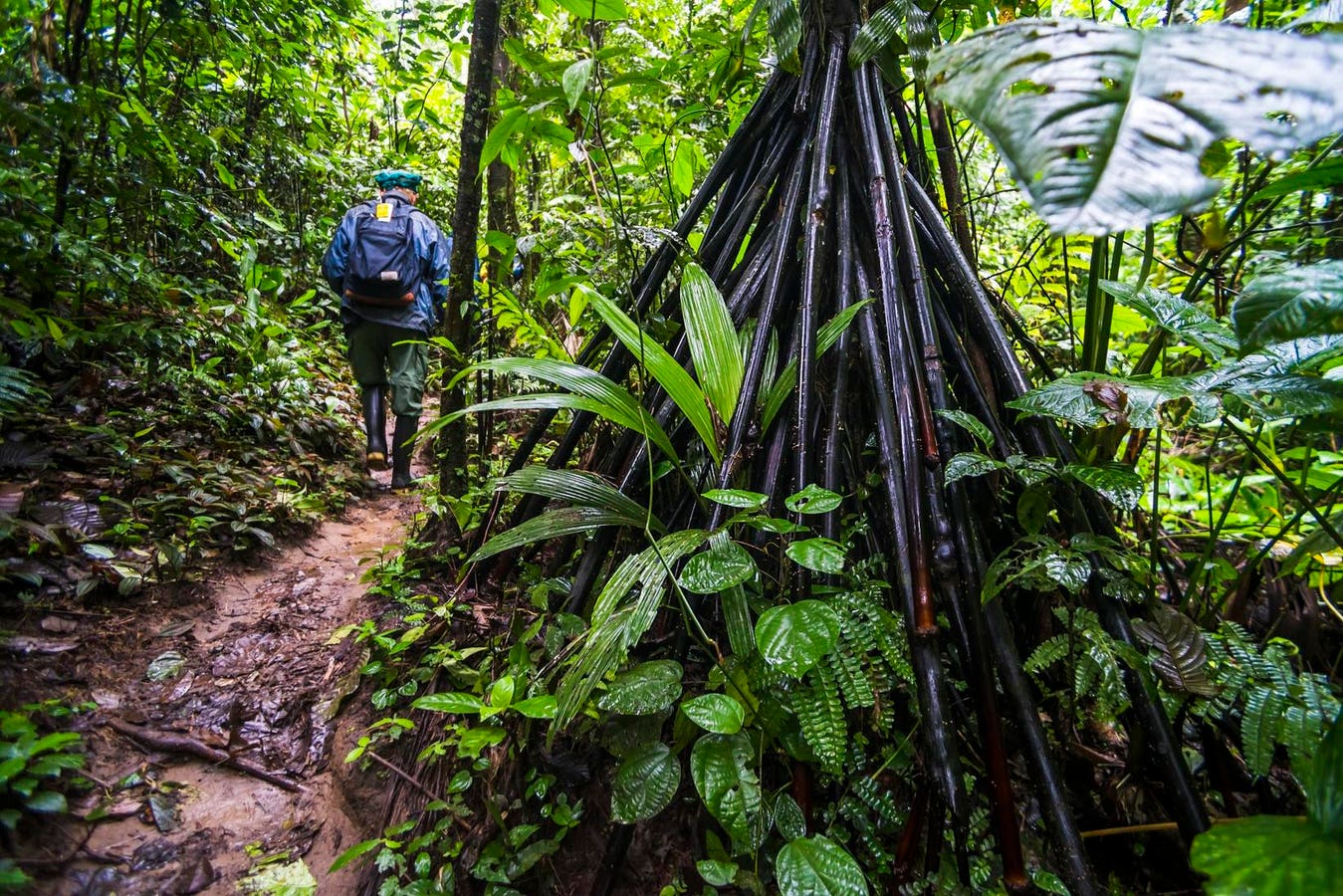
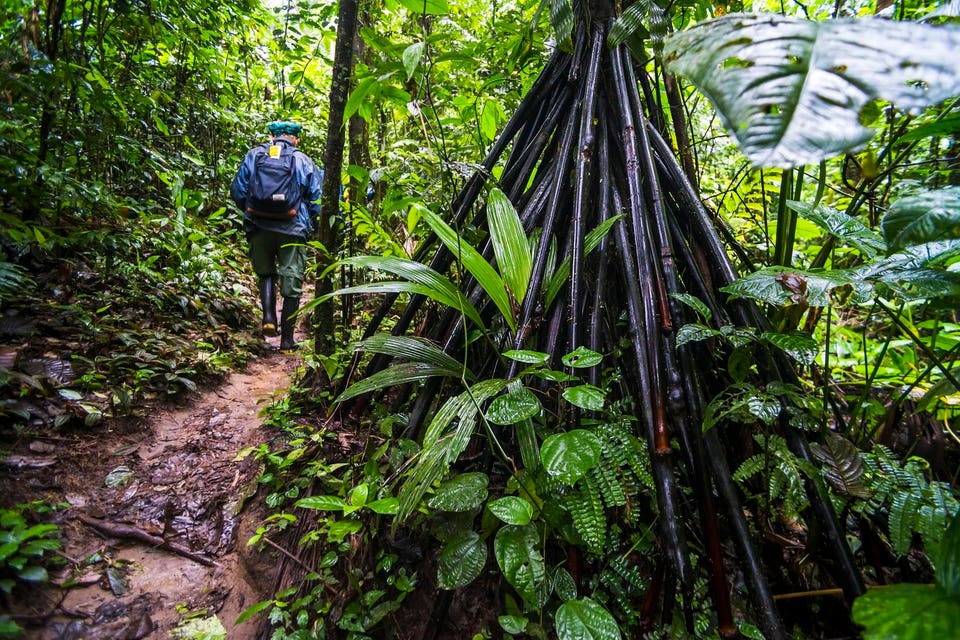
A legendary “walking” tree has captivated rainforest visitors for decades. However, the truth behind its strange, stilted roots is far more fascinating than the myth.
Matthew Williams-Ellis/Universal Images Group via Getty Images
Deep in the rainforests of Central and South America, there lives an iconic palm tree known as Socratea exorrhiza, or “cashapona.” For generations, local tour guides have told visitors an eerie story: that this palm doesn’t just stand in one place. By growing new roots and abandoning the old ones, it virtually “walks.” According to some legends, it can even walk as far as 20 meters (65 feet) a year.
Of course, when scientists studied Socratea exorrhiza, what they found wasn’t supernatural. The palm doesn’t “walk” in the sense that it literally uproots itself. Instead, its unique root system is a sophisticated evolutionary adaptation to difficult ground.
A Palm Tree That Looks Like It Has Legs
Look at Socratea exorrhiza too quickly, and you might think it stands on stilts. This is because its trunk rises from a cone of stilt-like roots that extend several feet above the soil, before angling into the ground. This structure gives the palm an eerie, almost animal-like posture — as though it’s being held up by multiple tentacle-like legs, rather than anchored by a normal root system.
Picture of walking palm or cashapona (Socratea exorrhiza), taken in the Yasuni National Park, in the Ecuadorean Amazon forest.
AFP via Getty Images
But those “legs” are no illusion. They are real, and they serve powerful biological functions. According to a detailed study of the palm’s stilt roots at forest sites in Panama and Costa Rica, published in Revista de Biología Tropical, the roots provide mechanical stability and facilitate rapid vertical growth.
This means that, even if the surrounding ground is uneven, swampy or prone to erosion, the palm’s elevated roots enable it to stay upright. Most notably, it does so without needing to invest heavily in a thicker trunk, as most other tree species would.
Does The Walking Palm Tree Actually Walk?
The notion that Socratea exorrhiza can “migrate” across a forest floor was likely first formalized in the 1980s by John Bodley and Foley Benson, who, in a study published in the journal Biotropica, speculated that the palm’s roots might allow it to “walk” away from its original germination spot.
This idea, which was likely just an analogy, caught on like wildfire among rainforest guides. And as most mysterious stories do, it’s evolved disproportionately over the years: it’s since been said that the palm regrows new stilt roots in places where it thinks conditions are better, while its older roots die off. Some locals even claim that the palm can crawl from 2 to 3 centimeters (0.8 to 1.2 inches) per day, or up to 20 meters (65 feet) per year.
But as alluring as this story is, science has largely challenged this interpretation. In 2005, tropical ecologist Gerardo Avalos and colleagues conducted field research on the walking palm, including measuring root growth and trunk position, and found no evidence of any actual “movement.”
According to their 2005 study, also published in the journal Biotropica, the trunk of the palm remains fixed: its new roots grow, and its old roots die. In other words, the theory that this palm can “walk” is nothing more than an urban legend; Avalos’ study ultimately proved that the tree’s base doesn’t move at all.
As Benjamin Radford explained in correspondence published by the Skeptical Inquirer, the myth likely proliferated due to its intuitive value: “The idea has some plausibility on its face — plants do grow toward sunlight — and the rain-forest is home to many unusual plants. But a tree that walks?”
As he continues, it becomes clear that, with a little critical thought and scrutiny, the idea of a walking tree becomes so far-fetched that it even seems comical. “If they encountered a half-buried boulder during their walk, would the walking trees trip?” Radford asked hypothetically. “And if they did, would they fall very, very slowly?”
Why Does The ‘Walking Palm Tree’ Have Such Long, Elevated Roots?
If the walking palm tree is a myth, then why is it that Socratea exorrhiza bears such dramatic stilt roots in the first place? Most likely, the answer lies in a combination of the tree’s structural needs and ecological strategy. These include, according to the abovementioned Revista de Biología Tropical study:
Stability in challenging soils. Rainforest floors are often soft, wet and unstable. Stilt roots form a wide base, which gives the trunk the necessary mechanical support for preventing both collapse and tipping.Vertical growth without girth. Rather than investing in a massive trunk, the palm can instead allocate its resources to grow upwards. The roots support structural load without requiring a bulky below‑ground system.Height advantage. By growing stilt roots, Socratea can quickly exploit light gaps in the canopy, without needing to wait long enough for its trunk to thicken. This is critical in a dense forest, as competition for sunlight is fierce in these contexts.
However, the myth of the walking palm somehow still manages to persist today. Yet, to ecologists and evolutionary biologists, Socratea exorrhiza is far more than a weird tourist tale. It’s a living case study in adaptation, which shows us the precise ways that plants evolve in order to solve complex environmental challenges.
Yet, after decades of study, the scientific consensus is clear: the walking palm does not, in fact, actually relocate its trunk in any way. That said, to dismiss the tree’s fascinating root structure as a gimmick would be to miss the real wonder. Socratea exorrhiza didn’t evolve to stroll across the forest floor; it evolved to stand resilient where life demands it most.
Are you an animal lover who owns a pet? Take the science-backed Pet Personality Test to know how well you know your little friend.
Do you have an eye for nature photography? Join my Nature Photography Club and take your tree photos to the next level.