
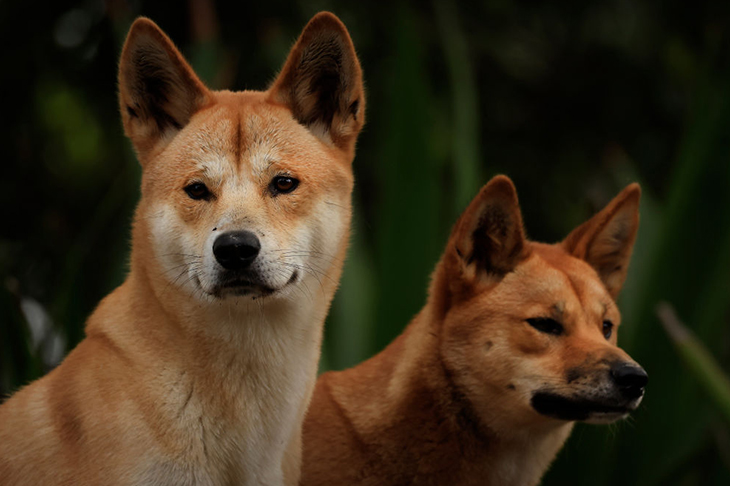
Lock up your babies, Brisbane; the Queensland government is considering lifting its ban on keeping dingos as pets. I had always assumed it was illegal to keep dingos as pets anywhere in Australia, possibly because my arrival on these shores was contemporaneous with the overturning of the Lindy Chamberlain conviction. But it seems that poor Azaria’s legally inferred demise and many subsequent and better documented attacks on much larger humans didn’t stop dingos benefitting from the Companion Animals Act of 1988. Overturning a decades-old categorisation of dingos as noxious animals, this legislation gave them the same legal status as chihuahuas in New South Wales, Western Australia and the Northern Territory. But Queensland always drags its heels, and given the frequency of dingo/human confrontation on one of the state’s biggest tourist attractions, Fraser Island, it’s hardly surprising that not all banana benders are anxious to have dingos parked on their verandas. What is surprising is that one of the reasons given for opposing the lifting of the ban is not the animal’s innate aggressiveness but its remarkable intelligence. ‘Imagine having a kelpie with an IQ of 130,’ is how one expert has put it, and there’s no shortage of evidence for such a claim. Infrared camera footage on YouTube, for example, of hungry dingos getting at livestock by pushing things against fences and standing on them to slip hooks over gate posts. But since the lifting of the Queensland ban was proposed, more rigorous experiments have been conducted to assess dingo behaviour around people. The most compelling of these is the ‘boot test’ conducted by cognitive ethologists at James Cook University. This required a number of men to drive their cars at high speed around the Mount Isa campus; first with a border collie locked in the boot, then with a dingo locked in the boot and then with their wife or girlfriend locked in the boot. No matter how many times the test was performed, the result was always the same. While the border collie – generally considered the most intelligent of domestic dog breeds – never failed to wag its tail and lick its owner’s face when the boot was opened, the dingo and the wife/girlfriend always displayed exactly the same kind of unbridled ferocity, sometimes inflicting serious injuries on the driver.
Certain unusual physiological characteristics of dingos allow them to do things which invite anthropomorphic interpretation. Uniquely amongst dogs they have double-jointed limbs and can subluxate – or temporarily dislocate – their hips. In addition to helping them run faster and jump higher in pursuit of prey, this means that during periods when prey is scarce they can maintain their fitness with simple yoga exercises. Perhaps more significantly, it also means that they are not restricted to the doggy-style congress which is the only reproductive option of their domestic cousins. Dingos also have universal paw joints, the canine equivalent of opposable thumbs, and can rotate their heads through 180 degrees, features which may explain why dingos account for such a disproportionately small percentage of Australian roadkill. Not only can they look much further left and right than wombats and possums before crossing roads, but when traffic is particularly heavy, they can also depress the buttons at pedestrian crossings.
While dingos cause far fewer fatalities than any of the top ten most dangerous domestic dog breeds, they certainly do not crave human companionship the way those dogs do, and this puzzled anthropologists for a long time, since we know that far from being an indigenous species like the thylacine, the dingo, like the nasi goreng, is an Indonesian export. We also know that for a very long time the relationship between First Nations Australians and dingos was comparable to that of an English country sportsman and his retriever. As long as the animal had a useful role it was guaranteed a share of the kill and a dry place to sleep. The invention of the boomerang is believed to have destroyed this symbiosis. And experts now believe it was the dingo’s sudden redundancy, and its realisation that it had become itself a potential protein source for people, which caused it to go walkabout. Not long ago, the same experts would have laughed at the suggestion that even the most intelligent quadruped species can harbour a collective grudge. But thanks to the sterling work of the social science departments of our finest universities we now know that the dingo’s aversion to humans is as heritable and durable as its gene sequence. That it is the result, in fact, of something Australia leads the world in. Inter-generational trauma.