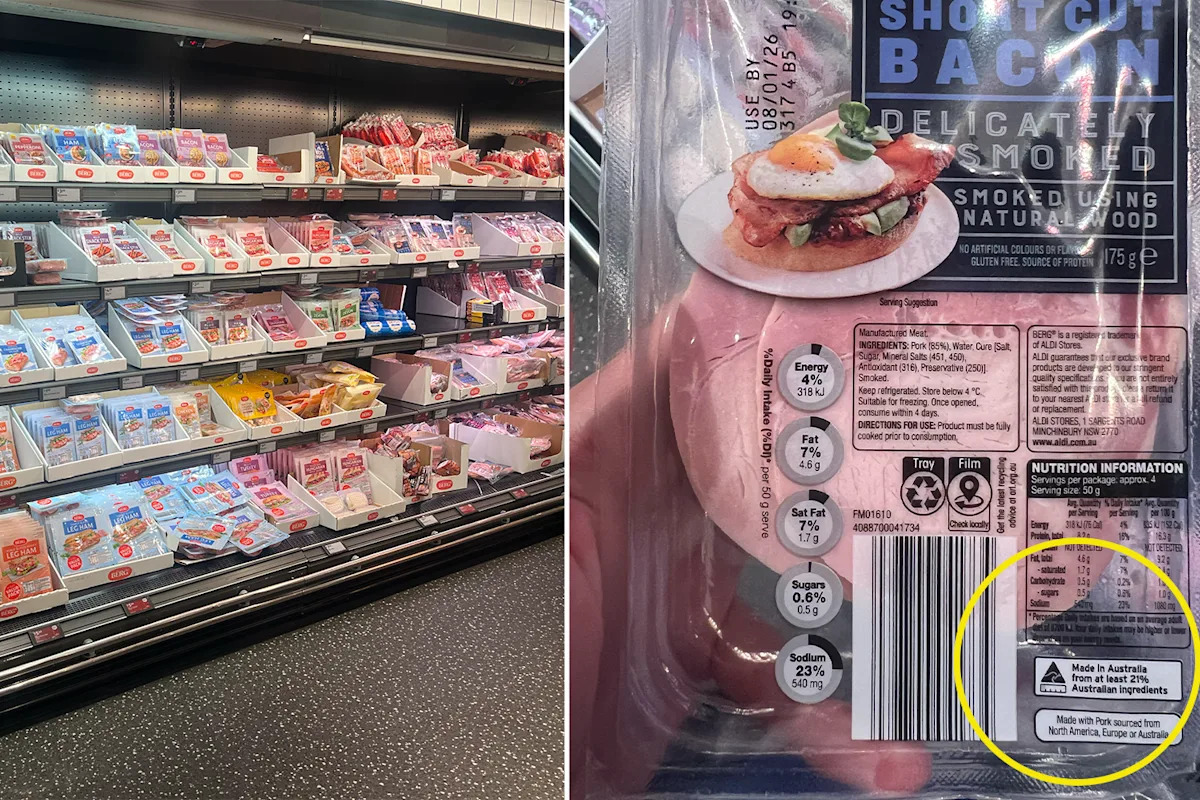
Australians are unknowingly picking up imported meat at the supermarket, assuming “Australian-made” labels mean it was raised and produced here. But an industry leader says many shoppers would be shocked to learn that’s not always the case.
Ahead of Christmas, Australian meat producers are reminding the public that up to 70 per cent of the bacon and ham on shelves is made from imported pork, worth a staggering $1.2 billion a year.
Confusingly, many of these products boast an Australian-made logo, the green and gold triangle with a kangaroo, but that simply means the product was processed, packaged or cooked here, with the majority of the animals actually bred overseas.
Margo Andrae, CEO of Australian Pork Limited (APL), said shoppers would be appalled to discover the truth and believes they are being “misled”.
In an interview with Yahoo News, she said that, traditionally, it was seen as more expensive to buy Australian, but nowadays “it’s probably down to about $1 per kilo difference”.
“So it’s now about the choice, and shoppers actually knowing what they’re putting into their baskets,” Andrae said. “Shoppers think they’re buying Australian when they’re actually not.”
Andrae said that over the last couple of decades, they’ve seen a move to imported products, warning, “it’s just not a fair playing field”.

A closer look at the packaging shows some products flaunting the logo are actually made with up to 86 per cent imported ingredients. Yahoo News Australia
Australian farmers are being ‘undercut’
These cheap imports are “undercutting Aussie farmers” who are held to higher welfare, sustainability, and biosecurity standards.
Despite contributing over $6.9 billion to the national economy, local producers aren’t able to compete.
At the time, the volume of imported bacon and ham had quadrupled since the early 2000s, according to figures from APL. They reached a two-year peak over the 12 months leading up to March this year.
“It’s those small goods,” Andrae explained.
“Your fresh pork is still fresh, your beautiful ham on the bone, your beautiful roast, all of that, that’s all fresh — people can be confident of that.
“But, your ham and bacon, 70 per cent of it is from the US and Europe.”
To be fully informed, Australians need to look for the bar chart on food packets.
“There’s a little bar chart underneath that goes from zero to 100,” she said. “And the fuller the bar, the more Aussie they are.
“Anything above 80 per cent, you can be guaranteed you’re supporting Aussie farmers,” Andrae said.
“That applies to all products. If you want to support all Australian farmers, that’s a great way to do it.”
Research shows 87 per cent of shoppers want clearer country-of-origin labelling so they can confidently choose local produce, with 80 per cent saying they’d opt for Australian pork if it were easier to identify on shelves.
Australian Pork is now calling for the removal of the kangaroo logo from processed meat unless it meets “Product of Australia” criteria, meaning it’s fully Australian.
It believes 80 per cent of Australian-grown ingredients should use the label.
Andrae said the campaign is particularly important as the festive period gets underway.
“It’s a really lovely reminder that if our pork product has a bone, you can guarantee it’s one of our own,” she said.
“The Christmas hams, which we sell over 1.6 million as we lead up into this time, can be a beautiful way to support Aussie pork farmers.

The famous green and gold kangaroo logo. Source: Australian government
Why do supermarkets stock imported meat?
Historically, supermarkets have stocked overseas meat largely because it was cheaper and more readily available in the volumes needed to meet constant demand.
Imported pork, in particular, is significantly less expensive for processors to buy, allowing major retailers to offer competitively priced bacon and ham year-round.
These products often come from countries with lower production costs and larger export-focused industries, making them an easy, reliable supply source.
There’s also a long-established supply chain built around imported pork for processed meats.
Australia doesn’t produce enough pork at the low price point required for mass-market ham and bacon, and local farmers operate under higher welfare, sustainability, and biosecurity standards that make costs higher.
As a result, supermarkets continue to rely on imported meat to fill that gap — even while Australian consumers often assume they’re buying local.
Do you have a story tip? Email: newsroomau@yahoonews.com.
You can also follow us on Facebook, Instagram, TikTok, Twitter and YouTube.