
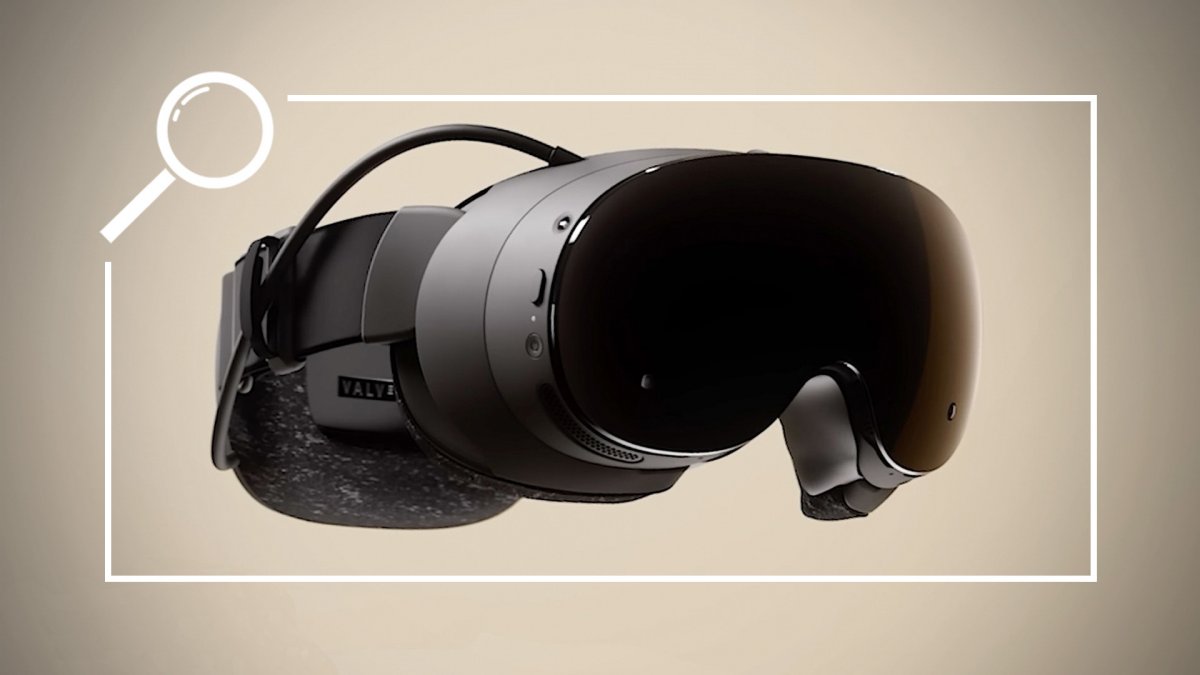
Steam Frame: What can the VR headset achieve?
Steam Frame is the most versatile VR product in years. This is evident in how differently the device can be described. It is primarily a PC VR headset, but at the same time an autonomous headset with an ARM chip that can render many games without an external computer. The device is designed for VR games but also serves as a classic game console that displays screen games from the Steam catalog on a large, virtual display. And although Steam Frame is also a fully functional Linux computer that supports many Windows games, it can also run Android titles.
The product’s name also suggests even greater ambitions: Steam Frame is intended to become a spatial computer that displays applications as freely floating windows (“Frames”), allowing users to simultaneously surf the web, consume media, and play Steam games.

Tomislav Bezmalinović is fascinated by all kinds of facial computers. Since 2025, he has been writing for heise online about the latest trends in smart glasses, VR headsets, and AR glasses.
After the dust of the announcement has settled, it’s time for a sober assessment. How is Steam Frame positioned in the market? Can it breathe new life into the VR industry? And what is Valve’s long-term strategy?
What makes Steam Frame unique
Steam Frame has a number of qualities that distinguish the VR headset and that Valve has paid particular attention to.
Firstly, Steam Frame is the first VR headset optimized for effortless PC VR streaming. Whereas previously you often had to buy and configure a dedicated router to achieve optimal results, now it’s enough to plug the included wireless adapter into a USB port on the PC. The software handles the rest. A feature called “Foveated Streaming” optimizes streaming quality along the gaze. In combination with the new Steam Machine, it should even be possible in the future to use the VR headset without booting up and a physical monitor.
Secondly, Steam Frame is designed as one of the most open VR systems to date. With SteamOS, it uses the same Linux-based operating system as the Steam Deck, making the Steam Frame more open to modding than any other VR headset. Since it uses an ARM chip unlike the Steam Deck, Steam Frame can run Android titles in addition to games from the Linux and Windows worlds, making it even more versatile than Valve’s handheld. The openness continues on the hardware side: the head strap, face cushion, speakers, and battery can be detached from the core module, allowing modders and third-party manufacturers to develop their own solutions for comfort, audio, and power supply. And thanks to an expansion slot, it’s possible to upgrade the VR headset with additional cameras, sensors, and other accessories.
Empfohlener redaktioneller Inhalt
Mit Ihrer Zustimmung wird hier ein externes YouTube-Video (Google Ireland Limited) geladen.
YouTube-Video immer laden
YouTube-Video jetzt laden
Thirdly, Steam Frame is designed through and through as a gaming headset. While Meta Quest has increasingly moved away from the game console is increasingly moving away from gaming consoles and towards the metaverse, Valve clearly focuses on gaming. As a hybrid VR headset from the ground up, Steam Frame does not differentiate between VR and screen games. This is also reflected in the new VR controllers, which combine input schemes from both gaming worlds, allowing for a seamless transition. The only regrettable thing is that Valve has no VR games in development for Steam Frame. That would have been an additional purchase incentive for the VR headset, which is set to be released in early 2026.
Valve is looking for a niche within a niche
d on these characteristics, Valve’s target groups can be identified: VR gamers who have so far shied away from the leap to PC VR because the setup and use are too cumbersome, Linux enthusiasts and modders within and outside the VR community, as well as Steam fans who want a Steam Deck with a large-format display. In In addition, there are owners of the Valve Index who have been waiting for a new VR headset from Valve for years and fundamentally avoid Meta products.
Valve’s first VR headset, the wired Valve Index, was a high-end device for its time. Steam Frame is positioned differently.
(Image: Valve)
The group of hardware enthusiasts is less of a focus than in the previous generation. While Valve’s first headset was clearly aimed at the high-end segment, the company is taking a more pragmatic approach with Steam Frame. To keep the price below the $1,000 mark of the Valve Index, Valve is relying on conventional LC displays at the level of the two-year-old Meta Quest 3 instead of expensive OLED microdisplays, as used in Apple Vision Pro and Samsung Galaxy XR. A decision that caused disappointment among many hardware enthusiasts.
Valve has no VR games for Steam Frame in the pipeline, and “Half-Life: Alyx” can still only be played with a PC connection.
(Image: Valve)
The final price of the VR headset is not yet known, but it is expected to be significantly higher than that of the Meta Quest 3 and 3S and therefore will not compete with Meta in the lower and mid-price range ($300 to $500). Valve will also hardly gain market share from the spatial computers from Samsung and Apple, which operate in even smaller niches due to high prices ($1800 and $3500, respectively), especially since the company is foregoing important features such as color passthrough, mixed reality, and hand tracking. It remains to be seen how strongly Valve has invested and will continue to invest in the multitasking capabilities of the Steam Frame. And whether the Snapdragon 8 Gen 3 offers sufficient performance for a spatial computer.
The official announcement video falsely suggests that Steam Frame supports color passthrough. In reality, you only see the outside world in black and white.
(Image: Valve)
Given the niche target audience and the expected price, Steam Frame should be classified as a niche product. If even cheaper headsets like the Quest 3 and Quest 3S sell below expectations, Valve can hardly expect higher sales figures. According to a report, the company plans for about half a million devices sold in the first year – a realistic expectation.
Steam Frame: Setting the course rather than being a game changer
Therefore, a turning point for the VR industry is not to be expected from this generation of Steam Frame. More important than the hardware, which is most discussed online, is the long-term bet Valve is making with Steam Frame. The goal is the same as with the Steam Deck and the Steam Machine: Valve wants to open up new user groups and access options for Steam on the one hand and future-proof the platform on the other.
At the heart of these efforts is SteamOS. The major innovation of the Steam Frame in the context of the Steam ecosystem is that Valve is relying on an ARM chip and enabling the Linux-based SteamOS for the chip architecture using the translation layer FEX. This step could prove to be groundbreaking.
On the one hand, SteamOS can thus position itself in the future as an alternative to the spatial operating systems of the competition, all of which are optimized for ARM chips: Meta’s Horizon OS, Apple’s visionOS, and Google’s Android XR. On the other hand, Valve is setting the course for a computer era in which ARM chips may gain even greater dominance. If Valve’s plan succeeds in more closely integrating SteamOS and ARM chips, it could pave the way for a Steam Deck or Steam Machine with an ARM chip. And Steam Frame provides the blueprint for it.
The potential reach of SteamOS extends far beyond Valve products. If Valve opens the operating system more broadly to third-party manufacturers, new ARM devices and device classes based on SteamOS could emerge. From handhelds to laptops to VR headsets: a comprehensive hardware ecosystem consisting of Steam computers.
(mho)
Don’t miss any news – follow us on
Facebook,
LinkedIn or
Mastodon.
This article was originally published in
It was translated with technical assistance and editorially reviewed before publication.
Dieser Link ist leider nicht mehr gültig.
Links zu verschenkten Artikeln werden ungültig,
wenn diese älter als 7 Tage sind oder zu oft aufgerufen wurden.
Sie benötigen ein heise+ Paket, um diesen Artikel zu lesen. Jetzt eine Woche unverbindlich testen – ohne Verpflichtung!