
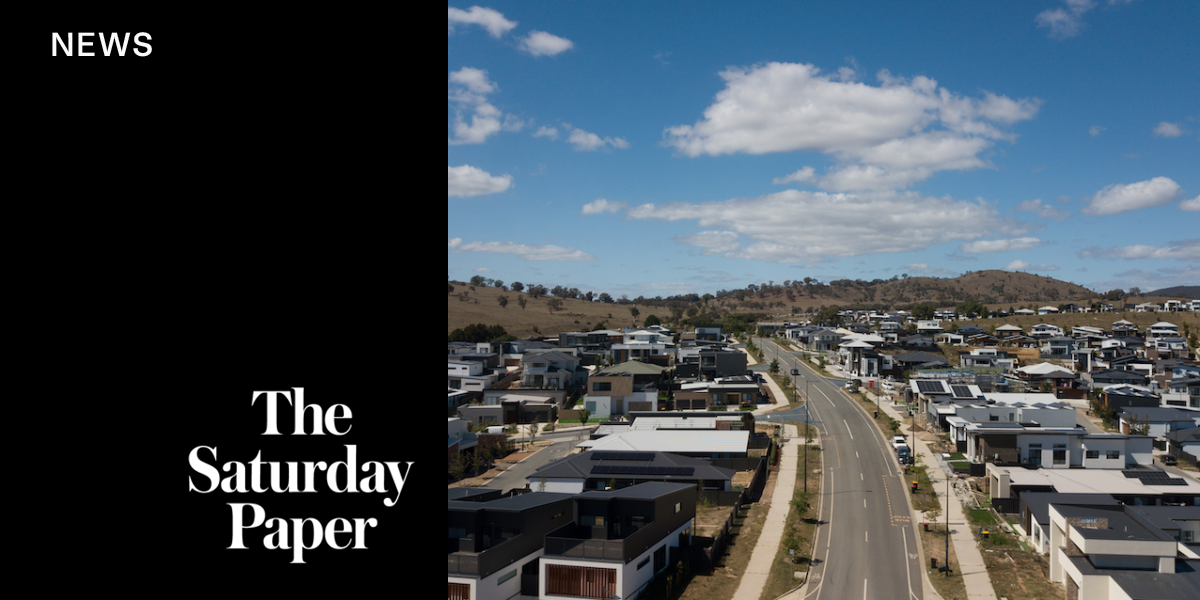
Signs of stabilisation in Australia’s rental market are raising hopes that new housing policies across the country can ease the affordability crisis.
It’s been a “decade of tumbleweeds” for Australian renters seeking relief, says the chair of National Shelter, John Engeler. He’s cautiously optimistic, however, about the latest report produced by his advocacy group, along with SGS Economics and Planning and Housing All Australians, which shows the burden of rental costs in most capital cities has remained the same or slightly improved.
Nevertheless, the only capital city that is affordable, according to their Rental Affordability Index (RAI), is Canberra.
It’s an indication of how dire the rental picture is in Australia that the 11th instalment of this index has experts hailing small positives as signs of progress. “It’s not fantastic or wonderful but it may have bottomed out and reached stabilisation,” Engeler tells The Saturday Paper. “There have been some slight improvements in most metropolitan cities, and certainly in Canberra there has been a marked improvement.
“There is enough confidence we’re starting to see green shoots of good government programs – good things at state, federal and local levels.”
The report noted that Canberra’s success owes in part to relatively high wages, and that wage growth has outpaced rent increases in the territory. Canberra is also the only jurisdiction in Australia that has rental caps. Under a scheme introduced in 2019, landlords in the ACT must get approval from the Civil and Administrative Tribunal, or written agreement from the tenant, for a rent increase that is 10 per cent more than the gain in the consumer price index over the previous year.
Engeler says there’s now enough data to show that these rent caps have been effective. “There’s nothing wrong with regulating your rental system so people can know when and by what amount the rental increases can be – commercial increases work like that all the time.”
The RAI is a measure of rental affordability across the country relative to the household earnings of 10 different low-to-moderate income groups. It uses the common metric that if a household is spending more than 30 per cent of its gross income on housing, it is in housing stress.
“There’s nothing wrong with regulating your rental system so people can know when and by what amount the rental increases can be – commercial increases work like that all the time.”
The index gives a score of 100 to each household that spends 30 per cent of its income on rent. A score from 80 to 100 means that between 30-38 per cent of income is spent on rent, and this is considered unaffordable. A household is experiencing “severely unaffordable rents” if it has a score of 60 to 80, meaning up to 60 per cent of income is going towards rent.
Sydney’s index has improved by three points to 100, meaning an average household is spending just under a third of its income on rent. In Sydney, the median weekly rent for a house is $780. Melbourne’s unaffordability has eased by nine points to 118, while Brisbane, Adelaide, Perth and Hobart also improved or remained the same. Perth has the most onerous rental costs of any capital city in the country, according to the report.
While rental caps are only in force in the ACT, state governments have undertaken a variety of reforms to address what they recognise as a major risk to their longevity. NSW, Victoria and South Australia have all made it illegal for landlords to evict tenants without cause. NSW and Western Australia have limited rental increases to once a year and ensured greater flexibility for pet owners, as Victoria did in 2020. Victoria has introduced a short-stay accommodation tax to tackle shortages arising from a lucrative holiday rentals market – similar policies are in place in the ACT and under consideration in South Australia.
The use of median incomes skews the data, however, obscuring the hardships still faced by people on low incomes or reliant on welfare, says Homelessness Australia chief executive Kate Colvin.
“Rents have risen so steeply for so many years, a small tapering off is certainly not taking rents back to where they were several years ago,” she says. “It’s really just slowing the growth, a very small moderation, and it’s still desperately unaffordable for people on the lowest incomes.”
The report shows that a single person on JobSeeker payments faces extremely or critically unaffordable rents in every single region of the country. In Melbourne, the median rent would account for all of the income of a person on these benefits. In Sydney, it would take four times their income.
Rent for a single person relying on pension payments is critically or severely unaffordable in all metropolitan areas. A couple earning the minimum wage, a combined $98,000 a year, will find rent severely unaffordable in Sydney and unaffordable in Melbourne.
The report paints a worse picture for regional Australia, where affordability has declined in all areas by as much as 5 per cent – in most cases to record lows – except for regional South Australia, where it has slightly improved. The greatest hardship is in the regions of Queensland.
This is likely the result of many people moving from major cities to the regions during and after the Covid-19 pandemic, and taking a higher salary with them, says SGS Economics principal Ellen White. “Then they could outbid a lot of the locals and that has probably pushed their rents up quite a bit.”
The RAI findings largely mirror recent findings from the Grattan Institute, its housing and economic security program associate Ashleigh Chang tells The Saturday Paper.
“At the heart of the problem is we’re really just not building enough homes where people most want to live,” Chang says. “That shortage has really just made housing more expensive and now our cities are among the least affordable in the world.”
Those facing the rental crisis are also locked out of buying a house. A separate report by Cotality, also released this week, found that the typical Australian home costs more than eight times the average household income – the worst multiple on record.
In Sydney, the house price to income ratio is 10 times, while it is just over seven times in Melbourne. The typical household will need 11 years to save up a 20 per cent deposit for a median house.
This data also offers small signs of stabilisation, however, with the burden easing slightly in Melbourne.
Recent housing and rental reforms by the Victorian government have helped improve the situation for renters in the state, Chang says. “[Melbourne] used to be the second most expensive city pre-Covid, and now the latest data shows it’s the third most affordable in Australia,” she says. “Reforms implemented are a step in the right direction for Victoria and other states, but they’ve got a lot further to go.”
The Victorian government is working to address supply shortages, with 1000 build-to-rent apartments completed in 2023/24, and more than 18,000 under construction.
In March, new regulations aiming to speed up the approval process for new townhouses and low-rise developments were introduced, and at the start of the year a tax on vacant residential properties was expanded.
This week a number of new rental rules come into effect, including a ban on no-fault evictions, an increase in the notice time required before a rent rise and a ban on rental bidding.
Action to boost supply is also being taken at the federal level. The Albanese government this week opened the latest round of its Housing Australia Future Fund (HAFF), which aims to build more than 21,000 social and affordable homes.
Colvin welcomes this as a positive step. “The government is doing absolutely the right thing by investing in social housing and we were really pleased to see round three of the HAFF announced this week, but we need new investments so we have rounds four and five, and this social housing program keeps delivering,” she says.
The Rental Affordability Index has now been running for more than a decade, and Ellen White says the reaction from federal leaders has changed significantly over these years. “In the past when we’ve released the index, especially at the federal level, the response was often that they were very interested, but that it was up to the states and territories to resolve,” she says.
“Now what I think we’re seeing at the national level is that politicians are taking this seriously and they do now see that the housing crisis is for all of us to deal with. That’s a real shift.”
This article was first published in the print edition of The Saturday Paper on
November 29, 2025 as “Glimmer of rental hope”.
For almost a decade, The Saturday Paper has published Australia’s leading writers and thinkers.
We have pursued stories that are ignored elsewhere, covering them with sensitivity and depth.
We have done this on refugee policy, on government integrity, on robo-debt, on aged care,
on climate change, on the pandemic.
All our journalism is fiercely independent. It relies on the support of readers.
By subscribing to The Saturday Paper, you are ensuring that we can continue to produce essential,
issue-defining coverage, to dig out stories that take time, to doggedly hold to account
politicians and the political class.
There are very few titles that have the freedom and the space to produce journalism like this.
In a country with a concentration of media ownership unlike anything else in the world,
it is vitally important. Your subscription helps make it possible.
Send this article to a friend for free.
Share this subscriber exclusive article with a friend or family member using share credits.

Used 1 of … credits
use share credits to share this article with friend or family.
You’ve shared all of your credits for this month. They will refresh on December 1. If you would like to share more, you can buy a gift subscription for a friend.
SHARE WITH A FRIEND
? CREDITS REMAIN
SHARE WITH A SUBSCRIBER
UNLIMITED
Loading…
News
Governments crack down on Airbnb rentals
Saul Eslake
Increasingly, state and local governments are legislating to curb the use of properties for short-stay accommodation, in hopes of easing a historically tight and costly rental market.