
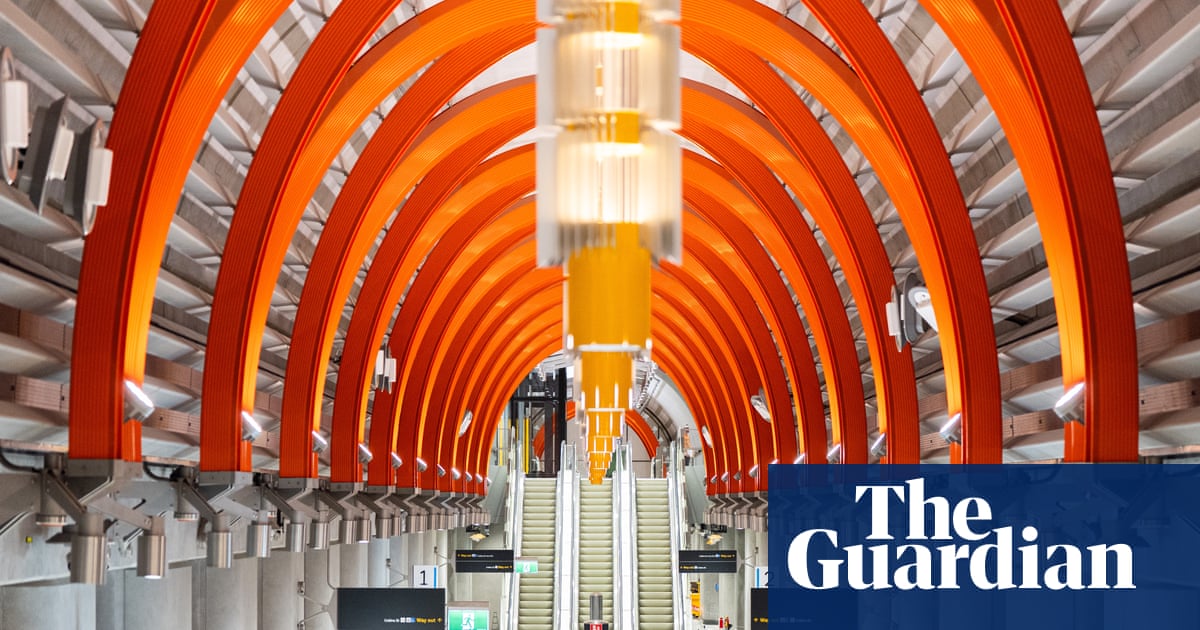
After years of seemingly endless roadworks and construction, the commuters of Melbourne will on Sunday finally get to ride trains on the Metro Tunnel, before driving through the West Gate Tunnel weeks later.
The government is so hopeful the two finished-yet-expensive projects will be embraced that Jacinta Allan quietly broke an unwritten rule of politics – she shared a 2015 photo featuring her predecessor, Daniel Andrews, to celebrate the Metro Tunnel’s completion.
Allow Instagram content?
This article includes content provided by Instagram. We ask for your permission before anything is loaded, as they may be using cookies and other technologies. To view this content, click ‘Allow and continue’.
With a government usually reluctant to both utter Andrews’ name and remind voters that Labor is deep into a third term ahead of another election, it hopes the construction chaos and cost of the 9km twin rail tunnel and five brand-new underground stations will quickly be forgotten.
The Metro Tunnel opens on Sunday – almost exactly one year out from the next election – with commuters to receive free public transport on weekends for the first two months, in what’s been described as a “thank you” for enduring years of disruption.
And in December, the massive West Gate Tunnel road project will follow.
How will the Metro Tunnel change people’s commutes?
Billed as the biggest overhaul of Melbourne’s transport network since the City Loop opened in the 1980s, the tunnel will connect the Sunbury line in the west to the Cranbourne and Pakenham lines in the south-east.
It includes five new stations: Anzac (on St Kilda Road), Arden (in North Melbourne), Parkville – which connects the city’s medical and research precinct to heavy rail for the first time – and State Library and Town Hall stations, which connect to Melbourne Central and Flinders Street stations, respectively.
From Sunday, trains will run through the Metro Tunnel every 20 minutes from Westall, on the Cranbourne-Pakenham line, and West Footscray, on the Sunbury line. Illustration: Victorian government
The tunnel will provide more frequent services on the lines, while freeing up City Loop capacity.
But the full benefits won’t been seen for months.
During the soft launch, or what the government has dubbed the “summer start”, Metro Tunnel trains will only operate between 10am and 3pm on weekdays, when services will run every 20 minutes between Westall, on the Cranbourne-Pakenham line, and West Footscray on the Sunbury line.
Sign up: AU Breaking News email
On weekends, they will run every 20 minutes from 10am to 7pm, and extend to East Pakenham every 40 minutes and Sunbury every 60 minutes.
During the “summer start”, weekend travel across public transport will be free.
 Eight storeys beneath Melbourne: first look inside the city’s new metro stations – video
The “big switch” will occur on Sunday 1 February, when the Cranbourne-Pakenham and Sunbury lines move out of the City Loop and begin running exclusively through the Metro Tunnel. The Frankston line will then move into the City Loop.
During peak periods, this will increase to every three to four minutes, which is a “turn up and go” service.
The entire public transport timetable across metropolitan and regional train lines, buses and trams also set to change on this date. The government is yet to release the timetable, but Allan said it will include 1,000 extra weekly services, with trains to run every 10 minutes from 6am to 10pm between Watergardens and Dandenong.
Roofing detail at Anzac Station, near the Shrine of Remembrance. Photograph: Asanka Brendon Ratnayake/The Guardian
“It is a massive change. It will cause flow and effects to the entire system,” she said of the timetable change in October.
skip past newsletter promotion
Sign up to Breaking News Australia
Get the most important news as it breaks
Privacy Notice: Newsletters may contain information about charities, online ads, and content funded by outside parties. If you do not have an account, we will create a guest account for you on theguardian.com to send you this newsletter. You can complete full registration at any time. For more information about how we use your data see our Privacy Policy. We use Google reCaptcha to protect our website and the Google Privacy Policy and Terms of Service apply.
after newsletter promotion
The government said transferring between lines – and connecting on to trams – will become a more common part of everyday travel.
Meanwhile, after a series of delays and cost blowouts, the West Gate Tunnel is due to open by the end of the year.
It consists of 6.8km of tunnels and 9.2km of elevated roads, which will provide a new river crossing and act as an alternative to the West Gate Bridge. The government has said it will also remove trucks from local streets in the inner-west, due to a 24-hour ban that also comes into effect when it opens.
What does this mean for the future?
The Metro Tunnel will also the backbone for future expansions, such as the long-awaited rail line to Melbourne Airport and the Suburban Rail Loop – a proposed 90km underground railway line, running between Cheltenham in the south-east and Werribee in the south-west.
Like those two projects – the Metro Tunnel also has its own checkered history. First proposed in 2008 as a 17km rail link from Footscray to Caulfield, the project was repeatedly shelved, revived and redesigned in the years since, amid political and funding fights.
After Andrews won the 2014 election, the then-Coalition federal government refused to contribute funding, but the state forged ahead. Originally budgeted at $11bn and due in 2024, early works began in 2015, with tunnelling starting in 2019. Construction was then halted when contractors sought an extra $3bn for cost overruns.
The front of the Arden station. Photograph: Asanka Brendon Ratnayake/The Guardian
The finish date was pushed to 2026, then brought forward to 2025.
The final cost to the state for the project is $13.48bn. But the total project cost is higher, with the builder also forced to chip in. The government has not disclosed the overall total.
The West Gate Tunnel has been beset by even bigger cost overruns and delays. A joint project between the government and a toll road operator, Transurban, construction began in early 2018 and was meant to be completed by September 2022.
But the discovery of toxic soil led to a legal standoff between the government, Transurban and the project’s builders. The cost to the state for the project blew out to $10.2bn as a result.
The two projects have added to the state’s mounting debt – forecast to hit to $194bn in 2028-29. But the government are undeterred – after the May budget, the treasurer said she believed voters would be more focused on the benefits of the new infrastructure rather than its price tag.
Behind closed doors, there is also hope the Metro Tunnel will accelerate both the Airport Rail and Suburban Rail Loop and make them feel more real in voters’ minds. The prime minister, Anthony Albanese, even used the tunnel as a backdrop to announce further federal funding for the SRL in the May budget.