

Lana wasn’t sure what to expect as the injector removed the syringe from her cheek.
As she lay in the chair, she was handed a mirror.
“I totally hated it,” she says.
Lana was told the hyaluronic acid (HA) dermal filler injected into her face was temporary and that her body would absorb it over time if she didn’t like the results.
She visited a cosmetic clinic in Melbourne after watching celebrities and friends on her social media feed transforming their faces using filler and botox.
In 2015, having just turned 40 and as a single mum of two, Lana made an appointment and agreed to filler.
After she returned home that night, Lana sat, staring into a mirror. She didn’t recognise the face looking back at her.
“I was in such a panic thinking, ‘What have I done to myself?”’ she said.
“When I smiled, it wasn’t my smile,” she says. “It looked horrible.”
‘No-one believed the filler was still in my face’
Lana received HA filler, which is sold as a temporary substance that is widely believed to break down over 12 to 18 months.
But over the next few years, Lana felt sure the filler was still in her face.
She says she spent thousands of dollars on consultations with doctors and specialists, desperate to know whether it would eventually go away.

Hyaluronic acid filler is the most common type of cosmetic dermal filler used and is injected under the skin. (ABC News: Rachel Clayton)
But it didn’t.
Some specialists said they didn’t believe that Lana could still have filler in her face.
One surgeon suggested she get even more. Another said she could consider a face lift.
Others dismissed her concerns and said Lana had body dysmorphia.
“You don’t know who to believe,” Lana says.
Eventually, the anxiety over how she looked would lead Lana to quit her job as a table dealer at a Melbourne casino.
“I always had a spotlight over my head,” she says.
” I just didn’t feel confident in my appearance.”
Feeling like she wasn’t getting any answers, Lana decided to email the filler manufacturer.
They responded with the same thing she had been told time and time again: the filler was temporary and would break down over time.
MRI shows filler under the skin years later
Lana was just beginning to accept that no-one would help when she stumbled upon surgeon Mark Ashton.
It was 2018, three years after she had been injected with the filler. Professor Ashton suggested something Lana hadn’t heard before — that she get an MRI of her face to see if the filler was still there.
Feeling out of options, Lana gave it a try.
‘Crystal clear’ new rules for nurses, dentists performing cosmetic injectables
When the results came back, they confirmed her fears.
“I still had dermal filler in my face,” Lana says.
Not only was filler detected in her cheeks, but the MRI report stated she also had what appeared to be lip implants.
“I never had dermal filler in my lips,” Lana says. “So it did migrate to my lips.”
Lana has since had four more MRIs, all showing the filler is still in her face.
‘Just fill ’em up because it dissolves’
Lana wasn’t the only one who was getting MRIs for suspected filler around this time, and it was these kinds of scans that had grabbed the attention of specialist radiologist Mobin Master.
He says the period when Lana got her filler was an “overfilling pandemic”.
“At the time, people were just filling,” he says.
“Just fill ’em up, pumped them up because they thought it dissolves.”
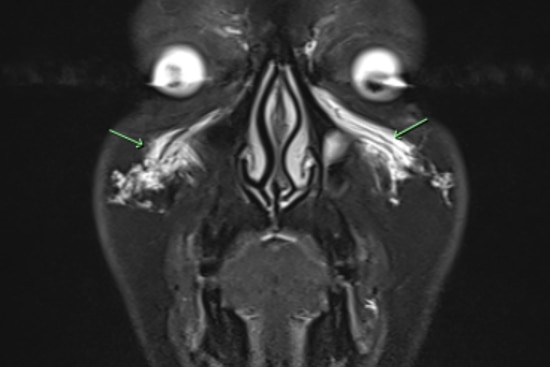
An MRI of Lana’s face from 2018 with arrows pointing to the filler she had in 2015. (Supplied)
Dr Master, who specialises in MRI, CT and ultrasound, was scanning patients who told him they hadn’t had filler for years.
“A lot of the patients were turned away [by doctors saying]: ‘You’re crazy, it can’t be filler, it has to be gone.'”
But the images told a different story.
“They are getting imaging and MRI and confirming that, yes, it’s the filler.”
Dr Master decided to conduct a study.
“I had to go through all their data, show that they’ve had filler in the mid face, how much they had, look at their medical notes,” Dr Master says.
“The MRI process took a huge amount of time.”
It took him about eight years to build an evidence base, culminating in a ground-breaking 2024 study that used MRI to detect dermal fillers deep in the face.
All 33 patients involved in the study still had filler present — even after two years. Most participants had not had filler for between two and five years, and some still showed traces of filler eight to 15 years after their last treatment.
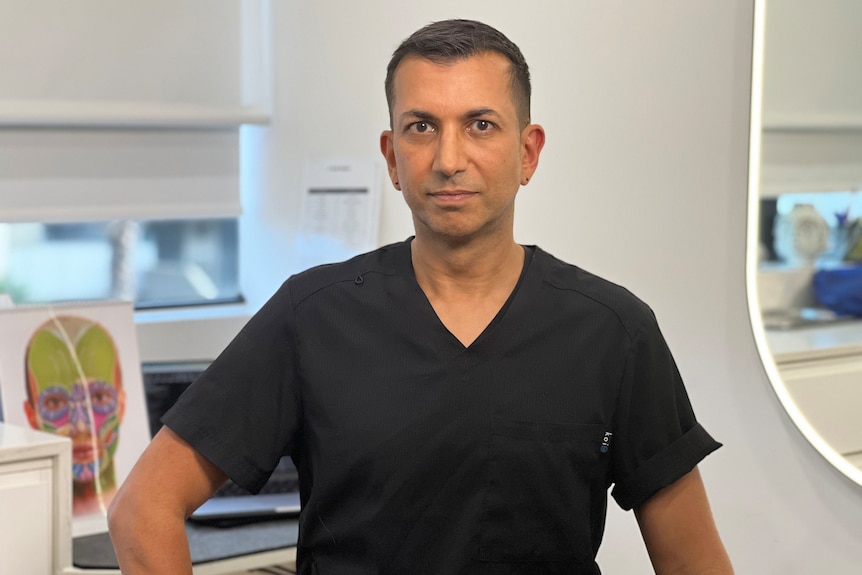
Mobin Master consults with patients seeking to have their filler dissolved and believes the risks of having filler are underplayed. (ABC News: Scott Jewell)
“So we’ve got solid evidence that fillers last longer than what we first were told.”
Before this, Dr Master says, initially, cosmetic companies used photography to determine whether filler had been absorbed.
He says issues can arise when patients wrongly assume the filler in their face has been absorbed, and they inject new treatments such as salmon sperm DNA.
“That has issues when it’s used in combination with dermal filler,” Dr Master says.
He says he also sees patients who later have immune reactions to filler.
“The filler might have been there for four or five years, and then suddenly they get itchy, they get pain, they get burning,” Dr Master says.
“It’s like breast implants — when your body doesn’t like it, they just have to come out.”
But for Lana, the “just have to come out” part wasn’t as easy as it sounds.
Hyaluronidase dissolver used to break down filler
Lana returned to the Melbourne cosmetic clinic a few days after she got her filler in 2015.
This time, she was there to see a doctor who had told her they could reverse it.
“I was told it would dissolve the filler,” Lana says.

Lana believes the dissolver broke down her connective tissue, instead of the filler, but hasn’t been able to prove it. (ABC News: Rachel Clayton)
Lana was injected with hyaluronidase, an enzyme commonly used to dissolve HA dermal filler.
Dissolving has recently become part of what some celebrities and social media influencers tout as the last stage of their injectables journey.
Celebrities Kylie Jenner and Courteney Cox have spoken publicly about having their filler dissolved.
Lana was told she would need to attend the clinic multiple times to dissolve the filler completely. In the end, she would return to the clinic four times in three years, but, as the MRI showed, the filler was still there.
While she can’t prove it, Lana says her own connective tissue in her face was dissolved instead and gave her “skin like bubblegum”.

Social media influenced Lana’s decision to get filler and botox. (ABC News: Rachel Clayton)
“It’s so stretchy and doughy,” she says.
But cosmetic specialists didn’t believe her. They said the dissolver couldn’t break down her own tissue.
Lana took the cosmetic clinic to the Victorian Civil and Administrative Tribunal (VCAT), which found that, while she had not signed a consent form for the hyaluronidase, she had given informed verbal consent for it to be used after being talked through the risks.
Lana also made a consumer claim over the dermal filler treatment she received, but her case with VCAT and another complaint with the Australian Health Practitioner Regulation Agency were ultimately rejected.
VCAT found the clinic had administered the treatment appropriately. It also found Lana was warned of risks, and the ongoing presence of dermal filler did not imply any wrongdoing on the part of the doctors, who used the product as intended.
Turning to social media for assurance
In 2021, six years after the dermal filler at the clinic, Lana turned to social media to try to figure out what was happening to her face.
“I thought I was the only one,” Lana says.
Lana started a Facebook group and posted about her symptoms after having dissolver.
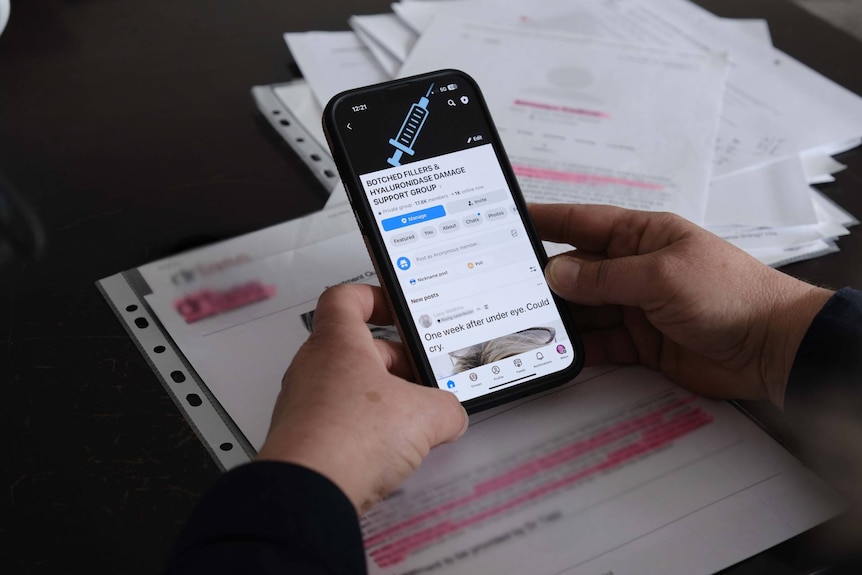
Lana’s Facebook page offers people a community who believe cosmetic injectables have damaged their bodies. (ABC News: Rachel Clayton)
Lana says she was flooded with replies from people saying they had similar symptoms.
Background Briefing has spoken to about a dozen people who have reported adverse outcomes from dermal fillers and dissolvers. Many thought these treatments were simple procedures, and were surprised when they experienced complications.
The group now has almost 18,000 members.
“There’s a lot of men in the group, there’s a lot of young women injecting their lips.”
Lana says the group can be overwhelming at times, particularly with mental health.
“We’ve had a couple of members commit suicide.
“A lot of women are consumed by the changes in their appearance. They feel like they’re not the same person anymore.”
Lana says members, including her, have faced isolation and been medically gaslit.
They also feel crippling shame.
“In the outside world, they don’t get the same support that they get in the group,” Lana says.
“There’s only so much you can tell a family member or a friend or even doctors because a lot of them gaslight you, and after a while that can really affect your mental health.”
Until a few weeks ago, Lana didn’t feel there were any options left.
Growing acceptance of ‘post-hyaluronidase syndrome’
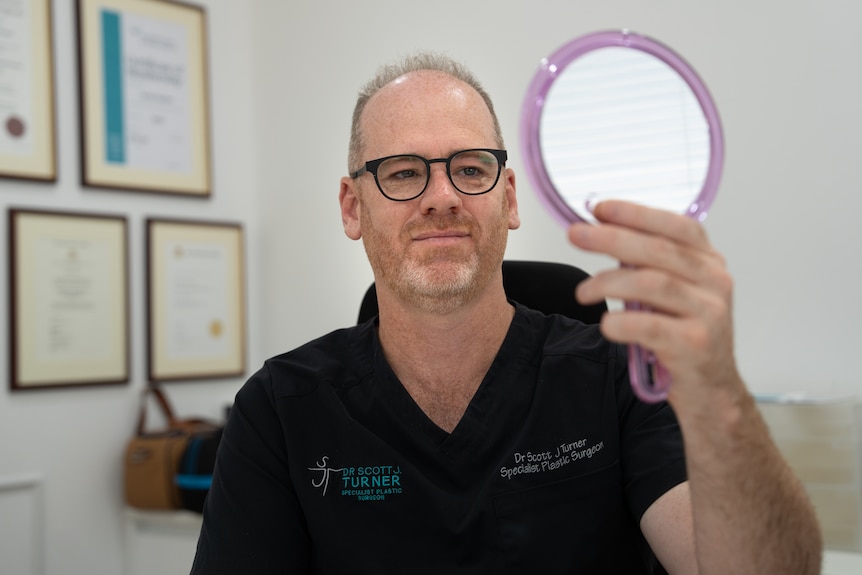
Scott Turner, a specialist plastic surgeon in Sydney, says he wishes more people knew about “post-hyaluronidase syndrome”.
In April 2024, a group of leading cosmetic surgeons in the United Kingdom coined the term “post-hyaluronidase syndrome” in a study that looked at 90 patients who had been injected with dissolver. The study found 18 per cent had incurred damage, including facial “hollowing” and “loosening”.
When Lana had her procedure almost a decade ago, post-hyaluronidase syndrome wasn’t a known issue, and some doctors still aren’t convinced it’s real, but Dr Turner disagrees.
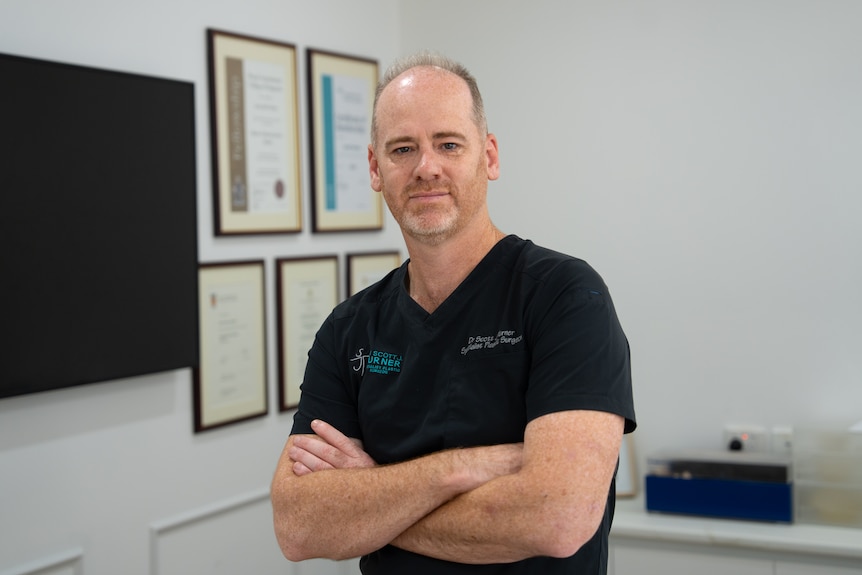
Scott Turner is one of few Australian cosmetic surgeons who has publicly acknowledged “post-hyaluronidase syndrome”. (ABC News: Jack Fisher)
He broke ranks last month with other surgeons in Australia by publicly acknowledging the condition “post-hyaluronidase syndrome”. He also said hyaluronidase — the chemical used to dissolve filler — could be more damaging than filler itself.
Dr Turner acknowledges there is no solid evidence base yet, but that he and other surgeons have observed the damage hyaluronidase can do to people’s faces.
“What we’re seeing more of now is when people have had fillers injected, then dissolved, re-injected and dissolved,” Dr Turner says.
“Is that the process of injecting filler, dissolving it and then adding more filler creates a widespread effect in the face that can affect everything from the skin to the fat layer down to the deeper layers.”
Scott Turner wants more people to be aware of the risks associated with cosmetic injectables. (ABC News: Jack Fisher)
He’s calling for more data monitoring so health authorities have a picture of how many filler and dissolver sessions are being given, and stronger record-keeping requirements so that if there are issues, patients can have a full record of what they have received.
Hyaluronidase unregulated, not TGA approved for use as filler dissolver
In Australia, hyaluronidase is an enzyme approved for medical uses when doctors need medicines or fluids to spread more easily through the body. Hyaluronidase helps fluids absorb under the skin, and can make local anaesthetic and pain medication work better during certain procedures.
Hyaluronidase is used off-label to dissolve dermal fillers in Australia, meaning the Therapeutic Goods Administration (TGA) has not approved it for that purpose, and the manufacturer has not conducted studies to demonstrate its effectiveness as a filler dissolver.
Cosmetic clinics have hyaluronidase on hand for medical emergencies, such as a vascular occlusion: when filler accidentally enters the bloodstream or blocks arteries, cutting off oxygen and, in worst cases, causing necrosis. The hyaluronidase can act quickly to break down the filler.
But the use of hyaluronidase as a filler dissolver is unregulated, meaning there are no TGA-approved guidelines on how to use it, and patients may end up being injected with different types and amounts depending on their injector.
Medical professionals are legally allowed to decide when they want to use it and must educate patients about what off-label means and make sure they are aware of the risks.
One prominent Australian surgeon told Background Briefing hyaluronidase should be used as a “rescue remedy”, and not as a “change of mind” medication for dissolving filler.
Other doctors the ABC spoke to disagree and believe hyaluronidase is safe to use for dissolving filler.
Robyn Langham is the chief medical advisor of the TGA and says practitioners must obtain fully informed consent from patients when using products off-label.
Because off-label use is up to the individual practitioner, Professor Langham says the TGA has no regulatory capacity to implement warnings.
“Where a practitioner elects to use [a drug off-label] and doesn’t warn the patient or may not even understand some of the safety products, that’s a real concern, but it’s a concern for the regulator of the clinician, which is AHPRA.”
The TGA does approve the use of hyaluronic acid (HA) fillers in Australia for cosmetic purposes. HA fillers — the most common type of filler used — are sold as temporary, with patients told the substance will break down in less than 18 months.
Professor Langham says any changes to product information of HA filler require a “signal” to be received by the TGA, either from its database of adverse events or advice from clinicians.
“Sometimes it’s a state government, sometimes it’s an international regulator or another country that is seeing problems. So once we see signals of adverse events or changes that need to be made to the product information, we’d go ahead and do it … after a full and proper evaluation of the evidence.”
Professor Langham says she’s not aware of a spike in adverse events being reported about hyaluronic acid fillers.
Social media changing behaviour, beauty standards
Lily Vrtik, president of the Australasian Society of Aesthetic Plastic Surgeons, says social media “trivialises” injectable treatments.
Dr Vrtik says injectables are frequently depicted as a casual consumer choice rather than a medical procedure, and the prevalence of before-and-after videos on Instagram and TikTok is reshaping public perceptions of appearance and normality.
“It’s a story. People tend to relate to it, and it grabs their attention,” she says.
But it can mean many patients arrive at clinics “demanding a service” from social media examples, and overlook the risks.
“People, [especially] young people, who use social media and look at these things, overestimate the prevalence of cosmetic treatment; they think that everybody’s having it when, in actual fact, it’s not the majority of the population.”
Dr Vrtik also says people who use filters and editing apps on their own photos and videos are more likely to undergo cosmetic procedures.
“Social media changes people’s behaviours and thoughts and makes them really vulnerable, especially young people, because they’re at that stage of their life where they’re trying to establish their self-worth, their self-identity and their self-confidence.
“We can’t deny that appearance and the way you look is a major contributor to the establishment of that self-identity.”
Lana says the cosmetic transformations she saw on Instagram, especially of “older women looking fantastic for their age”, pushed her towards cosmetic injectables.
“No wrinkles, no fine lines, plump cheeks, plump lips, and I wanted to look fabulous at that age, like these women,” she says.
The Kardashian family were particularly influential.
“They kept on looking better and better and better, and that’s what I fell for. I wanted to enhance my appearance and look fabulous for my age.”
She hopes the side effects she experienced from dissolver and filler will be formally recognised soon, but she’s not sure if her face will ever return to what it was.
“I really don’t have much hope. If [only] I could turn back time, I totally regret my decision.”