
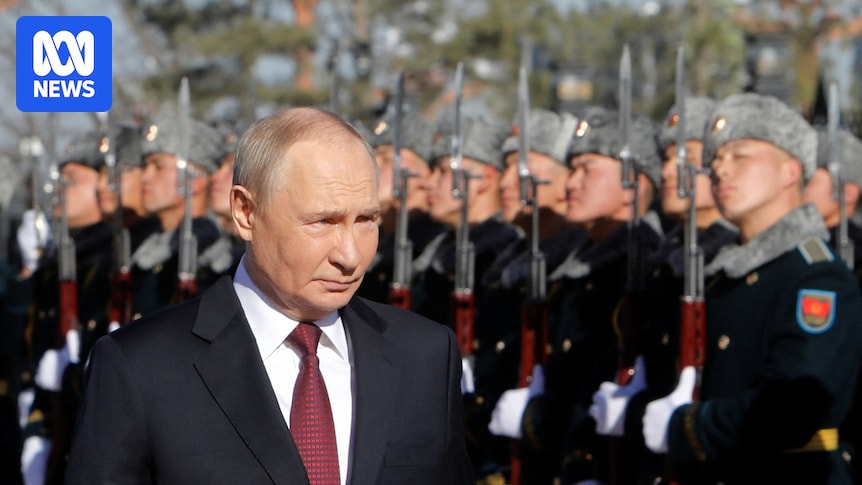
Lots of people have had something to say about a peace deal for Ukraine over the past ten days, with one notable exception: the man around whom this story spins, Vladimir Putin.
That was until Thursday.
The latest flurry of talk about a 28-point plan for Ukraine seems to have been designed to mess with our collective heads even more than most of Donald Trump’s global interventions.
There was the leaking of the plan which was, or wasn’t, actually drawn up by Russia, then adopted by the Trump team and which, for a while, was being seen as a fait accompli which Ukraine had to agree to by Thursday.
There was the grim message to his nation from Ukrainian President Volodymir Zelenskyy about being confronted with a choice between loss of dignity and a loss of a key partner.
There were hastily organised meetings between US officials and the Ukrainians and frantic scrabbling by shocked European nations, and lots of politely worded statements designed not to antagonise Trump.
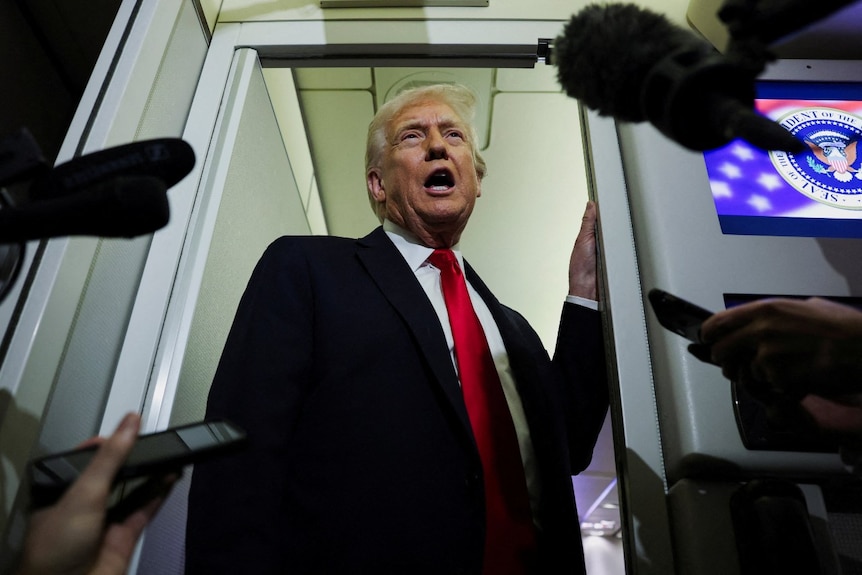
The strategic depth of this conflict makes it more complicated than something that can be solved purely by Trump applying pressure. (Reuters: Anna Rose Layden)
Confusion all round
Journalists were left reading tea leaves for signs of where things were going amid references to positive developments. Always there was the search for ways to throw the story forward to the likelihood of a next round of meetings, including those that are supposed to be held in Moscow next week.
But through it all Putin said nothing.
When he did, it should not have been a surprise that his words appeared to flatten any expectations that things may have changed, or that there was scope here for compromise.
“It would be impolite to speak about any final versions [of the plan], since there are none,” Putin told reporters at a press conference during a visit to Kyrgyzstan on Thursday.
“There was no draft [peace] treaty. There was a set of questions that were proposed to be discussed and finally formulated.”
What we know about the 28-point plan for peace
The Financial Times said that when he was asked about his stance on the Donbas region, Putin said Russia would stop fighting only when Ukraine withdrew its troops.
“If they don’t withdraw, we’ll achieve this by force of arms,” he said.
International legal recognition of Crimea and Donbas — where Russia holds some but not all of the territory — as Russian was crucial, he said.
As the FT noted: “[Putin’s comments] suggest he is sticking to his approach with US President Donald Trump, in which he has repeatedly signalled readiness to negotiate while holding fast to hardline demands. Meanwhile, Russia is slowly advancing on the battlefield.”
What makes the stand-off in Ukraine much more complicated than something that can be solved purely by Trump applying pressure is the strategic depth of this conflict.
It’s not just about Russia versus Ukraine, or a question of withholding military support on the one hand and sanctions on the other.
In addition to Putin’s well-documented view that Ukraine is an absolutely intrinsic part of Russia, is the post-Cold War make up of Europe.
The Russians are aggrieved at what they believe was a major breach of an agreement by the West, after the fall of the Berlin Wall and the Soviet Union, to not expand NATO to the East — which it has done.
Loading A European war
Putin has long argued that this has posed a threat to Russia. And it was talk of Ukraine joining NATO that was at least partly used as his rationale for invasion.
On the equal and opposite side, both NATO and Europe more broadly, now see Ukraine as its frontline against Russian aggression.
It’s not just a question of supporting Ukraine but of Ukraine’s massive military machine being the frontline for a wildly disorganised and fractured community of countries who are dealing with basic issues of disorganised and rundown national military organisations and infrastructure unable to move military hardware along roads or rail lines that are too narrow.
The ratcheting up of the Ukraine conflict into what is perceived as a European war is already well underway.
Putin says US plan could be ‘basis’ for end to Ukraine war
Putin was dismissive of the warnings by European leaders that Russia could attack Europe.
“That sounds laughable to us, really,” he said.
But it is no laughing matter to a host of European political and military leaders.
Consider Germany. Three years ago, the Germans were reluctant to supply weapons directly to Ukraine lest it provoke Russia.
This was despite an historic declaration of a shift — a Zeitenwende or turning point — in its approach to defence issues after Russia’s invasion of Ukraine.
Germany’s history had made it cautious to be seen to be talking or acting aggressively. The Zeitenwende saw a commitment to a big increase in defence spending, trying to revive the moribund Bundeswehr — or German armed forces — which suffer particularly high personnel shortages; reducing its energy reliance on Russia; and becoming more supportive of the idea of European security strategy.
All that has changed.
Loading…’Our last summer of peace’
Earlier this week, Foreign Minister Johann Wadephul warned that Russia could be in a position to attack a NATO country within the next four years.
“Our intelligence services are telling us urgently that Russia is at least creating the option of a war against NATO by 2029 at the latest,” Wadephul told the Berlin Foreign Policy Forum.
He argued that Russia’s “imperial” ambitions extended far beyond Ukraine, as Moscow has significantly expanded its military capabilities and ramped up weapons production in recent years.
“Russia has largely geared its economy and society toward war. At the same time, Russia is recruiting more soldiers than it currently needs,” Wadephul said, adding that almost one additional division is being recruited every month.
“These divisions, without a doubt, have their sights set on us — on the European Union, on NATO. The threat to our country from Russia is no longer a distant concern; it is already a reality.”
He accused Moscow of using “hybrid war” tactics against NATO allies, including airspace violations, sabotage, and disinformation campaigns designed to destabilise these countries.
His colleague, Defence Minister Boris Pistorius, told German newspaper Frankfurter Allgemeine Zeitung, that while military experts and most intelligence services had until now estimated that Russia might be able to launch an attack against a NATO member state from 2029, he said that “some military historians think … that we have already experienced our last summer of peace”.
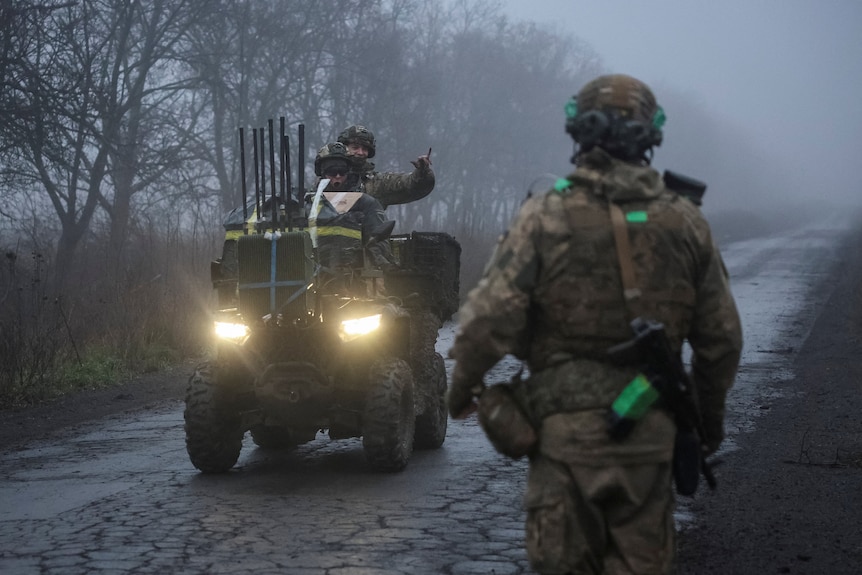
Ukraine and Europe are almost certainly never going to be satisfied that even giving up territory that has been conquered will stave off Russian aggression. (Reuters)
‘An imminent threat’
Chief of the German armed forces, General Carsten Breuer, has described Russia as “an imminent threat”.
Polish Prime Minister Donald Tusk spoke of the country entering a “pre-war phase” earlier this year.
After the sabotage of a Polish railway line earlier this month, the chief of the General Staff of the Polish Armed Forces, General Wieslaw Kukula, said “the adversary has begun preparations for war”.
“They are creating an environment here that aims to undermine public trust in the government, in key institutions such as the armed forces and the police, and to create conditions favourable for potential aggression on Polish territory,” he said.
The language is all getting very alarming (or alarmist, depending on your perspective). But it is becoming part of the normal framework in which Europe is discussing its future.
French Army Chief General Fabien Mandon stirred controversy this week when he said France had to be prepared to “lose its children” in a potential war with Russia, even as President Emmanuel Macron introduced voluntary military service.
“We have the know-how, and we have the economic and demographic strength to dissuade the regime in Moscow,” General Mandon said. “What we are lacking… is the spirit. The spirit which accepts that we will have to suffer if we are to protect what we are.”
Something has now been unleashed in Europe which is going to be hard to put back in the bottle.
Pragmatists can debate the realities of what Ukraine has lost and what it might have to give up.
But Putin will not tolerate foreign forces in Ukraine — since it was the spectre of NATO stretching there that so exercised him in the first place — and Ukraine and Europe are almost certainly never going to be satisfied that even giving up territory that has been conquered (let alone territory Putin is demanding which he does not currently hold) will stave off Russian aggression.
This is the deep-seated and complex reality which Trump’s demands for an end to the conflict confront.
Laura Tingle is the ABC’s Global Affairs Editor.