
When Nam June Paik shipped a dozen television sets to the home of Rolf Jährling in West Germany, they were still a rarity in Europe. Few households had a single unit in 1963. As an avant-garde composer and performance artist inventing multimedia art avant la lettre, Paik recognized television as an experimental platform par excellence, and sought to show its potential for artistic expression before Europe surrendered to the American way of network TV.
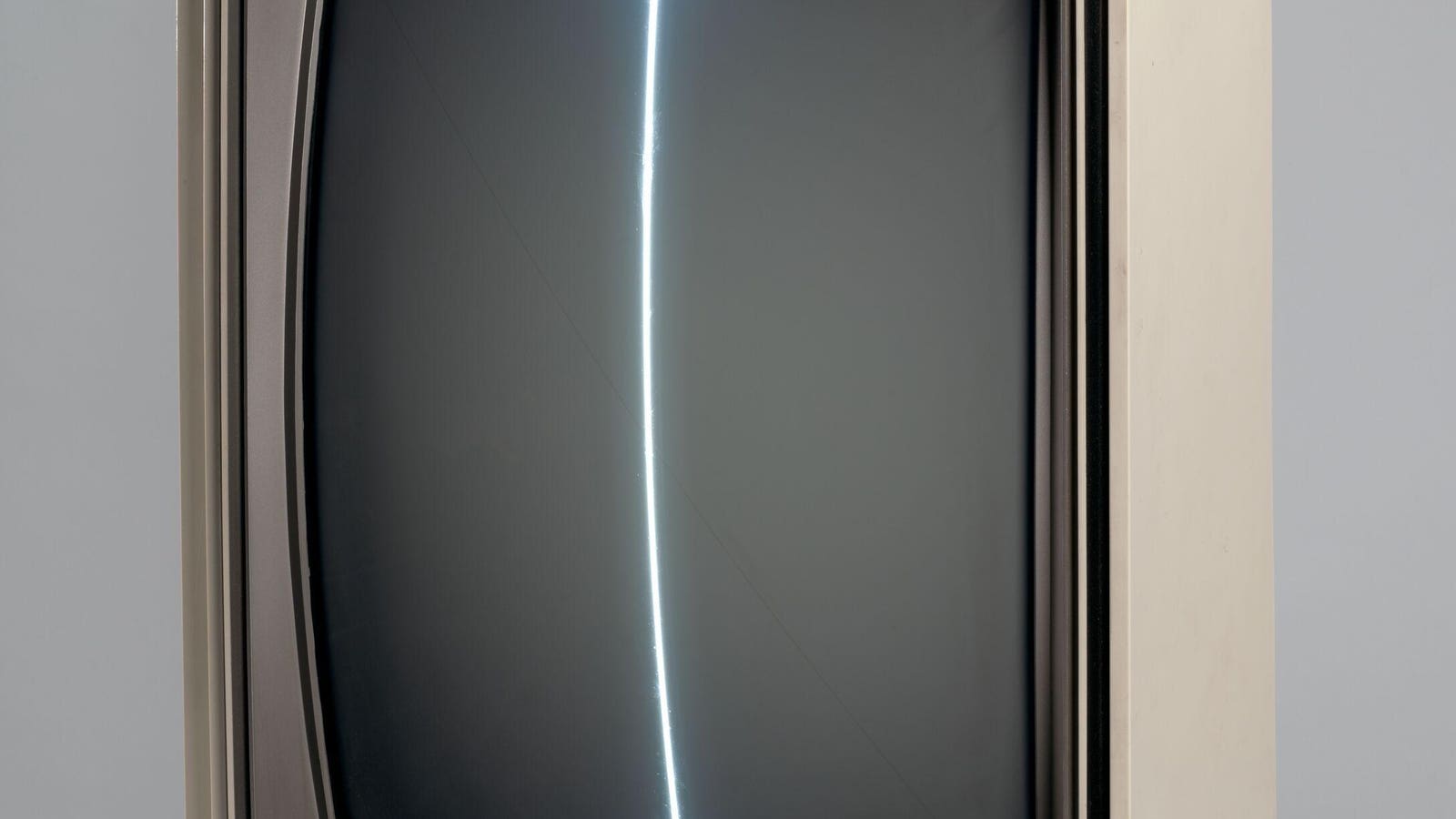
Jährling’s house was the site of Paik’s first exhibition of televisions, artfully modified with magnets and other contrivances that scrambled the broadcast content. But two of Paik’s precious TVs arrived broken. The one that wouldn’t turn on, he displayed face-down. The other, which showed only a single horizontal line crossing the center of the screen, he set on its side, dubbing the accidental artwork Zen for TV.
Nam June Paik, Zen for TV, 1963 (executed 1981). Altered television set, 22 13/16 × 16 15/16 × 14 3/16 in. (57.9 × 43 × 36 cm). The Museum of Modern Art, New York. The Gilbert and Lila Silverman Fluxus Collection Gift. © Nam June Paik, Digital Image © The Museum of Modern Art/Licensed by SCALA / Art Resource, NY.
© 2012 MoMA, N.Y.
The name was not only a reference to the Buddhist tradition in which Paik was raised before moving to Europe, but also referred to a Fluxus performance he presented two years before arriving at Jährling’s house. Following an instruction by the composer La Monte Young to “draw a straight line and follow it”, Paik dipped his hair in a bowl of ink and brushed it over an unfurled roll of paper as he crawled across the floor, dubbing his performance Zen for Head. With the repetition of the word Zen, he connected the two works, recognizing the TV raster line as a drawing, and the television as a sort of drawing machine.
A magnificently conceived and executed exhibition at the Menil Collection in Houston follows Paik’s line through decades of artistic practice on both sides of the Atlantic, showing the extraordinary range of ways in which artists adapted and challenged the new medium between the late 1950s and the ‘80s. Taking drawing as a central theme, Lines of Resolution presents several dozen works in media ranging from ink on paper to video and electronic art that collectively reveal a counternarrative to the conventional view that television homogenized and trivialized midcentury culture.
Paik’s appropriation of a broken television as a machine for drawing led to decades of work in which the raster line became a means of probing and visualizing phenomena both external and internal to the artist. Before the advent of pixels and LED displays, television used magnets to direct electron beams back and forth across phosphorescent glass faster than the eye could see, stacking the lines so tightly that no space remained between, forming images by varying the intensity of light from point to point. Motion was achieved by presenting rasterized images in rapid succession. The TV camera captured pictures in an equivalent way. To transmit moving images, a broadcaster merely needed to use the camera to modulate the amplitude of a radio signal, controlling the TV’s cathode from moment to moment. Paik ingeniously took this drawing process in hand, sequentially inscribing horizontal lines or other marks on sheets of paper. Often these compositions were abstract – in contrast to the sitcoms preferred by CBS and NBC – evoking atmospheric conditions or expressing emotions in a language that was starkly contemporary yet strikingly personal.
Paik was hardly the only artist to deploy raster operations. For instance, when Robert Rauschenberg appropriated imagery from periodicals for his mixed media compositions, he often soaked magazine pages in solvent and transferred the pictures onto large sheets of drawing paper by exerting pressure from side to side in a succession of horizontal scan lines.
Jaime Davidovich gave more tangible expression to raster operations by covering a television screen with horizontal lines of blue, red, and yellow tape. The choice of colors was not only informed by the three hues from which color images were generated on TV screens, but also influenced by a famous set of three monochrome paintings by Alexander Rodchenko. In 1921, the Russian Constructivist presented Pure Red Color, Pure Blue Color, and Pure Yellow Color as the “logical conclusion” of painting, provocatively asserting that art needed to move beyond bourgeois aesthetics to engage societal issues. With Blue, Red, Yellow, presented as a three-channel video in 1974, Davidovich suggested an equally logical conclusion to mass media, implying that the utilitarianism advocated by Rodchenko needed to be overcome in its own right, especially in the West, where the Capitalist TV networks had successfully turned Rodchenko’s proposition against the values that motivated him. Blue, Red, Yellow compellingly suggested that art was the optimal channel to engage societal issues. Although Blue, Red, Yellow has been presented as an homage to Rodchenko, it was also a riposte.
In the work of Mimi Smith, drawing proved to be a potent critique of the boob tube’s content. Beginning in the mid-1970s, she transcribed TV newscasts, rendering the words on paper in neatly stacked raster lines evocative of the monotonous programming she witnessed. Only by focusing on her uniform script does the viewer find the unsettling information placidly packaged for broadcast consumption. For instance, one of her Television Drawings transcribes a program about violence in America, with lines about getting “shot to death in a supermarket”, as well as living in fear and lack of compassion. Smith’s works powerfully address the paradoxical relationship between media access and impact in the early stages of an attention economy that has subsequently become predominant.
Dating from the same period, Howardena Pindell’s critique of mass media is more oblique, but ultimately more disturbing, revealing the origins of polarization in a society where public information is privately consumed. To produce her Video Drawings, Pindell made complex diagrams on acetate, comprising hundreds of arrows annotated with numbers that seemed to make sense of a complicated phenomenon or situation. She then attached one of her diagrams to her TV screen with static electricity and waited. When the broadcast image serendipitously appeared to correspond with her ersatz analysis, she snapped a photograph. Whether annotating a news program or a hockey game, the result looks informative enough that one might be convinced that Pindell had discovered hidden meaning. Decades before QAnon, Pindell’s wayward arrows pinpointed the mediated apophenia underlying conspiracy theories and confirmation bias.
Howardena Pindell, Video Drawings: Hockey, 1975. Chromogenic print, 8 × 10 in. (20.3 × 25.4 cm). Courtesy of the artist and Garth Greenan Gallery, NY. © Howardena Pindell. Image courtesy of Greenan Gallery, NY
© Howardena Pindell
The lines drawn in Catherine Elwes’s Two Drawings on Glass are the diametric opposite of those inscribed by Pindell. For this 1978 video work, Elwes stood nude behind a window while instructing the artist Adrian Gill to draw on the glass, using a standard life drawing technique to reduce her body to a measured set of angles. When Gill was finished, Elwes covered her body in paint, and smeared the glass with her hands, belly and breasts, physically overcoming the constraints of standardized beauty in realms ranging from art to TV.
With Two Drawings on Glass, Elwes activated the video technology underlying television to create an artwork that put her on screen. The artistic cooption of television as a medium was arguably the most significant effect of TV on art, a revolution equivalent to the invention of photography (which one of photography’s progenitors incidentally saw as a new kind of drawing, dubbed his technique “the pencil of nature”). Treating video as a modern alternative to drawing or painting was by no means exclusive to Elwes. In fact, one of the most inventive and persistent practitioners was Nam June Paik.
Video art eventually became totally detached from its origins in television, especially after technology advanced to an extent that anybody could create content with a smartphone and upload it to YouTube or TikTok. Because videos are so easily produced, video art is no longer conceptually laden by the machinery of production. The change is liberating, but can also be problematic, especially given how deeply digital media penetrates everyday life.
Lines of Resolution can therefore be viewed as more than just a retrospective. Like Elwes’s voiceover in her video, the exhibition is also instructional. Today’s pervasive technologies need to be overtly probed, much as Paik manipulated televisions with magnets. As Davidovich’s riposte to Rodchenko suggested – and as all the other works in the Menil exhibition support – the strongest counterforce to mediated mediocrity is art.